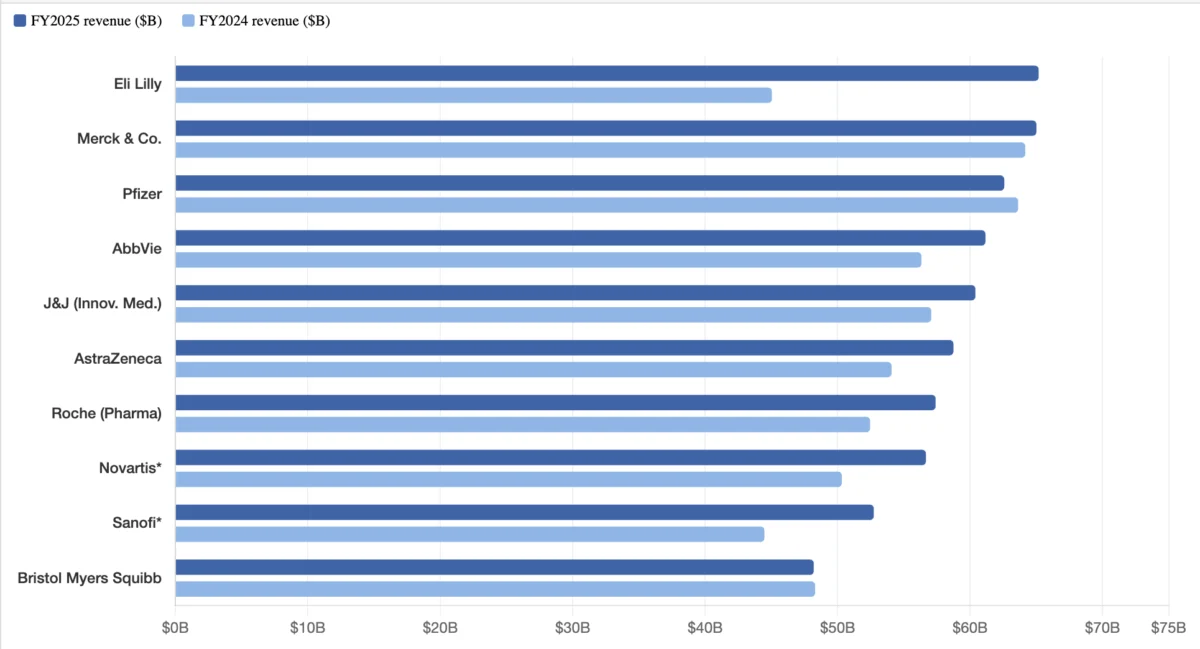
Eli Lilly and Company has achieved a historic milestone, concluding fiscal year 2025 as the world’s highest-earning pharmaceutical company by revenue. This ascent marks a significant shift in the global pharmaceutical landscape, driven predominantly by the unprecedented commercial success of its groundbreaking tirzepatide franchise, comprising the diabetes medication Mounjaro and the obesity treatment Zepbound. The company reported a staggering $65.2 billion in total revenue for FY2025, narrowly surpassing long-standing industry leader Merck & Co., which posted $65.0 billion. This achievement represents an extraordinary acceleration in growth, with Lilly’s revenue surging approximately 44.7% year-over-year, equating to an impressive gain of roughly $20.1 billion in a single year. The speed of this rise has even outpaced previous expert predictions, with analysts having anticipated Lilly to overtake competitors by late 2026 under base-case assumptions; the company achieved this feat a full year ahead of schedule.
The Ascent to the Top: A Chronology of Unprecedented Growth
Eli Lilly’s journey to the pinnacle of the pharmaceutical industry in 2025 is a narrative of strategic foresight, robust research and development, and impeccable market timing, particularly with its flagship tirzepatide assets. For context, the company’s revenue stood at $24.5 billion in 2020. In a mere five years, Lilly has nearly tripled its annual revenue, an acceleration virtually unparalleled among its peers in recent history.
The foundation for this remarkable growth was laid years prior with the development of tirzepatide, a novel GIP (glucose-dependent insulinotropic polypeptide) and GLP-1 (glucagon-like peptide-1) receptor agonist. Mounjaro (tirzepatide) received its initial U.S. FDA approval for the treatment of type 2 diabetes in May 2022, quickly demonstrating superior efficacy in glycemic control and weight reduction compared to existing treatments. Its launch was met with immense demand, rapidly becoming a blockbuster drug.
Building on Mounjaro’s success and the compelling weight loss data observed in clinical trials for diabetes, Lilly pursued and secured FDA approval for tirzepatide under the brand name Zepbound for chronic weight management in adults with obesity or overweight with at least one weight-related condition in November 2023. This strategic move unlocked an even larger market, positioning Lilly at the forefront of the burgeoning global fight against obesity.
The fiscal year 2025 results vividly illustrate the impact of these launches. Mounjaro’s revenue nearly doubled, reaching an astounding $23.0 billion (+99% year-over-year), while Zepbound, despite being a newer entrant, nearly tripled its sales to $13.5 billion (+175%). Combined, the tirzepatide franchise generated $36.5 billion in revenue, representing over half of Lilly’s total earnings for the year. To underscore the magnitude of this figure, this single franchise now generates more annual revenue than entire pharmaceutical companies such as Bristol Myers Squibb or Sanofi, highlighting its transformative power for Lilly.
The previously cited prediction of Lilly surpassing Merck by late 2026, with a base-case model projecting $77.2 billion in revenue for that year, has been swiftly overtaken. Lilly’s current 2026 guidance, ranging from $80 billion to $83 billion, already runs ahead of that aggressive model, signaling continued confidence in its growth trajectory. This early achievement underscores the profound and rapid shift occurring within the pharmaceutical sector, driven by innovation in metabolic diseases.
The Tirzepatide Phenomenon: An In-Depth Look at the Engine of Growth
The success of Mounjaro and Zepbound is not merely a commercial triumph but a testament to the therapeutic potential of the GLP-1 and GIP receptor agonist class. These drugs work by mimicking natural hormones that help regulate blood sugar, slow gastric emptying, and suppress appetite. Tirzepatide, as a dual agonist, targets both GLP-1 and GIP receptors, offering a synergistic effect that has demonstrated superior outcomes in both blood sugar control for type 2 diabetes and significant weight loss for obesity, often exceeding the efficacy seen with single GLP-1 agonists.
Clinical trial data for tirzepatide in obesity (SURMOUNT trials) showed average weight reductions of up to 22.5% (approximately 52 pounds) at the highest dose over 72 weeks, a level of efficacy previously only achievable through bariatric surgery. This profound impact on weight, coupled with improvements in various cardiometabolic risk factors, has positioned Zepbound as a game-changer in a medical field historically underserved by effective pharmacotherapy. For type 2 diabetes, Mounjaro demonstrated superior A1C reductions compared to other commonly used diabetes medications, further solidifying its clinical value.
The market reception has been overwhelmingly positive. Patients and physicians alike have embraced these therapies, driven by unmet needs in managing chronic conditions that affect hundreds of millions globally. The global market for GLP-1 agonists, encompassing both diabetes and obesity indications, has exploded, with analysts projecting it could reach hundreds of billions of dollars annually in the coming decade. Lilly’s early lead with tirzepatide, combined with robust supply chain management and aggressive marketing, has allowed it to capture a substantial share of this rapidly expanding market.
Beyond Tirzepatide: Lilly’s Diverse Portfolio and Strategic Vision
While the tirzepatide franchise is undeniably the primary engine of Lilly’s recent growth, it is crucial to recognize that the company’s overall strength stems from a broader and increasingly diversified portfolio, coupled with a strategic long-term vision. The remaining approximately $28.7 billion in revenue (after subtracting tirzepatide’s contribution from the total $65.2 billion) comes from a range of established and emerging products across various therapeutic areas.
Key contributors include:
- Trulicity (dulaglutide): Another GLP-1 receptor agonist for type 2 diabetes, though facing increasing competition from Mounjaro and other new entrants, it remains a significant revenue generator.
- Verzenio (abemaciclib): A CDK4/6 inhibitor for breast cancer, which continues to demonstrate strong growth as a leading treatment in its class.
- Jardiance (empagliflozin): A SGLT2 inhibitor for type 2 diabetes, heart failure, and chronic kidney disease, developed in partnership with Boehringer Ingelheim, also contributing substantially to Lilly’s diabetes franchise.
- Taltz (ixekizumab): An IL-17A inhibitor for psoriatic arthritis, plaque psoriasis, and ankylosing spondylitis, maintaining a strong position in the immunology market.
- Cymbalta (duloxetine): While facing generic competition, its legacy sales still contribute to the overall revenue.
- Donanemab: Lilly’s experimental Alzheimer’s drug, which has shown promising results in late-stage trials, represents a significant potential future growth driver, albeit with complex regulatory and market access hurdles. Its potential approval and launch in the near future could further solidify Lilly’s long-term outlook, diversifying its high-value pipeline beyond metabolic disorders.
Lilly’s strategic vision extends beyond individual product launches. The company has consistently invested heavily in research and development, fostering an innovative culture that prioritizes unmet medical needs. This commitment is evident in its robust pipeline, which includes candidates for oncology, immunology, neuroscience, and other metabolic disorders. The company’s willingness to invest in high-risk, high-reward areas, coupled with efficient clinical development, has been instrumental in cultivating its current leading position. Furthermore, Lilly has been proactive in expanding its manufacturing capabilities to meet the soaring demand for its key products, a critical factor in sustaining growth and market share in highly competitive therapeutic areas.
Industry Landscape and Competitive Dynamics
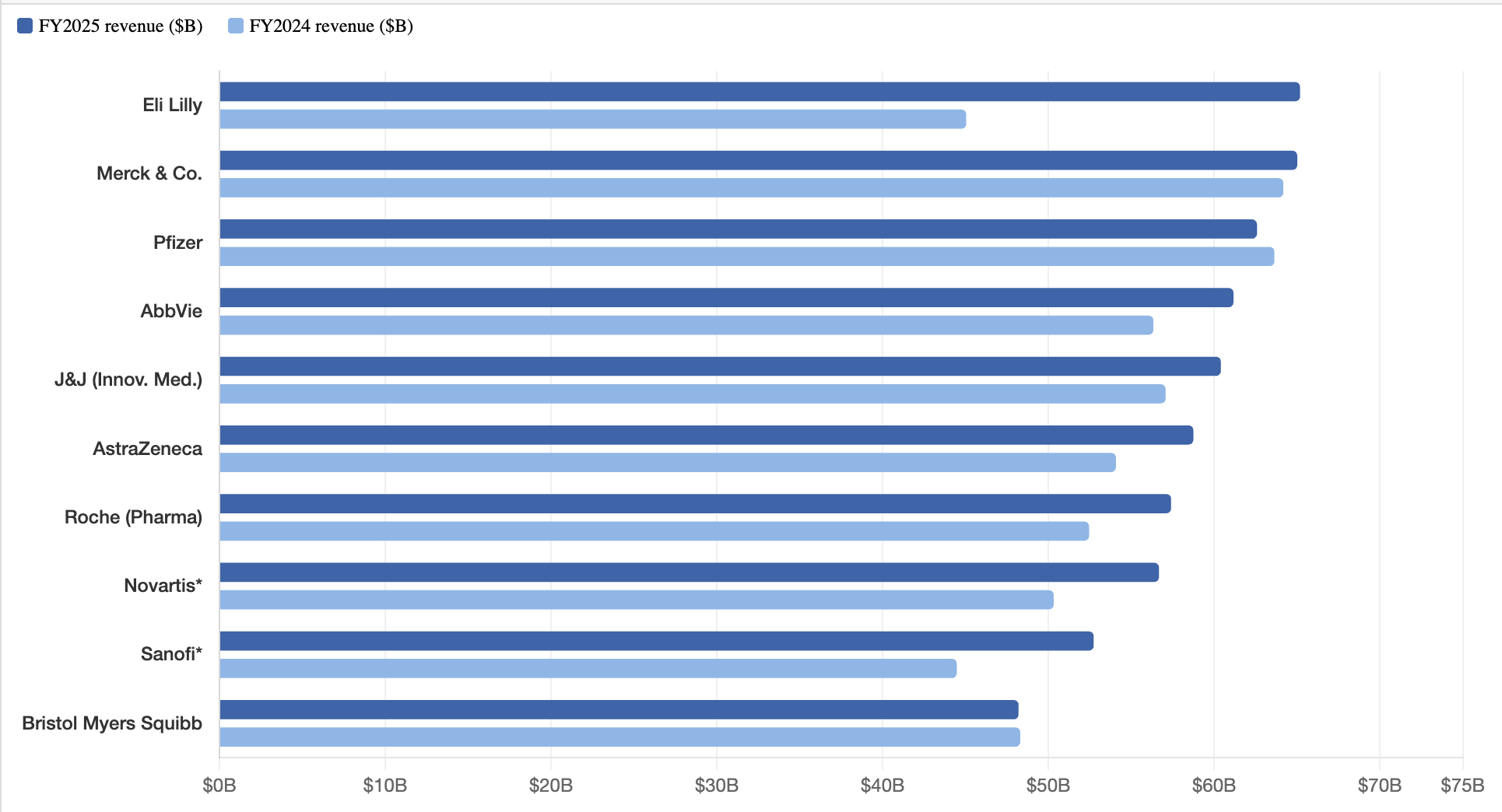
Lilly’s ascent to the top position by revenue marks a notable shift in the pharmaceutical industry’s hierarchy. Merck & Co., a stalwart in the industry known for its oncology powerhouse Keytruda (pembrolizumab) and a robust vaccine portfolio, saw its revenue remain essentially flat in FY2025. While Keytruda continues to be a dominant force in immuno-oncology, generating tens of billions in annual sales, its growth trajectory, combined with other portfolio elements, was insufficient to counter Lilly’s explosive expansion. Merck’s performance, while solid, highlights the immense pressure and dynamic nature of the top-tier pharmaceutical market, where sustained, rapid growth often requires breakthroughs in novel therapeutic areas.
The broader pharmaceutical landscape is characterized by intense competition, especially in lucrative therapeutic classes like GLP-1 agonists. Novo Nordisk, with its own successful GLP-1 products Ozempic (semaglutide for diabetes) and Wegovy (semaglutide for obesity), remains a formidable competitor. While Novo Nordisk has also experienced remarkable growth driven by these drugs, Lilly’s dual-agonist tirzepatide has carved out a significant niche, demonstrating competitive or superior efficacy in various head-to-head comparisons. This rivalry is driving further innovation, with both companies investing heavily in next-generation metabolic drugs, including oral formulations and combination therapies, suggesting that the "weight loss wars" are far from over.
Beyond metabolic disorders, the pharmaceutical industry continues to grapple with challenges such as patent cliffs for established blockbusters, increasing scrutiny over drug pricing, and the escalating costs of R&D. Companies that can consistently deliver truly innovative and highly effective therapies, particularly in areas with high unmet needs, are best positioned for long-term success. Lilly’s current trajectory is a prime example of this paradigm.
Analyst Perspectives and Market Valuation
The financial markets have reacted with immense enthusiasm to Lilly’s performance and future prospects. The company’s market capitalization has soared, with its valuation reaching unprecedented levels, exceeding $800 billion at times. This valuation reflects not only current sales but also strong investor confidence in Lilly’s pipeline, its ability to execute on manufacturing and commercialization, and the sustained demand for its leading products.
Industry analysts have largely reiterated their bullish outlooks on Lilly. Many point to the massive addressable market for obesity and type 2 diabetes, which combined affect hundreds of millions globally. Despite the current high demand, penetration rates for effective pharmacological treatments remain relatively low, suggesting substantial runway for continued growth. Analysts also cite Lilly’s strong intellectual property protection for tirzepatide, providing a significant period of market exclusivity.
However, some analysts also raise questions about the sustainability of such rapid growth and the company’s heavy reliance on a single franchise. While the tirzepatide franchise is robust, any significant future competition, unexpected safety concerns, or major shifts in reimbursement policies could introduce volatility. Nevertheless, the consensus remains that Lilly is exceptionally well-positioned for the foreseeable future, driven by a strong product portfolio and a pipeline that continues to deliver promising candidates.
Challenges and Future Outlook
Despite its current dominance, Eli Lilly faces several critical challenges and opportunities moving forward. One immediate challenge is scaling up manufacturing to meet the overwhelming global demand for Mounjaro and Zepbound. The company has been investing billions in new production facilities, but supply constraints can impact market share and patient access. Ensuring a consistent and adequate supply will be paramount to sustaining growth and preventing competitors from gaining ground due to availability issues.
Another significant area of focus will be pricing and market access. As GLP-1 agonists become more widely adopted, particularly for obesity, healthcare systems and payers globally are grappling with the high costs associated with these treatments. Lilly will need to navigate complex reimbursement landscapes and demonstrate the long-term cost-effectiveness and health benefits of its drugs to ensure broad patient access. Political and public pressure on drug pricing is a persistent factor in the pharmaceutical industry, and drugs with such high sales volumes often attract increased scrutiny.
Competition is also set to intensify. While Lilly currently holds a leading position, competitors are actively developing their own next-generation GLP-1 agonists, including multi-agonists and oral formulations, which could offer even greater convenience or efficacy. The emergence of new players or novel mechanisms of action could challenge Lilly’s market dominance in the future.
Looking ahead, Lilly’s strategic direction will likely involve continued heavy investment in R&D to diversify its portfolio further. While metabolic health remains a core strength, breakthroughs in other areas like Alzheimer’s disease (with donanemab), oncology, and immunology will be crucial for long-term, sustainable growth beyond the tirzepatide patent life. The company’s ability to successfully launch and grow new blockbusters will define its trajectory over the next decade. Furthermore, global expansion, particularly into emerging markets, represents another avenue for sustained growth, provided the company can navigate diverse regulatory and commercial environments.
Broader Implications for Pharmaceutical Innovation
Eli Lilly’s ascendancy has profound implications for the entire pharmaceutical industry. It reinforces the notion that true innovation in areas of high unmet medical need can lead to transformative commercial success, even in a mature and highly regulated industry. This success story may encourage increased investment in complex biological targets and novel mechanisms of action, especially in chronic diseases with large patient populations such as obesity, diabetes, and neurodegenerative disorders.
The Mounjaro/Zepbound phenomenon also highlights the increasing importance of combination therapies and multi-agonist approaches, demonstrating that targeting multiple pathways simultaneously can yield superior clinical outcomes. This could spur a new wave of drug discovery focused on more sophisticated pharmacological interventions.
Finally, Lilly’s rapid rise underscores the dynamic nature of market leadership in pharmaceuticals. While established giants may enjoy periods of stability, a single groundbreaking drug or franchise can swiftly redraw the competitive map, challenging incumbents and elevating agile, innovative companies to the forefront. This constant evolution ensures a vibrant, albeit fiercely competitive, environment dedicated to advancing global health. The company’s guidance for 2026, already surpassing previous optimistic projections, signals that Eli Lilly is not merely resting on its laurels but is poised for continued expansion, cementing its status as a pharmaceutical powerhouse for years to come.