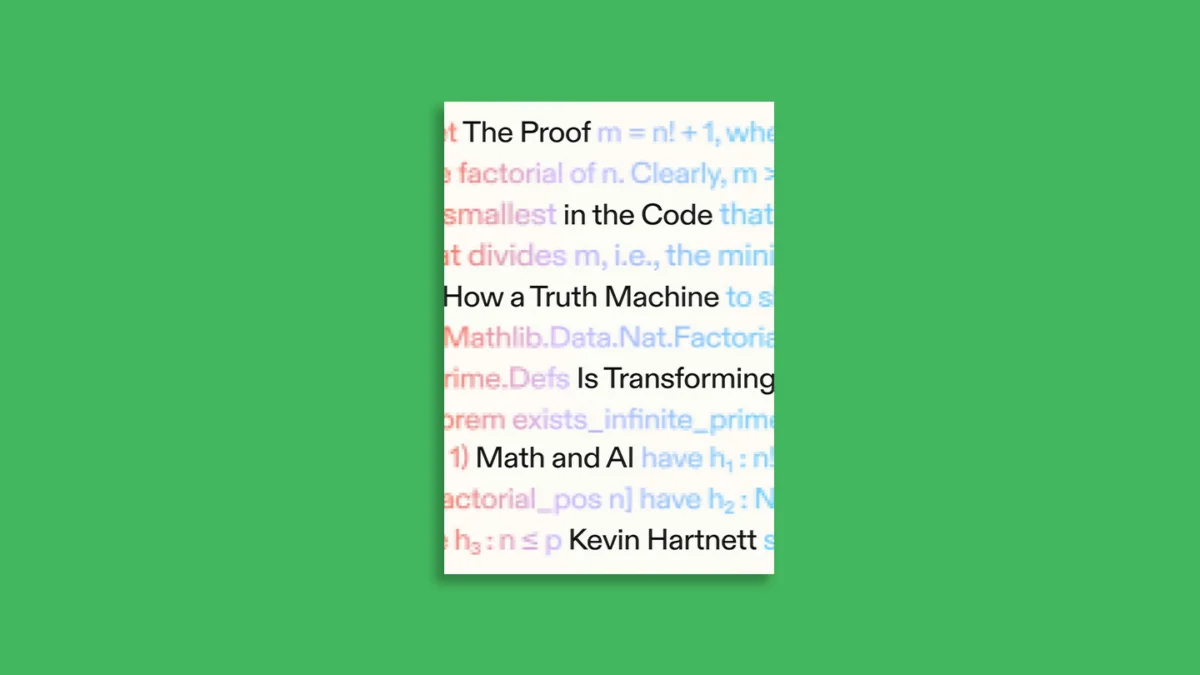
The landscape of mathematical discovery is undergoing a profound transformation, driven by the burgeoning capabilities of artificial intelligence and sophisticated software tools. A compelling narrative of this evolution is meticulously detailed in Kevin Hartnett’s recent book, The Proof in the Code, which charts the rise of computer programs capable of tackling complex mathematical problems and verifying intricate proofs. This journalistic exploration delves into the origins, development, and burgeoning impact of tools like Lean, a proof assistant program that has become a cornerstone for both mathematicians and AI researchers, heralding a new era of rigor and accelerated discovery in the world of abstract thought.
The Dawn of Algorithmic Proof: From Code Verification to Mathematical Frontiers
The genesis of this revolution can be traced back to 2013, when Leo de Moura, then a software engineer at Microsoft Research, launched Lean. Initially conceived as a tool for verifying the correctness of software code, Lean’s inherent logical structure and precision proved to be remarkably adaptable to the rigorous demands of mathematical proof. The analogy is stark: a bug in software code, like a flaw in a mathematical proof, can lead to catastrophic errors. Both disciplines rely on exact syntax and a series of logically connected steps to achieve a desired outcome. A program runs when its code is logically sound; a new mathematical theorem is established through a flawlessly constructed proof.
Hartnett’s account highlights the foresight and persistence of de Moura, who pursued the development of Lean with the conviction that its potential extended far beyond mere software validation. This vision, initially met with limited commercial traction, gradually found fertile ground within the academic mathematics community. A dedicated cadre of mathematicians and computer scientists recognized Lean’s power to imbue mathematical research with an unprecedented level of certainty.
The International Mathematical Olympiad: A Landmark Demonstration
A pivotal moment underscoring the growing prowess of AI in mathematical reasoning occurred in 2024. Google DeepMind, a leading artificial intelligence research laboratory, entered its AI program, AlphaProof, as an unofficial participant in the prestigious International Mathematical Olympiad (IMO). This competition, a grueling two-day event where top young mathematicians from around the globe tackle six advanced problems, served as a crucial benchmark. AlphaProof, a sophisticated mathematical theorem solver designed to prove mathematical statements, achieved a remarkable silver-medal cutoff score of 28 out of a possible 42 points.
This achievement was not an isolated incident but rather the culmination of years of dedicated effort in training AI systems to automate mathematical reasoning. The ambition behind these endeavors, as articulated by researchers at Google DeepMind and other institutions, extended beyond merely solving competition problems. They aimed to equip AI with more generalized reasoning capabilities, potentially leading to applications in real-world challenges. A key aspiration is the development of AI tools that can mitigate "hallucinations"—instances where AI generates fabricated information—by grounding their outputs in robust logical frameworks. The IMO performance of AlphaProof served as a powerful testament to the progress made in this domain.
Lean’s Ascent: From Obscurity to Indispensability
The success of programs like AlphaProof is deeply intertwined with the evolution of proof assistant software, with Lean emerging as a dominant force. Jeremy Avigad of Carnegie Mellon University was among the earliest adopters, recognizing Lean’s potential to formalize mathematical proofs shortly after its launch. Proof assistants, also known as interactive theorem provers, offer a mechanism to verify human-generated mathematical proofs. These proofs, often spanning hundreds of pages and requiring months of meticulous review, are susceptible to human error. Proof assistants, while not capable of independently generating novel proofs, can rigorously check the logical integrity of existing ones, thereby accelerating the establishment of new mathematical facts and facilitating the construction of subsequent, more complex theorems.
However, the initial adoption of proof assistants was not without its hurdles. Hartnett details the challenges faced by mathematicians in adapting to these tools. The process required translating problems from natural language into a precise, coded format and constructing extensive libraries of definitions and theorems for fundamental mathematical concepts. Kevin Buzzard, a mathematics professor at Imperial College London, encountered this firsthand when developing problem sets for his undergraduate students to learn Lean. He recounts the program’s demand for a formal proof of the seemingly self-evident statement that "2 is not equal to 1." While humans intuitively grasp such truths, Lean, as a logic engine, necessitates explicit justification for every step.
Building the Mathematical Library: A Collaborative Endeavor
The primary obstacle to Lean’s widespread adoption was the scarcity of pre-coded mathematical knowledge within its libraries. To expand these resources, a concerted effort was required from mathematicians themselves. Hartnett chronicles the dedication of individuals and groups who championed Lean, persuading their peers to engage with the program and contribute to its growth. A notable example is the 2018 initiative by Buzzard and his colleagues to translate the complex mathematical concept of "perfectoid spaces" into Lean. This ambitious undertaking, involving months of intensive work and thousands of lines of code, exemplified the commitment required to enrich the program’s mathematical repertoire.
The collaborative spirit and the tangible benefits of these efforts began to yield significant results. By 2025, Hartnett observes that "tens of thousands of users across academia and technology were launching increasingly ambitious projects on top of Lean." This burgeoning user base included AI researchers who found in Lean an invaluable repository of advanced mathematical knowledge, essential for training sophisticated math-solving AI models like AlphaProof.
The "Truth Machine": A Shared Vision for Rigor
At the core of both de Moura’s and the mathematicians’ motivations lay the pursuit of a "truth machine"—a computer program capable of providing an unimpeachable guarantee of logical correctness. For de Moura, this vision translated into ensuring the absolute reliability of software code, the bedrock of critical applications like Microsoft Word. For mathematicians, the "truth machine" promised a new paradigm for mathematical discovery, one characterized by enhanced rigor, meticulous organization, and absolute precision in proof construction.
This convergence of interests—the software engineer’s quest for bug-free code and the mathematician’s pursuit of irrefutable truths—fueled the collaborative spirit that propelled Lean forward. The ability of proof assistants to verify proofs not only safeguards against errors but also allows mathematicians to build upon established results with greater confidence, accelerating the pace of innovation.
Implications and the Future of Mathematical Exploration
The implications of AI-driven proof assistance and theorem proving are far-reaching. In fields such as cryptography, where the security of algorithms relies on complex mathematical underpinnings, the ability to rigorously verify proofs can lead to stronger, more secure systems. In theoretical physics, where abstract mathematical models describe the fundamental workings of the universe, AI assistance could potentially unlock new avenues of inquiry by verifying intricate theoretical frameworks.
The integration of AI into mathematical research also raises broader questions about the nature of discovery itself. While AI currently excels at verification and problem-solving within defined frameworks, the spark of human intuition and creativity in formulating entirely new conjectures remains a unique human attribute. However, as AI systems become more sophisticated, the boundaries between verification and generation may blur, leading to new forms of human-AI collaboration in the creative process of mathematics.
A Narrative of Persistence and Collaboration
While The Proof in the Code offers an engrossing account of Lean’s development, Hartnett’s narrative style, which sometimes jumps between timelines and introduces characters and anecdotes without explicit connections, can present a challenge for some readers. However, for those with a curiosity for the intersection of computer science and mathematics, the book provides rich texture to the story of Lean and its pivotal role in a transformative period for mathematics. It is a testament to the power of persistent innovation, collaborative spirit, and the enduring human quest for certainty and understanding. The algorithmic ascent in mathematics is not merely a technological advancement; it represents a fundamental shift in how we explore, validate, and expand the frontiers of human knowledge.