

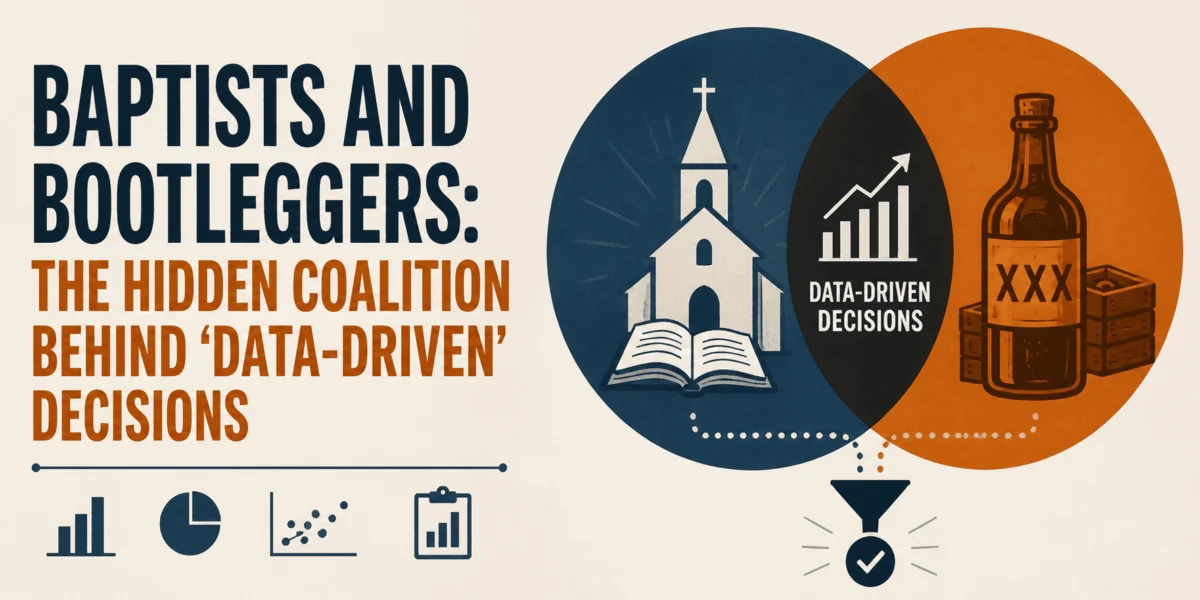
In the contemporary corporate landscape, the assertion of being "data-driven" has become a powerful declaration, often serving as the ultimate arbiter in strategic discussions and a shield against dissenting viewpoints. Yet, beneath this seemingly unified pursuit of objective truth lies a complex interplay of motivations, sometimes forming an unwitting alliance that shapes organizational trajectories in profound ways. This phenomenon, rooted in a concept first articulated by economist Bruce Yandle, reveals how ostensibly disparate interests can converge to advocate for identical outcomes, albeit for entirely different reasons. Understanding this "Bootleggers and Baptists" dynamic is crucial for any organization genuinely committed to sound, evidence-based decision-making.
The Genesis of a Framework: Bruce Yandle’s "Bootleggers and Baptists"
The analytical framework known as "Bootleggers and Baptists" was introduced by regulatory economist Bruce Yandle in 1983. His seminal work explored the political economy of regulation, particularly focusing on the surprising coalitions that emerge to support specific legislative outcomes. Yandle’s original observation stemmed from the peculiar history of Sunday alcohol sales bans in the American South.
During and after the Prohibition era, various states maintained strict regulations on alcohol sales, often prohibiting them on Sundays. On the surface, these laws were championed by religious groups, such as Baptists, who advocated for them on moral and ethical grounds, believing that restricting alcohol access on the Sabbath was inherently righteous and beneficial for society. Their public advocacy provided a strong, morally defensible rationale for the legislation.
However, Yandle keenly observed that another, less visible group also strongly favored these same laws: bootleggers. For illicit alcohol producers and distributors, Sunday bans eliminated legitimate competition from licensed establishments for an entire day, effectively creating a monopoly for their illegal operations. They benefited financially from the very regulations that the Baptists championed for moral reasons.
This unlikely coalition — the morally driven Baptists and the profit-motivated bootleggers — proved highly effective. The Baptists provided the public-facing legitimacy and moral imperative, making it politically palatable for lawmakers to enact and maintain such restrictions. The bootleggers, operating quietly in the background, reaped the economic benefits. Yandle’s profound insight was that these coalitions, where groups with divergent motivations converge on a shared policy outcome, are often more successful in achieving regulatory goals than either group could manage alone. The framework highlights how public policy, ostensibly driven by noble intentions, can simultaneously serve private, often less transparent, interests.
The Modern Data Landscape: A Parallel Reality
The "Bootleggers and Baptists" framework finds a remarkably precise and often unsettling parallel in the contemporary world of data analytics and corporate decision-making. The increasing sophistication of data collection, processing, and analysis tools, coupled with a pervasive cultural emphasis on "data-driven" strategies, has created an environment ripe for such dynamics. Organizations across industries invest billions annually in data infrastructure, analytics platforms, and data science talent, all with the stated goal of making more informed, objective decisions. Yet, the very language of data, intended to bring clarity, can also be co-opted to serve pre-existing agendas.
The phrase "according to data analytics" has evolved into a rhetorical device capable of silencing dissent and lending an aura of irrefutable truth to a proposal. This perceived authority of data, however, can emanate from two fundamentally different sources within an organization: genuine intellectual curiosity and a pre-determined conclusion seeking statistical validation.
The "Baptists" of Data: True Believers in Evidence
In any data-literate organization, there are individuals who embody the spirit of the "Baptists." These are the genuine proponents of evidence-based decision-making. They approach data with an open mind, driven by a sincere desire to understand underlying patterns, test hypotheses, and uncover objective truths. Their motivation is rooted in the conviction that rigorous data analysis leads to superior outcomes for the organization.
Characteristics of data Baptists include:
- Intellectual Honesty: They are comfortable with uncertainty and prepared to adjust their beliefs or recommendations when data contradicts their initial hypotheses. They view data as a flashlight illuminating a dark room, willing to accept whatever the light reveals, even if inconvenient.
- Methodological Rigor: They advocate for clean data pipelines, robust data governance, statistically sound A/B testing, and transparent analytical methodologies. Their focus is on the integrity of the process, understanding that flawed data or analysis will lead to flawed conclusions.
- Focus on the Full Picture: They strive to consider all relevant metrics, potential biases, and confounding factors. They prioritize statistical significance and contextual understanding over immediate, favorable results.
- Humility and Adaptability: They are quick to admit when they were wrong or when more information is needed. Their goal is learning and improvement, not being "right."
These individuals are invaluable assets, serving as the moral and intellectual compass for data initiatives. Their credibility is earned through consistent adherence to scientific principles and an unwavering commitment to objective truth. This genuine belief in the power of data, irrespective of its structure or implications, makes them unwitting but powerful allies for the "bootleggers."
The "Bootleggers" of Data: Agenda-Driven Validation Seekers
Opposite the Baptists are the "Bootleggers" of data. These individuals approach data not as a tool for discovery, but as a resource for validation. They begin with a pre-determined conclusion or a desired outcome, then strategically navigate the vast sea of available data to find numbers that support their existing narrative. They are fluent in the language of evidence, capable of crafting compelling presentations, citing dashboards, and referencing metrics. However, their analytical process is a reverse-engineered journey, where the destination is fixed before the exploration even begins.
Tactics employed by data Bootleggers often include:
- Cherry-Picking Data: Selecting specific time ranges, cohorts, or data subsets that align with their preferred trend while deliberately omitting contradictory evidence. For instance, highlighting a two-week spike in user engagement while ignoring a preceding three-month decline.
- Metric Manipulation: Focusing on metrics that flatter their initiative while downplaying or ignoring those that tell a less favorable story. If a new AI-generated ad campaign garners more clicks, they will emphasize click-through rates (CTR) but conveniently omit rising bounce rates, decreased time on page, or increased cost per acquisition (CPA).
- Misinterpreting Correlation as Causation: Leaning heavily on correlation when it supports their argument, but dismissing it as mere coincidence when it challenges their position.
- Data Silencing: Actively suppressing or failing to present data that argues against their position, or framing negative data in a way that minimizes its significance.
- Confirmation Bias Exploitation: Leveraging the inherent human tendency to seek out and interpret information that confirms one’s existing beliefs.
- Narrative Over Nuance: Prioritizing a clean, persuasive story over the complexities and uncertainties inherent in most real-world data sets.
What makes data Bootleggers particularly effective, and often hard to detect, is their ability to mimic the language and presentation style of the Baptists. They use the same vocabulary ("data-driven," "evidence-based," "statistical significance"), reference the same tools, and maintain an outward appearance of analytical rigor. From an external perspective, or even within a meeting, it can be extraordinarily difficult to distinguish between someone genuinely following the data and someone selectively presenting it.
The Power of the Coalition: Why It Works So Well
The true power of the "Bootleggers and Baptists" framework in the data realm lies in how these two seemingly disparate groups inadvertently empower each other. The Baptists, with their unwavering commitment to objective truth and rigorous methodology, provide invaluable legitimacy to the decisions that emerge from such a coalition. When an individual known for their analytical integrity and commitment to data-driven principles supports a particular conclusion, it significantly lowers the political and intellectual cost for others in the organization to fall in line. Their endorsement acts as a powerful stamp of approval.
The bootleggers skillfully ride this wave of credibility. They understand that their pre-determined agenda gains immense traction when it appears to be supported by the objective analysis championed by the Baptists. The presence of genuine data proponents lends an air of unimpeachable objectivity to outcomes that were, in reality, steered by a hidden agenda.
Crucially, the Baptists are often unaware of their role in this coalition. From their perspective, the decision was indeed made on merit, because they genuinely observed data pointing in that direction. They engaged with the numbers in good faith, applied their analytical skills, and arrived at a conclusion. What they may not realize is that the "right" numbers—the ones that ultimately shaped the decision—were strategically curated or emphasized by the bootleggers. This subtle manipulation of the data landscape ensures that the Baptists’ genuine efforts inadvertently serve the bootleggers’ pre-existing goals. This dynamic can erode trust, lead to suboptimal decisions, and foster a culture where "data-driven" becomes a performative act rather than a genuine commitment to discovery.
Implications and Consequences for Organizations
The widespread operation of such coalitions carries significant implications for organizations:
- Suboptimal Decision-Making: The most direct consequence is that decisions are not truly optimized for the organization’s long-term health. Instead, they serve individual or departmental agendas, leading to resource misallocation, missed opportunities, and potentially detrimental strategic shifts. A study by IBM in 2016 estimated that poor data quality alone costs the US economy $3.1 trillion annually, a figure exacerbated when data is actively manipulated.
- Erosion of Trust: Over time, if decisions consistently fail to yield expected results despite being "data-driven," trust in the analytics function and leadership’s judgment will erode. Employees may become cynical about data initiatives, perceiving them as tools for political maneuvering rather than genuine insight.
- Cultural Stagnation: A culture dominated by bootleggers stifles innovation and critical thinking. If challenging the "data-driven" narrative is seen as challenging the data itself, dissent is suppressed, and opportunities for genuine discovery are lost. This can lead to a "yes-man" environment where inconvenient truths are ignored.
- Ethical Concerns: The deliberate manipulation of data raises significant ethical questions. It can lead to decisions that harm customers, employees, or stakeholders, all under the guise of objective analysis. The increasing focus on ethical AI and responsible data use highlights the growing awareness of these risks.
- Competitive Disadvantage: In an increasingly data-intensive global economy, organizations that fail to cultivate a truly objective, data-driven culture will inevitably fall behind competitors who leverage data for genuine strategic advantage.
Strategies for Discerning the Players and Fostering True Data-Driven Culture
Identifying Baptists and Bootleggers, while challenging, is critical for organizational health. Several strategies can help:
-
Observe Reactions to Contradictory Data: This is perhaps the most telling indicator.
- Baptists will engage with contradictory data. They will ask probing follow-up questions, critically revisit their assumptions, seek additional context, and be willing to change their direction or recommendations based on new evidence. Their curiosity remains paramount.
- Bootleggers will pivot. They might reframe the original question, shift to a different metric, suddenly declare the data "incomplete" or "not capturing the full picture," or dismiss the contradictory evidence as an outlier. Their goal is to maintain their narrative, not to explore truth.
-
Scrutinize the Analytical Process:
- Who presents the data vs. who selects it? There is a fundamental difference between an analyst who rigorously examines all available evidence and presents a balanced view, and someone who curates a specific subset of data to bolster a pre-existing argument. Organizations should foster environments where the full analytical pipeline, from data collection to interpretation, is transparent and open to scrutiny.
- Was the process genuinely exploratory? Ask if the conclusion was already circulating or informally agreed upon before the data was even pulled. True data-driven discovery allows the data to speak for itself, even if it leads to unexpected conclusions.
- Demand a "Devil’s Advocate" View: Encourage presentations that explicitly address counter-arguments or present data that might challenge the primary recommendation. A robust analysis includes a discussion of limitations, alternative interpretations, and potential risks.
-
Promote Data Literacy and Critical Thinking: Empowering employees at all levels to understand basic statistical concepts, data visualization best practices, and common biases (e.g., confirmation bias, selection bias) can create a more discerning organizational culture. Data literacy shouldn’t be confined to data scientists; it should be a core competency for all decision-makers.
-
Establish Strong Data Governance and Ethics: Implement clear policies around data collection, storage, analysis, and reporting. Promote an ethical framework that values data integrity and objective reporting over political expediency. This includes independent data audits and reviews of significant analytical projects.
-
Foster a Culture of Psychological Safety: Employees must feel safe to challenge "data-driven" conclusions without fear of reprisal, especially when their concerns are based on legitimate data discrepancies or methodological flaws. A culture that rewards truth-seeking, even when inconvenient, is essential.
Broader Significance: Beyond Data
Yandle’s framework, though originating in regulatory economics, describes a universal pattern of human and organizational behavior. Wherever decisions carry significant moral, intellectual, or reputational weight, there will invariably be individuals who genuinely believe in the underlying principles (the Baptists) and those who are adept at exploiting the cover these principles provide for their own agendas (the Bootleggers).
In the context of data-driven culture, the best defense against being swayed by a bootlegger-baptist coalition is a combination of vigilant curiosity and methodological skepticism. It means not just asking "What does this data say?" but critically inquiring "Why this data? What data is not being shown? What are the alternative interpretations?"
The numbers themselves can be real, the analysis can appear sound, and yet the entire presentation can still serve a pre-determined, self-serving agenda. Truly good data practice extends beyond statistical accuracy; it demands a deep, ethical inquiry into the motivations, completeness, and context behind every data-driven assertion. Only then can organizations truly harness the power of data for genuine progress, rather than falling prey to its manipulative potential.
















Leave a Reply