

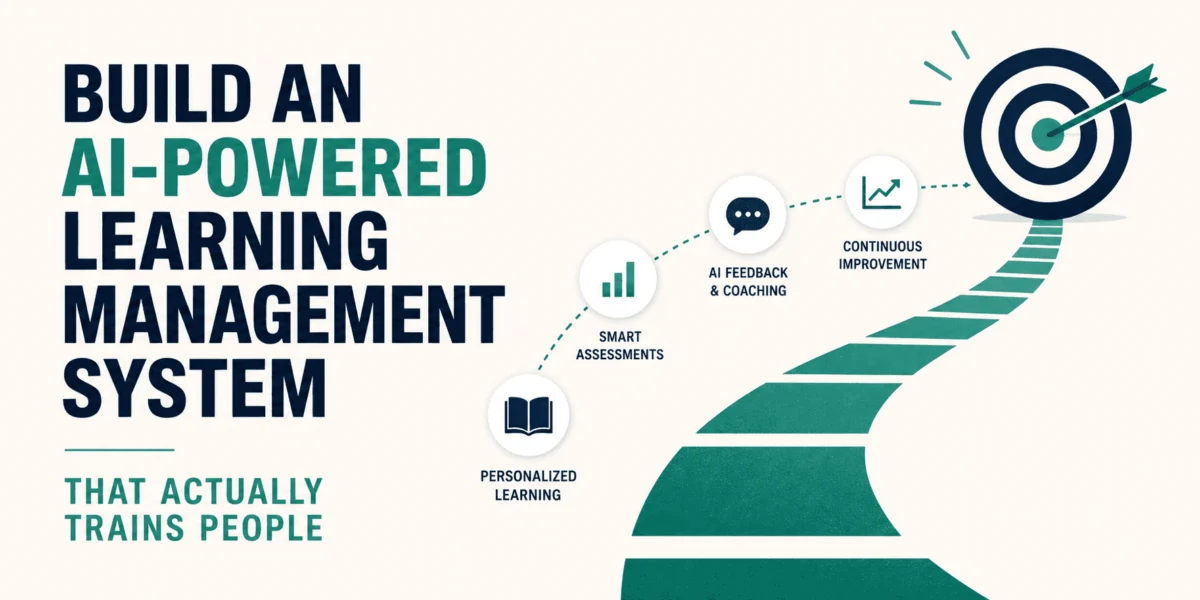
The Evolution and Shortcomings of Traditional E-Learning
For years, online learning platforms have been instrumental in democratizing access to education, yet their inherent design often falls short of fostering true mastery. The conventional model typically involves a learner clicking through a fixed sequence of slides, completing quizzes with easily searchable answers, and receiving a certificate that may not accurately reflect acquired knowledge. This approach, while convenient, primarily tracks engagement metrics like clicks and completion percentages, failing to gauge the depth of understanding or identify specific areas of struggle.
Traditional LMS platforms, exemplified by well-known systems like Moodle, Canvas, and Blackboard, serve as digital repositories for educational content, facilitating its delivery, management, and tracking. However, their static nature presents significant limitations:
- One-Size-Fits-All Content Delivery: Every learner receives the exact same content in the same order, regardless of their prior knowledge, learning style, or pace. This disregards the fundamental principle of individualized education.
- Static and Outdated Assessments: Quizzes often comprise a fixed bank of questions that can quickly become obsolete or be easily circumvented through memorization or external resources. This undermines the integrity of assessment and provides an inaccurate measure of learning.
- Lack of Real-Time Support: Learners frequently encounter points of confusion or difficulty without immediate access to clarification or personalized guidance. This often leads to frustration, disengagement, and a high attrition rate in online courses.
- Limited Progress Metrics: Dashboards typically display a simple percentage of content completed, offering little insight into a learner’s mastery of specific topics or their progression in complex skills.
Research consistently highlights the inefficacy of passive e-learning. The Research Institute of America reports that learners retain only 8-10% of content delivered via traditional e-learning methods. In stark contrast, active and personalized learning approaches can boost retention rates to 25-60%. This substantial gap underscores the urgent need for more dynamic and adaptive educational tools.
Introducing the AI-Powered Learning Management System
An AI-powered LMS transcends the limitations of its predecessors by leveraging artificial intelligence to create a highly personalized and adaptive learning experience. Unlike a textbook that offers uniform content, an AI-powered system functions more like a dedicated private tutor, dynamically adjusting to each individual. Key functionalities include:
- Personalized Content Delivery: The system analyzes a learner’s existing knowledge and performance to tailor the sequence and type of content presented.
- Real-Time Support and Intervention: AI-driven tools can identify when a learner is struggling and provide immediate, targeted assistance.
- Dynamic Assessment Generation: Quizzes and assessments are generated on the fly, ensuring variety and making it impossible to pass without genuine understanding.
- Comprehensive Mastery Tracking: Beyond mere completion, the system monitors and reports on a learner’s actual mastery of concepts over time.
The project demonstrates how to build such a system entirely with open-source tools, making it accessible and cost-effective for developers and educational institutions alike.
The Open-Source Technological Foundation
The proposed AI-powered LMS is built upon a robust and entirely open-source technology stack, eliminating the need for expensive API subscriptions or proprietary cloud services. This approach not only reduces operational costs but also fosters transparency and community-driven development.
| Layer | Tool | Purpose |
|---|---|---|
| AI Model | Ollama + Mistral 7B | Runs the language model locally, enabling on-device AI processing. |
| Backend | FastAPI (Python) | Provides high-performance API routes and handles WebSocket connections. |
| Frontend | React | Powers the dynamic and responsive user interface. |
| Data Store | In-memory (Python dict) | Manages learner profiles and progress data for quick access. |
Why Open-Source AI?
- Ollama: This platform allows users to download and run open-source large language models (LLMs) directly on their local machines. This capability is pivotal, as it negates the reliance on cloud-based APIs, eliminating usage fees and ensuring data privacy. Ollama supports a variety of powerful models, including Mistral, LLaMA 3, and Phi-3, offering flexibility and future-proofing.
- Mistral 7B: Chosen for its balance of performance and efficiency, Mistral 7B is a compact yet highly capable LLM. It excels at following instructions accurately, generating clean structured outputs (like JSON), and handling conversational Q&A effectively—qualities crucial for the various intelligent modules within the LMS. Its ability to run efficiently on most modern laptops makes it an ideal candidate for local deployment.
- FastAPI: As a modern Python web framework, FastAPI is renowned for its speed and asynchronous capabilities. Its native support for WebSockets is particularly important for enabling real-time, streaming interactions, such as those required for a live AI tutor experience. This ensures a fluid and responsive user experience.
- React: A popular JavaScript library for building user interfaces, React provides the necessary tools to create a dynamic, interactive, and intuitive frontend for the LMS. Its component-based architecture facilitates modular development and maintenance.
Four Pillars of Adaptive Learning
The AI-powered LMS integrates four intelligent features that work in concert to create a genuinely adaptive learning environment.
1. Adaptive Learning Paths
The core problem addressed by adaptive learning paths is the inefficiency of a uniform curriculum. A novice and an expert embarking on the same course, for instance, in Python programming, possess vastly different needs. The adaptive learning module dynamically constructs a personalized learning sequence for each individual.
- Mechanism: When a learner specifies a learning goal (e.g., "Learn Python for data science"), the system queries the Mistral LLM. This query incorporates the learner’s current knowledge profile, including their mastery scores in various topics and previously completed modules. It also provides a summary of all available course modules.
- AI Logic: The LLM, acting as a "curriculum expert," generates an ordered list of module IDs. Its instructions are precise: skip already completed modules, prioritize areas where the learner shows weakness, and arrange content from easier to more challenging topics. This ensures that the generated path is both relevant and optimally challenging.
- Dynamic Recalculation: The learning path is not static. After each quiz completion, the learner’s mastery scores are updated, prompting a recalculation of their path. This responsiveness means that a learner who rapidly grasps concepts will be advanced to more complex material sooner, while one who struggles will be routed back to foundational content for reinforcement.
- Learner Experience: Users interact with a "Learning Path" tab, where they input their goals. Within moments, a custom sequence of modules appears, detailing topics, difficulty levels, and direct access points to quizzes or the AI tutor. This transparency empowers learners and provides a clear roadmap.
2. AI-Generated Quizzes and Assessments
The challenge with traditional assessments lies in their static nature, which quickly renders them ineffective for truly measuring understanding. Learners can share answers, memorize solutions without comprehension, or simply Google their way to a passing score. AI-generated quizzes overcome these issues by offering unique, dynamic assessments every time.
- Mechanism: Upon a learner’s request for a quiz on a specific module, the backend retrieves the relevant course content. This content is then fed to the Mistral LLM with explicit instructions to generate a structured JSON quiz, typically comprising multiple-choice questions with predefined options and a correct answer.
- Content Relevance: Every quiz is generated directly from the specific module’s course material, ensuring that questions are highly relevant and current. The dynamic generation means that repeated attempts at a quiz will present different questions, reinforcing learning through varied exposure rather than rote memorization.
- Enhanced Feedback: Crucially, upon submission, incorrect answers are accompanied by detailed explanations, not merely a "wrong" mark. Cognitive science research, notably by Hattie & Timperley (2007), consistently demonstrates that explanatory feedback significantly enhances retention and deeper learning compared to simple right/wrong indicators.
- Progression Logic: Achieving a score of 75% or higher on a quiz marks the module as completed, unlocking subsequent steps in the personalized learning path and contributing to the learner’s overall mastery profile.
3. The Natural Language AI Tutor
One of the most significant barriers to online learning success is the lack of immediate support when learners encounter difficulties. The inability to ask questions in real-time often leads to frustration and course abandonment. The AI tutor module addresses this by providing an always-available, infinitely patient, and context-aware virtual instructor.
- Real-Time Interaction: The tutor operates over a WebSocket connection, establishing a persistent, bidirectional communication channel between the user’s browser and the backend. This enables token-by-token streaming of the AI’s responses, mimicking natural human typing and eliminating frustrating wait times for full responses.
- Contextual Understanding (RAG): The tutor employs Retrieval-Augmented Generation (RAG). Before formulating an answer, it dynamically pulls relevant sections of the course content into the prompt as context. This ensures that Mistral’s responses are grounded in the specific learning material, minimizing the risk of generic, incorrect, or irrelevant information.
- Conversational Memory: To facilitate natural interaction, the system includes the entire conversation history in each new prompt. This allows the tutor to remember previous exchanges within the same session, making the dialogue feel coherent and personalized, avoiding repetitive questions or answers.
- Learner Experience: Learners engage with a familiar chat interface on the "AI Tutor" tab. Questions are typed and answered in real-time. The tutor’s awareness of the current module content means it can provide highly targeted assistance without requiring the user to specify the topic repeatedly.
4. Progress Tracking and Analytics
Traditional LMS dashboards often present a superficial view of progress, typically a percentage bar that fills as content is clicked through. This offers little insight into actual learning. The AI-powered LMS introduces a sophisticated progress tracking system that focuses on mastery, derived from sustained performance over time.
- Mastery Score Calculation (EMA): Every quiz submission triggers an update to the learner’s mastery score using an Exponential Moving Average (EMA). This formula—
New mastery = 30% recent score + 70% historical mastery—gives greater weight to recent performance while retaining the influence of past results. This ensures that the mastery score is responsive to improvement but not unduly swayed by a single anomalous performance, providing an honest and dynamic representation of skill. - Comprehensive Event Logging: All learner actions—from initiating a module, submitting a quiz, to passing or failing—are meticulously logged with timestamps. This creates a detailed chronological record of learning activity, which serves as the foundation for the dashboard’s analytics.
- Informative Dashboard: The "Dashboard" tab offers a clear and actionable overview of learner progress. It displays overall course completion, individual module mastery scores, and a chronological history of learning activities. This comprehensive view allows learners to understand their strengths, identify areas needing further attention, and track their development beyond simple content consumption.
The Synergistic Feedback Loop: A Holistic Learning Ecosystem
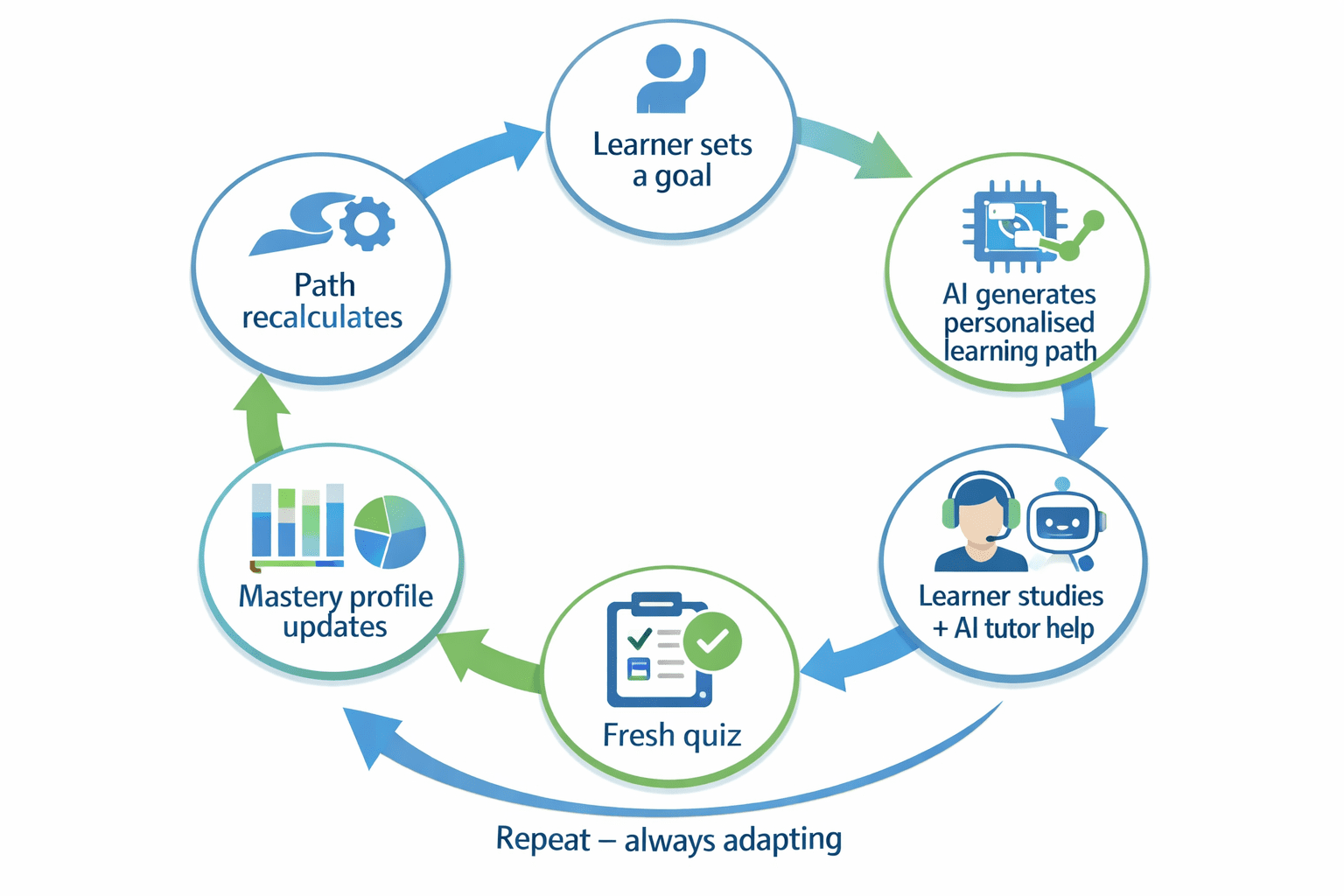
While each module offers significant benefits independently, their true power emerges from their integrated operation within a continuous feedback loop. This interconnectedness ensures that the system is never static; it constantly adapts and responds to the learner’s evolving performance.
- Adaptive Path Generation: A learner sets a goal, and the system generates a personalized path based on their initial profile.
- Module Engagement: The learner engages with a module, potentially utilizing the AI Tutor for clarification or assistance.
- Quiz Assessment: Upon completing a module, the learner takes an AI-generated quiz, which is unique to that attempt.
- Mastery Update: Quiz results are processed, updating the learner’s mastery scores for the relevant topics using the EMA.
- Path Recalculation: The updated mastery scores trigger a recalculation of the adaptive learning path, potentially reordering modules, suggesting remedial content, or advancing the learner to more complex topics.
- Progress Tracking: All activities and score updates are logged and reflected on the dashboard, providing transparent analytics.
This iterative process creates a truly dynamic learning environment. The system actively learns about each learner with every interaction, continuously refining its approach to guide them towards genuine mastery. The entire architecture runs locally, leveraging Ollama and Mistral 7B, emphasizing a future of powerful AI applications without cloud dependency or API costs.
Implications for the Future of Education
The development of this open-source AI-powered LMS marks a significant milestone in educational technology. It demonstrates that advanced, adaptive learning systems are no longer the exclusive domain of well-funded institutions or proprietary software vendors. By providing a blueprint for building such a system with free tools, this project lowers the barrier to entry for innovators and educators worldwide.
The broader implications are profound:
- Increased Learning Efficacy: By focusing on mastery and providing personalized support, these systems have the potential to significantly improve learning outcomes and retention rates.
- Reduced Course Attrition: The constant availability of an AI tutor and the adaptive nature of content can keep learners engaged and prevent them from getting stuck and dropping out.
- Democratization of Advanced Education: Open-source AI tools make sophisticated learning solutions accessible to a wider range of educational contexts, from individual developers to small non-profits and institutions with limited budgets.
- Data-Driven Pedagogy: The detailed progress tracking and analytics provide educators with unprecedented insights into learning patterns, allowing for more informed curriculum design and pedagogical adjustments.
This initiative signifies a pivotal shift from systems that merely track clicks to those that genuinely track learning. The full project, including all backend routes, React components, and detailed setup instructions, is available on GitHub (zenUnicorn/AI-Powered-Learning-Management-System), inviting developers and educators to explore, contribute, and adapt this powerful framework.
Shittu Olumide, the software engineer and technical writer behind this innovative project, continues to advocate for leveraging cutting-edge technologies to create impactful solutions. His work, frequently shared on platforms like Twitter, embodies a passion for simplifying complex concepts and crafting compelling narratives in the realm of technology.










Leave a Reply