

Agentic AI systems, designed to intelligently perform complex tasks by autonomously selecting and utilizing various digital tools, are fundamentally reliant on a language model’s capacity for precise and reliable tool calling. This crucial ability involves accurately identifying the appropriate function, formatting arguments with exacting precision, and seamlessly integrating the resulting outputs into sophisticated, multi-step workflows. While frontier-tier large language models (LLMs) such as OpenAI’s ChatGPT, Anthropic’s Claude, and Google’s Gemini have demonstrated exceptional proficiency in these areas, their operational demands present significant trade-offs. The substantial computational costs, inherent latency in processing, and formidable hardware requirements often render them impractical or financially prohibitive for widespread real-world deployment, particularly in environments with resource constraints or stringent performance expectations. In response to these challenges, small language models (SLMs) have rapidly advanced, progressively closing the capability gap. A growing number of compact, open-weight options now provide first-class tool-calling support, negating the necessity for vast data center infrastructure for their operation. This evolution is democratizing access to sophisticated AI agents, enabling their deployment on edge devices, personal computers, and other low-VRAM machines, thereby opening new frontiers for innovation across diverse industries.
The paradigm shift towards more efficient and accessible AI is underpinned by the continuous innovation in model architecture, training methodologies, and data curation. Developers and researchers are increasingly focusing on optimizing models not just for raw performance, but for deployability and operational efficiency. This includes architectural innovations like Grouped Query Attention (GQA) and Sliding Window Attention (SWA) which improve inference speed and memory footprint, as well as refined training curricula that prioritize reasoning and instruction-following capabilities within a smaller parameter budget. The open-source nature of many of these SLMs further accelerates their adoption, allowing developers to inspect, modify, and fine-tune models to specific use cases, fostering a collaborative ecosystem of innovation.
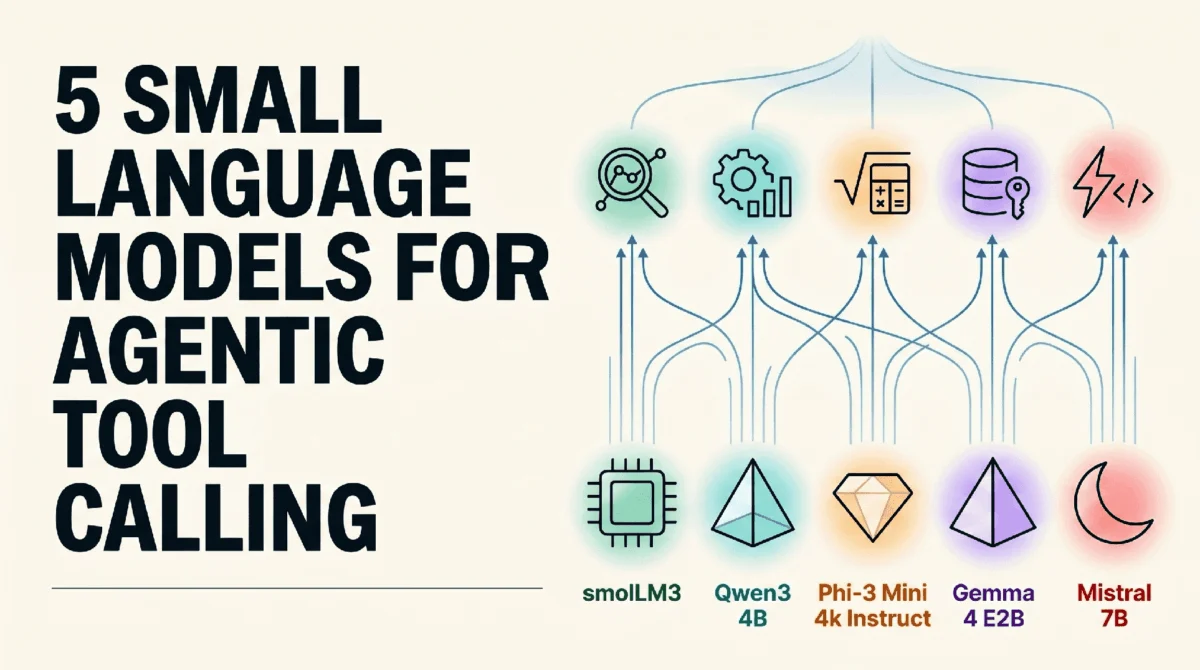
The following five small language models exemplify this trend, each offering distinct advantages in the domain of agentic tool calling. These models, presented without a specific ranking, represent the forefront of accessible AI, enabling a new generation of intelligent applications. For consistency and convenience, all referenced model links direct to their respective Hugging Face-hosted versions, a central hub for the open-source AI community.
SmolLM3-3B: Pushing the Boundaries of Compact Intelligence
Technical Overview and Architectural Innovations
SmolLM3-3B emerges as a significant contender in the small language model landscape, boasting 3 billion parameters and designed to redefine the capabilities of compact models. Developed by Hugging Face, it champions a decoder-only transformer architecture, integrating Grouped Query Attention (GQA) and No Positional Embeddings (NoPE) with an optimized 3:1 ratio. GQA, a key innovation, allows multiple query heads to share a single key-value head group, significantly reducing memory consumption and increasing inference speed compared to traditional multi-head attention, making it ideal for resource-constrained environments. The absence of positional embeddings (NoPE) further simplifies the architecture while maintaining performance through other contextual cues.
The model’s training regimen is particularly notable. It was pretrained on an expansive 11.2 trillion tokens, following a carefully staged curriculum that included web data, code, mathematical problems, and reasoning-centric datasets. This comprehensive pretraining ensures a broad understanding and robust foundational knowledge. A critical post-training phase involved an additional 140 billion reasoning tokens, aimed at enhancing its logical deduction and problem-solving abilities. This was followed by Supervised Fine-Tuning (SFT) and alignment via Anchored Preference Optimization (APO), Hugging Face’s bespoke off-policy approach to preference alignment, which refines the model’s responses to be more helpful, harmless, and aligned with human instructions.
Key Features and Agentic Capabilities
SmolLM3-3B distinguishes itself with dual-mode reasoning, allowing for a toggle between "thinking" and "no-think" states, providing flexibility for applications requiring explicit chain-of-thought or direct, concise answers. Its multilingual support spans six major languages—English, French, Spanish, German, Italian, and Portuguese—broadening its applicability across international markets. Furthermore, it offers an impressive native context length of 64K tokens, extendable up to 128K through YaRN extrapolation, enabling it to process and understand lengthy documents and complex conversational histories.
For agentic workflows, SmolLM3-3B provides two distinct and highly flexible tool-calling interfaces: JSON/XML blobs via xml_tools and Python-style function calls through python_tools. This dual approach allows developers to integrate the model into diverse pipelines, from traditional API interactions to more programmatic tool orchestrations, making it exceptionally versatile for applications such as Retrieval-Augmented Generation (RAG) systems and complex agentic frameworks.
Implications and Use Cases
Released under the permissive Apache 2.0 license, SmolLM3-3B is a fully open release, including its weights, datasets, and training code. This transparency and openness are invaluable for researchers and developers, fostering further innovation and customization. Its design makes it an ideal candidate for chatbots requiring sophisticated reasoning, RAG systems demanding efficient information retrieval, and code assistants operating on constrained hardware like edge devices or machines with limited VRAM. The model’s ability to deliver high performance within a small footprint represents a significant step towards democratizing advanced AI capabilities, making them accessible beyond large-scale data centers.
Qwen3-4B-Instruct-2507: Long Context and Multilingual Proficiency
Advancements in General Capabilities and Architecture
Qwen3-4B-Instruct-2507, an iteration from Alibaba Cloud’s Qwen series, represents a substantial upgrade to the Qwen3-4B non-thinking mode. This version introduces significant enhancements across a spectrum of general capabilities, including superior instruction following, refined logical reasoning, improved text comprehension, enhanced performance in mathematics and science, robust coding abilities, and particularly strong tool usage. It also boasts substantial gains in long-tail knowledge coverage across more than 100 languages, making it a truly global model.
Architecturally, both the Instruct and Thinking variants of Qwen3-4B share a common foundation: 4 billion total parameters (with 3.6 billion excluding embeddings) distributed across 36 transformer layers. It leverages Grouped Query Attention (GQA) with 32 query heads and 8 key/value heads, a configuration chosen for its efficiency in managing memory and enabling processing of very long contexts without prohibitive computational costs.
Exceptional Context Length and Tooling Integration
One of Qwen3-4B-Instruct-2507’s most striking features is its colossal native context length of 262,144 tokens. This immense capacity allows the model to process and synthesize information from extremely long documents, extended conversations, or large codebases, making it invaluable for applications requiring deep contextual understanding and retention over prolonged interactions. This specific non-thinking variant is optimized for direct, rapid-response use cases, delivering concise answers without the explicit chain-of-thought traces often seen in "thinking" modes. This makes it particularly well-suited for scenarios where low latency and directness are paramount, such as in chatbots, customer support systems, and tool-calling agents that need to act swiftly.
Qwen3 excels in its native tool-calling capabilities. Alibaba recommends utilizing the Qwen-Agent framework, a specialized environment designed to simplify tool integration. This framework encapsulates tool-calling templates and parsers internally, significantly reducing development complexity and streamlining the process of building sophisticated agents. The framework also supports MCP server configuration files, offering flexibility for deployment in various enterprise environments. The robust multilingual support further extends its utility, enabling agentic applications to serve a diverse global user base.
Market Position and Strategic Importance
The Qwen series, backed by Alibaba, underscores the increasing focus of major technology companies on developing high-performance, open-source AI models that can compete with proprietary solutions. Qwen3-4B-Instruct-2507’s combination of advanced general capabilities, extraordinary context length, and efficient tool-calling mechanisms positions it as a formidable choice for developers aiming to build versatile and globally applicable agentic AI systems. Its Apache 2.0 license further encourages broad adoption and commercial integration, reinforcing its role in the democratized AI landscape.
Phi-3-mini-4k-instruct: Microsoft’s "Small but Smart" Vision
Training Philosophy and Performance Benchmarks
Phi-3-Mini-4K-Instruct, a 3.8 billion parameter model from Microsoft, exemplifies the "small but smart" philosophy. It was trained using the meticulously curated Phi-3 datasets, which comprise both synthetic data and highly filtered publicly available web data. The emphasis during data selection was on high-quality, reasoning-dense properties, a critical factor in enabling compact models to achieve disproportionately high performance. This strategic approach to data curation allows Phi-3-mini to punch above its weight, demonstrating capabilities that rival much larger models.
Following its initial training, the model underwent a rigorous post-training process. This included Supervised Fine-Tuning (SFT) to enhance instruction following, and Direct Preference Optimization (DPO), a state-of-the-art alignment technique that optimizes models based on human preferences, further refining its safety and adherence to instructions. At its launch, Phi-3-mini garnered significant attention for its remarkable ability to run efficiently on-device, including smartphones, while achieving performance benchmarks comparable to models like GPT-3.5. This achievement was a strong validation of Microsoft’s focused approach to building highly capable yet resource-efficient AI.
Design for Constrained Environments and Tool Integration
Phi-3-mini-4k-instruct is primarily engineered for environments constrained by memory and computational resources, as well as latency-bound scenarios. Its compact size and optimized architecture make it ideal for edge computing, enabling advanced AI functionalities directly on user devices without requiring constant cloud connectivity. The model particularly excels in tasks demanding strong reasoning, with a notable aptitude for mathematical and logical problem-solving.
While older than some of the other models on this list and featuring a more modest 4K token context window, its strengths lie in its efficiency and robust reasoning. Its tool-calling capabilities are facilitated via a flexible chat template, requiring Hugging Face’s transformers library version 4.41.2 or later. This integration mechanism allows developers to easily incorporate function calls into their agentic workflows, leveraging Phi-3-mini’s core reasoning abilities to orchestrate tool usage.
Permissive Licensing and Commercial Adoption
Crucially, Phi-3-mini-4k-instruct is released under the highly permissive MIT license. This makes it one of the most commercially attractive and widely adoptable open-weight options available, allowing businesses and developers to integrate, modify, and distribute the model with minimal restrictions. Its strong general reasoning capabilities and permissive license have made it a popular foundational model for fine-tuning in a myriad of commercial applications, from intelligent assistants to specialized enterprise solutions. Microsoft’s strategic investment in Phi-3 underscores a commitment to making advanced AI more accessible and deployable across a broader spectrum of hardware and applications.
Gemma-4-E2B-it: Multimodal Intelligence at the Edge
Hybrid Attention and Per-Layer Embeddings
Gemma-4-E2B, a distinguished member of Google DeepMind’s Gemma 4 family, represents a cutting-edge approach to efficient and powerful AI. This model introduces a novel hybrid attention mechanism, combining local sliding window attention with full global attention. This architectural innovation is pivotal, delivering the processing speed and low memory footprint characteristic of lightweight models, without compromising the deep contextual awareness essential for tackling complex, long-context tasks. The sliding window attention efficiently processes local dependencies, while global attention ensures critical information from distant parts of the input is not overlooked.
The "E" in E2B denotes "effective" parameters, a concept enabled by a key architectural breakthrough: Per-Layer Embeddings (PLE). PLE involves adding a dedicated conditioning vector at every decoder layer. This ingenious mechanism allows the E2B model to operate effectively with a minimal memory footprint—under 1.5 GB of memory with quantization—while still producing high-quality, valuable outputs. This makes it uniquely suited for extremely resource-constrained environments where traditional models would be unfeasible.
Multimodal Capabilities and Edge Deployment
Gemma-4-E2B boasts an effective parameter count of 2.3 billion (with a total of 5.1 billion including embeddings) spread across 35 layers. It features a sliding window of 512 tokens and an impressive context length of 128K tokens, coupled with a vast vocabulary size of 262K. A significant differentiator for Gemma-4-E2B is its native multimodal support. Beyond text, it can process image inputs, short audio clips (up to 30 seconds), and video (parsed as frames). This multimodal capability transforms it into a versatile foundation for truly intelligent agents that can interact with and understand the world through various sensory inputs.
The model supports native function calling, seamlessly enabling sophisticated agentic workflows. It is meticulously optimized for on-device deployment, targeting mobile and Internet of Things (IoT) devices, making it a frontrunner for edge AI applications. Imagine smart home devices, wearable technology, or industrial sensors powered by Gemma-4-E2B, performing complex tasks and interacting intelligently with their environment.
License Shift and Strategic Impact
Released under the Apache 2.0 license, Gemma 4 E2B signifies a crucial shift from the more restrictive custom licenses of earlier Gemma generations. This change is highly beneficial for broader adoption and commercial integration, allowing developers and enterprises to freely build upon and deploy the model. Google DeepMind’s commitment to delivering advanced multimodal capabilities in an ultra-efficient, open-source package positions Gemma 4 E2B as an exceptionally attractive option for developers building cutting-edge agentic applications that operate entirely at the edge, fostering a new wave of localized, intelligent systems.
Mistral-7B-Instruct-v0.3: An Industry Workhorse for General Instruction Following
Evolution and Architectural Refinements
Mistral-7B-Instruct-v0.3 is the instruct fine-tuned iteration of Mistral-7B-v0.3, a model that has rapidly cemented its position as an industry standard. This version introduces three critical enhancements over its predecessor, v0.2: an extended vocabulary to 32,768 tokens, support for the updated v3 Mistral tokenizer, and crucially, native support for function calling. With 7.25 billion parameters, it is the largest model within this selection, often providing a balance between performance and deployability that makes it exceptionally versatile.
The model’s architecture incorporates Grouped Query Attention (GQA) for accelerated inference and Sliding Window Attention (SWA) to efficiently manage long sequences. SWA processes tokens within a fixed window, drastically reducing computational load for long contexts while maintaining a high degree of local context awareness. This combination allows Mistral-7B-Instruct-v0.3 to handle a substantial context length of 32,768 tokens, making it capable of processing detailed instructions and lengthy conversational histories.
Dedicated Tool Calling and Widespread Adoption
The integration of function calling in v0.3 is a major leap for agentic applications. This capability is made robust and explicit through the extended vocabulary, which now includes dedicated tokens such as TOOL_CALLS, AVAILABLE_TOOLS, and TOOL_RESULTS. This structured approach provides a clear and consistent interface for developers to define and integrate external tools, ensuring reliable execution within agentic frameworks. The official documentation from Hugging Face provides comprehensive guidelines on utilizing this advanced tool-use and function-calling mechanism.
As the largest model in this roundup, Mistral-7B-Instruct-v0.3 typically offers the strongest general instruction-following performance among its compact peers. Its blend of performance, efficiency, and open-source availability has propelled it to become an industry-standard workhorse. It is widely accessible through various inference platforms and frameworks, including Ollama for local deployment, vLLM for high-throughput serving, and most commercial inference providers.
Strategic Impact and Developer Community
Mistral AI, the creator of the Mistral series, has rapidly gained acclaim for its focus on developing highly performant and compact models that challenge the dominance of larger proprietary systems. The Apache 2.0 license further solidifies Mistral-7B-Instruct-v0.3’s position as a cornerstone for developers building a wide array of AI applications, from complex enterprise agents to personal productivity tools. Its widespread adoption and strong community support underscore its reliability and versatility, making it a go-to choice for developers seeking a powerful yet manageable model for agentic workflows.
The Broader Implications: Democratizing Agentic AI
The five models detailed—SmolLM3-3B, Qwen3-4B-Instruct-2507, Phi-3-mini-4k-instruct, Gemma-4-E2B-it, and Mistral-7B-Instruct-v0.3—collectively demonstrate a pivotal shift in the artificial intelligence landscape. While they span a diverse range of architectures, parameter counts, context window sizes, and release timelines, they share a critical common trait: each provides robust, structured tool-calling support within a compact, open-weight package. This convergence of capabilities within smaller models is a testament to the relentless innovation in AI research and engineering, focusing on efficiency without sacrificing core intelligence.
The advent of these capable agentic models signifies that the deployment of sophisticated AI no longer necessitates gargantuan infrastructure or exclusive access to frontier models. From Hugging Face’s fully transparent SmolLM3, which offers deep architectural insights and comprehensive training data, to Google DeepMind’s multimodal, edge-optimized Gemma 4 E2B, the selection illustrates that powerful AI can now be brought closer to the data source and the user. This decentralization of AI capabilities carries profound implications for various sectors. For instance, in manufacturing, edge AI can enable real-time anomaly detection and predictive maintenance without sending sensitive data to the cloud. In personal computing, intelligent assistants can run entirely on-device, enhancing privacy and responsiveness.
The availability of models under permissive licenses like Apache 2.0 and MIT further democratizes AI development. It empowers startups, individual developers, and academic researchers to experiment, innovate, and deploy advanced AI solutions without prohibitive licensing costs or restrictive usage terms. This fosters a vibrant ecosystem of innovation, leading to a proliferation of specialized AI applications tailored to specific needs and industries.
Whether the priority is unparalleled on-device inference, handling exceptionally long contexts, achieving broad multilingual coverage, or securing the most permissive license for commercial use, the current landscape of small language models offers compelling options. These models are not merely scaled-down versions of their larger counterparts; they represent a distinct class of AI designed for efficiency, accessibility, and practical deployment. Their continued evolution promises to unlock new possibilities for AI agents, driving innovation in areas previously limited by the computational and financial barriers of large-scale AI. While this list highlights a selection of models with direct experience and proven performance, the rapid pace of development suggests that the ecosystem of capable small language models with advanced tool-calling capabilities will continue to expand, further solidifying their role as essential components in the future of intelligent systems.












Leave a Reply