

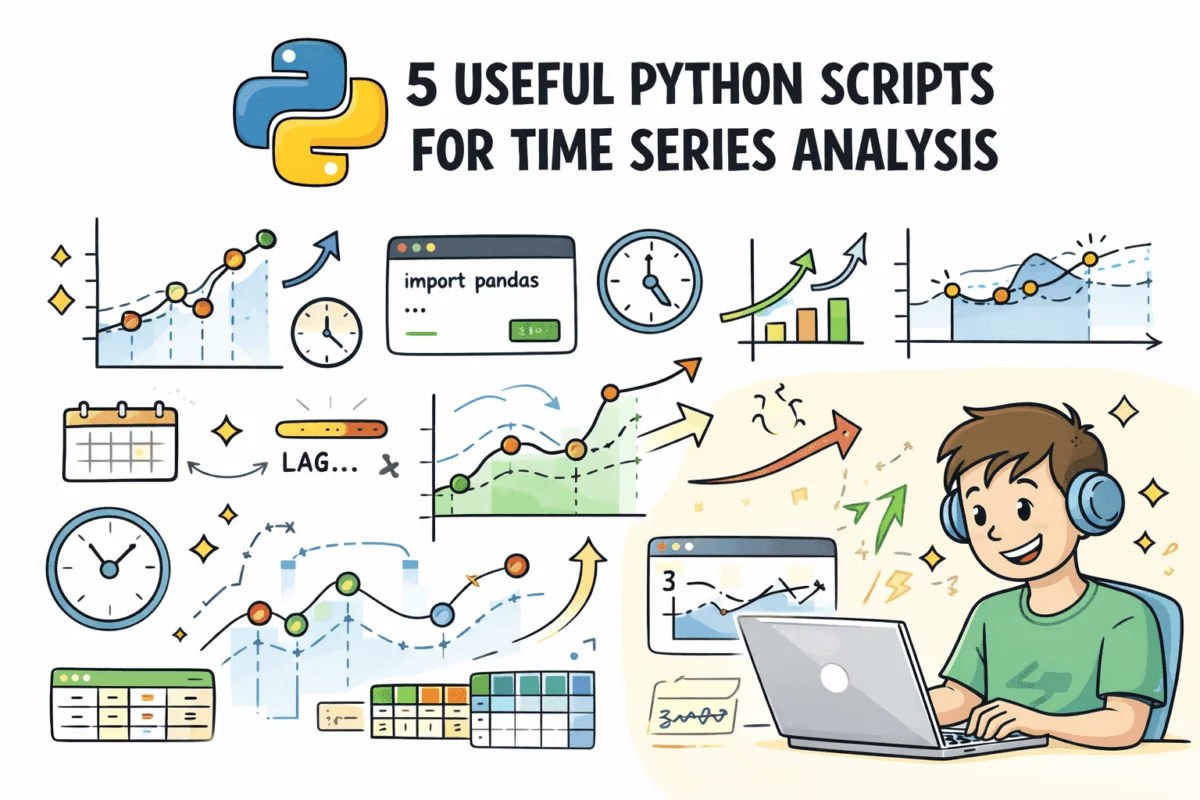
The relentless proliferation of data across virtually every sector of the global economy has underscored the critical importance of sophisticated analytical tools. Among the most prevalent and valuable forms of data is time series data, which captures observations recorded sequentially over time. From predicting stock market fluctuations and forecasting retail demand to monitoring industrial sensor outputs and diagnosing patient health trends, the ability to accurately analyze and interpret time series data is paramount for informed decision-making. However, working with this type of data presents a unique set of challenges, including irregularity, noise, seasonality, and complex interdependencies. Addressing these common hurdles, a new suite of five Python scripts, developed by Bala Priya C, offers data professionals a robust and accessible toolkit for streamlining key time series analysis tasks. These scripts, made available on GitHub, are designed to transform raw, often messy, time series inputs into actionable insights, thereby democratizing advanced analytical capabilities.
The Growing Imperative of Time Series Data Analysis
In an era defined by data-driven insights, the volume and velocity of time series data continue to escalate. Industries such as finance rely on granular second-by-second trading data to inform algorithmic strategies. Manufacturing and IoT deployments generate petabytes of sensor data crucial for predictive maintenance and operational optimization. Healthcare leverages patient vital signs and electronic health records to detect anomalies and anticipate medical events. Retail and e-commerce track sales, website traffic, and customer interactions over time to optimize inventory, personalize marketing, and forecast future demand.
Despite its immense potential, time series data is inherently complex. It rarely arrives in a perfectly clean, uniformly spaced format. Gaps, duplicate entries, and inconsistent timestamps are common, requiring meticulous preprocessing before any meaningful analysis can commence. Furthermore, embedded within this data are often multiple underlying components: a long-term trend, recurring seasonal patterns, and irreducible random noise. Distinguishing these components is vital for accurate interpretation and forecasting. The sheer scale of data also makes manual identification of anomalies impractical, while comparing multiple related series to understand their lead-lag relationships or co-movement can quickly become overwhelming. Python, with its rich ecosystem of libraries like Pandas, NumPy, Matplotlib, and Statsmodels, has emerged as the de facto language for data science, providing the computational backbone for tackling these challenges. These five scripts leverage this powerful ecosystem, offering pragmatic solutions to pervasive problems.
The Foundation: Ensuring Data Integrity and Consistency
The initial and often most time-consuming step in any time series analysis is data preparation. Real-world data is seldom pristine, and this is particularly true for time series, which can originate from diverse sources like continuous sensor feeds, discrete transaction logs, or irregularly updated databases. Without a consistent and clean dataset, subsequent analyses risk being inaccurate or misleading—a classic case of "garbage in, garbage out."
Script 1: Resampling and Aggregating Irregular Time Series Data
The first script, ts_resampler.py, directly addresses the fundamental issue of data irregularity. Time series data frequently arrives with non-uniform intervals; sensor readings might be taken every 17 seconds, while financial transactions occur at unpredictable times. Before applying any statistical models or even basic charting, it is essential to align the data to a consistent frequency, such as daily, hourly, or monthly. This process, known as resampling, standardizes the time index, making the data amenable to further analysis.
The script operates by taking a CSV or Excel file containing a datetime column and one or more value columns. It leverages the powerful resample() function from the Pandas library, which is a cornerstone for time series manipulation in Python. Users can specify the desired output frequency using standard Pandas frequency strings (e.g., ‘D’ for daily, ‘H’ for hourly, ‘M’ for monthly). Crucially, the script allows for per-column aggregation methods, recognizing that different data types require different aggregation strategies. For instance, a temperature series might be averaged (mean()) over an hour, while sales figures would be summed (sum()).
Beyond simple resampling, the script also intelligently handles missing intervals that arise after the resampling process. Options include forward-fill (carrying the last valid observation forward), interpolation (estimating missing values based on surrounding data points), or explicitly flagging gaps with NaN. A summary report detailing all changes and a gap report listing absent intervals in the original data ensure transparency and traceability. This foundational script is indispensable for establishing a clean, uniform dataset, laying the groundwork for all subsequent analytical steps and ensuring the reliability of any derived insights or models.
Safeguarding Analysis: Identifying and Mitigating Anomalies
Once the time series data is regularized, the next critical step is to identify and address any anomalous data points. A single outlier, whether a spurious sensor reading, a fraudulent transaction, or an erroneous data entry, can significantly skew averages, distort trend lines, and undermine the accuracy of predictive models. Manual detection of these anomalies becomes practically impossible as data volumes grow.
Script 2: Detecting Anomalies in Time Series Data
The ts_anomaly_detector.py script provides an automated and configurable solution for flagging unusual data points. It scans one or more numeric columns within a time series file and identifies values that deviate significantly from expected patterns. The script offers a choice of three widely recognized detection methods, each suited to different data characteristics and robustness requirements:
- Z-score Method: This statistical technique identifies anomalies based on how many standard deviations a data point is from the mean. Typically, points exceeding a configurable threshold (e.g., ±3 standard deviations) are flagged as outliers. It is effective for data that is approximately normally distributed.
- Interquartile Range (IQR) Method: More robust to extreme values, the IQR method flags points that fall outside 1.5 times the interquartile range (the difference between the 75th and 25th percentiles) above the upper quartile or below the lower quartile. This method is particularly useful for skewed distributions or data with existing outliers.
- Rolling Statistics Method: This adaptive approach computes a moving mean and standard deviation over a user-defined window. Data points that deviate significantly from this local context are flagged. This method is highly effective for time series exhibiting strong trends or seasonality, as it adapts to the changing baseline of the series rather than relying on a static global mean and standard deviation.
The script outputs an annotated file, clearly marking each flagged point and indicating which method identified it. An accompanying summary report provides an overview of detected anomalies. For visual inspection and validation, an optional --plot flag generates charts for each column, highlighting the anomalous points. By proactively identifying and addressing these outliers, data professionals can ensure that their analyses are based on reliable data, preventing misinterpretations and improving the integrity of downstream models and business decisions.
Unveiling Underlying Patterns: Decomposing Complexity
Many real-world time series are a composite of several distinct underlying forces. Understanding these individual components is crucial for gaining deeper insights into the data-generating process and for making more accurate forecasts. Without this decomposition, the interplay of trends, seasonality, and noise can obscure true patterns and drivers.
Script 3: Decomposing a Series into Trend, Seasonality, and Residuals
The ts_decompose.py script applies classical time series decomposition to disentangle these components. It separates the observed series into three fundamental elements:
- Trend Component: Represents the long-term progression of the series, indicating whether it is generally increasing, decreasing, or remaining stable over an extended period.
- Seasonal Component: Captures the regular, repeating patterns or cycles that occur within a fixed period (e.g., daily, weekly, monthly, yearly). This could be daily peak usage, weekly sales cycles, or annual holiday spikes.
- Residual Component: Represents the irregular, unpredictable fluctuations or noise in the series after the trend and seasonal components have been removed. This component is often what remains to be modeled by more advanced techniques or is indicative of random events.
The script leverages statsmodels.tsa.seasonal.seasonal_decompose(), a powerful function from the statsmodels library, a cornerstone of statistical modeling in Python. Users can configure the decomposition period, which is essential for accurately identifying seasonal patterns. The script supports both additive and multiplicative decomposition models:
- Additive Model: Assumes that the magnitude of seasonal fluctuations is constant over time, suitable for series where the seasonal variation does not change with the level of the trend (e.g.,
Observed = Trend + Seasonality + Residual). - Multiplicative Model: Assumes that the magnitude of seasonal fluctuations increases or decreases proportionally with the level of the trend, suitable for series where seasonal variation scales with the overall trend (e.g.,
Observed = Trend × Seasonality × Residual).
The output is an Excel file containing the original series alongside the three extracted components as separate columns. A multi-panel chart visually presents all four components stacked, offering an intuitive understanding of the series’ structure. This decomposition provides invaluable context for understanding the underlying dynamics of a time series, informing strategic decisions, and improving the accuracy of future forecasts by allowing analysts to model each component separately or to focus on the de-trended and de-seasonalized residuals.
Peering into the Future: Advanced Forecasting Capabilities
The ability to accurately forecast future values of a time series is arguably one of the most sought-after capabilities in data science. From inventory management and financial planning to resource allocation and risk assessment, reliable predictions drive strategic decision-making. However, building robust forecasting models typically involves a complex process of model selection, parameter tuning, and rigorous validation, often requiring specialized statistical expertise.
Script 4: Forecasting with Seasonal AutoRegressive Integrated Moving Average (SARIMA)
The ts_forecast.py script automates the process of generating forecasts using the Seasonal AutoRegressive Integrated Moving Average (SARIMA) model, a widely recognized and powerful statistical method for time series forecasting. SARIMA models are an extension of the ARIMA model, specifically designed to handle time series with both non-stationary trends and seasonal patterns. A SARIMA model is typically denoted as SARIMA(p,d,q)(P,D,Q)s, where:
- (p,d,q) refer to the non-seasonal components (AR order, differencing order, MA order).
- (P,D,Q) refer to the seasonal components (seasonal AR order, seasonal differencing order, seasonal MA order).
- s refers to the number of periods in each season.
The script utilizes statsmodels.tsa.statespace.sarimax.SARIMAX for model fitting, providing a robust and flexible framework. One of its most significant features is the optional --auto-order flag. When enabled, the script performs a lightweight grid search over a configurable range of ARIMA and seasonal parameters. It then selects the parameter combination that minimizes the Akaike Information Criterion (AIC), a statistical measure used for model comparison that balances model fit with complexity. This automation significantly reduces the manual effort and statistical expertise required to identify optimal model parameters, making SARIMA more accessible.
For rigorous validation, the time series is intelligently split into a training set and a held-out test set, with the size of the test set configurable by the user. The model is initially fitted on the training data, and its accuracy is reported on the test set using standard metrics such as Mean Absolute Error (MAE) and Root Mean Squared Error (RMSE). These metrics provide an objective assessment of the model’s predictive performance on unseen data. After validation, the final SARIMA model is re-fit on the entire series to produce the forward forecast for a user-specified number of periods. The output includes not only the point forecast but also 95% confidence intervals, providing a range within which future values are expected to fall. A comprehensive forecast chart is saved, visually depicting the historical series, the actuals versus predictions in the test period, and the forward forecast complete with confidence bands. This script empowers data professionals to generate statistically sound and transparent forecasts, critical for proactive planning and strategic decision-making across industries.
Understanding Interdependencies: Comparative Analysis of Multiple Series
In many complex systems, multiple time series interact and influence one another. For instance, sales of various products in a portfolio, performance metrics from different regions, or readings from an array of sensors are rarely independent. Understanding how these series move together, or whether one leads or lags another, is crucial for comprehensive analysis, causal inference, and system optimization. Merely plotting multiple series on the same chart often falls short of revealing these intricate relationships.
Script 5: Comparing Multiple Time Series
The ts_compare.py script is designed to systematically analyze and compare multiple time series within a single dataset. It takes a file containing several time series columns, aligns them to a common frequency (utilizing the resampling capabilities of Pandas), and then generates a multi-tab comparison report that delves into their interrelationships.
The script provides several key analytical outputs:
- Pairwise Correlations: It computes both Pearson and Spearman correlation coefficients for every pair of series. Pearson correlation measures linear relationships, while Spearman correlation assesses monotonic relationships, making it robust to non-linear associations and outliers. These correlations are presented in a clear matrix format within a dedicated tab of the output file.
- Lag Analysis (Cross-Correlation): This advanced feature computes the cross-correlation for each pair of series up to a configurable maximum lag. Cross-correlation is invaluable for identifying leading/lagging relationships, determining if changes in one series consistently precede or follow changes in another. For example, it could reveal if a marketing campaign (Series A) leads to a measurable increase in sales (Series B) after a certain number of days. The script identifies the specific lag at which each pair exhibits its strongest correlation, providing insights into potential causal or predictive relationships.
- Side-by-Side Summary Statistics: A dedicated tab presents essential descriptive statistics for each individual series, including mean, standard deviation, minimum, maximum, and trend direction. The trend direction is determined by the slope of a simple linear fit, offering a quick overview of each series’ long-term movement.
- Top Correlated Pairs Charts: To provide visual context, the script automatically generates dual-axis line charts for the top five most correlated pairs of series. These visualizations help analysts intuitively grasp the dynamics of the most strongly related series.
By providing a comprehensive comparative analysis, this script empowers data professionals to uncover hidden relationships, identify drivers, and understand the complex interplay within a collection of time series. This is vital for applications ranging from portfolio optimization and market basket analysis to system diagnostics and understanding complex ecological or sociological phenomena.
Broader Impact and Strategic Value: Empowering Data Professionals
Collectively, Bala Priya C’s five Python scripts represent a significant contribution to the data science community, offering a robust and accessible framework for handling the most common and challenging aspects of time series analysis. Their impact extends beyond mere computational efficiency, fostering a more rigorous and reliable approach to data-driven decision-making.
Firstly, these scripts democratize advanced time series analysis. By abstracting away much of the underlying statistical complexity and programming intricacies, they make powerful techniques like SARIMA forecasting and seasonal decomposition accessible to a broader audience of data analysts, business intelligence professionals, and domain experts who may not possess deep statistical modeling expertise. The emphasis on configurable parameters and clear outputs means that users can leverage these tools effectively with minimal setup and a focus on interpreting results.
Secondly, the scripts significantly enhance efficiency and reproducibility. Manual execution of these tasks, especially across numerous datasets or with varying parameters, is time-consuming and prone to human error. Automation through these scripts ensures consistency, reduces the likelihood of mistakes, and allows analysts to allocate more time to strategic thinking and insight generation rather than repetitive data manipulation. The clear configuration options and output formats also promote reproducibility, a cornerstone of sound scientific and analytical practice.
Finally, by addressing the entire workflow from data preparation and anomaly detection to decomposition, forecasting, and comparative analysis, the suite provides a cohesive toolkit. Data professionals can seamlessly integrate these scripts into their existing data pipelines, creating end-to-end solutions for monitoring, prediction, and strategic analysis. The open-source nature of these contributions further fosters community collaboration and continuous improvement, allowing for adaptations and enhancements over time.
Conclusion: A Robust Framework for Time Series Excellence
The increasing reliance on time series data across industries necessitates tools that are both powerful and user-friendly. Bala Priya C’s collection of five Python scripts—covering resampling, anomaly detection, decomposition, SARIMA forecasting, and multi-series comparison—provides exactly that. These scripts are not merely isolated utilities but form a comprehensive, logical workflow for navigating the complexities of time series data. They empower data professionals to move beyond basic visualizations and into sophisticated analytical territory, yielding deeper insights, more accurate predictions, and ultimately, better strategic outcomes.
As organizations continue to grapple with ever-growing volumes of temporal data, the adoption of such accessible and robust analytical frameworks will be crucial for maintaining a competitive edge and driving innovation. By streamlining complex tasks and promoting rigorous methodology, these Python scripts pave the way for a future where time series analysis is not just a specialized skill but a foundational component of intelligent, data-driven decision-making. Data professionals are encouraged to explore these tools, integrate them into their workflows, and leverage their capabilities to unlock the full potential of their time-dependent datasets.


















Leave a Reply