A collaborative research effort between the University of Vienna and the University of Duisburg-Essen has successfully demonstrated quantum interference in metallic nanoparticles of unprecedented size, marking a significant milestone in the ongoing quest to define the boundaries between the microscopic quantum world and the macroscopic classical world. The study, published in the prestigious journal Nature, details how researchers observed wave-like behavior in clusters of sodium atoms comprising up to 10,000 individual units. These particles, measuring approximately eight nanometers in diameter and weighing over 170,000 atomic mass units, represent some of the most massive objects ever to be placed in a state of quantum superposition.
The findings challenge long-held intuitions regarding the scale at which quantum mechanics operates. While the laws of quantum physics—which allow for particles to exist in multiple states or locations simultaneously—are routinely observed in electrons and small atoms, larger objects typically behave according to the deterministic laws of classical physics. This experiment effectively bridges that gap, showing that even "lumps of metal" visible under high-end electron microscopy can maintain quantum coherence under strictly controlled conditions.
The Evolution of Matter-Wave Interferometry
To understand the magnitude of this achievement, it is necessary to view it within the historical context of quantum theory. In 1924, French physicist Louis de Broglie proposed that all matter possesses wave-like properties, a concept known as wave-particle duality. This was first confirmed in 1927 through experiments with electrons. Over the following decades, scientists pushed this frontier further, demonstrating interference in increasingly complex systems, including neutrons, atoms, and small molecules.
In 1999, the University of Vienna group, led by Markus Arndt, made headlines by demonstrating quantum interference in "buckyballs"—spherical carbon molecules ($C_60$) consisting of 60 atoms. At the time, this was considered a massive leap. Since then, the group has steadily increased the complexity and mass of the particles under study. The recent transition from organic molecules to metallic sodium clusters represents a paradigm shift, as it moves the research from the realm of molecular chemistry into the territory of solid-state physics and materials science.
The current experiment utilized sodium clusters that are nearly 300 times heavier than those original buckyballs. By successfully observing interference in these clusters, the team has provided a rigorous test of the Schrödinger equation—the fundamental equation of quantum mechanics—at a scale where many theoretical physicists suspected "collapse models" might begin to take over.
Experimental Methodology: Creating the Superposition
The experimental setup required extreme precision to prevent the delicate quantum states from collapsing due to environmental interaction, a process known as decoherence. The researchers began by creating a beam of sodium clusters. Using a specialized source, sodium was heated and then expanded through a nozzle, causing the atoms to aggregate into clusters ranging from 5,000 to 10,000 atoms.
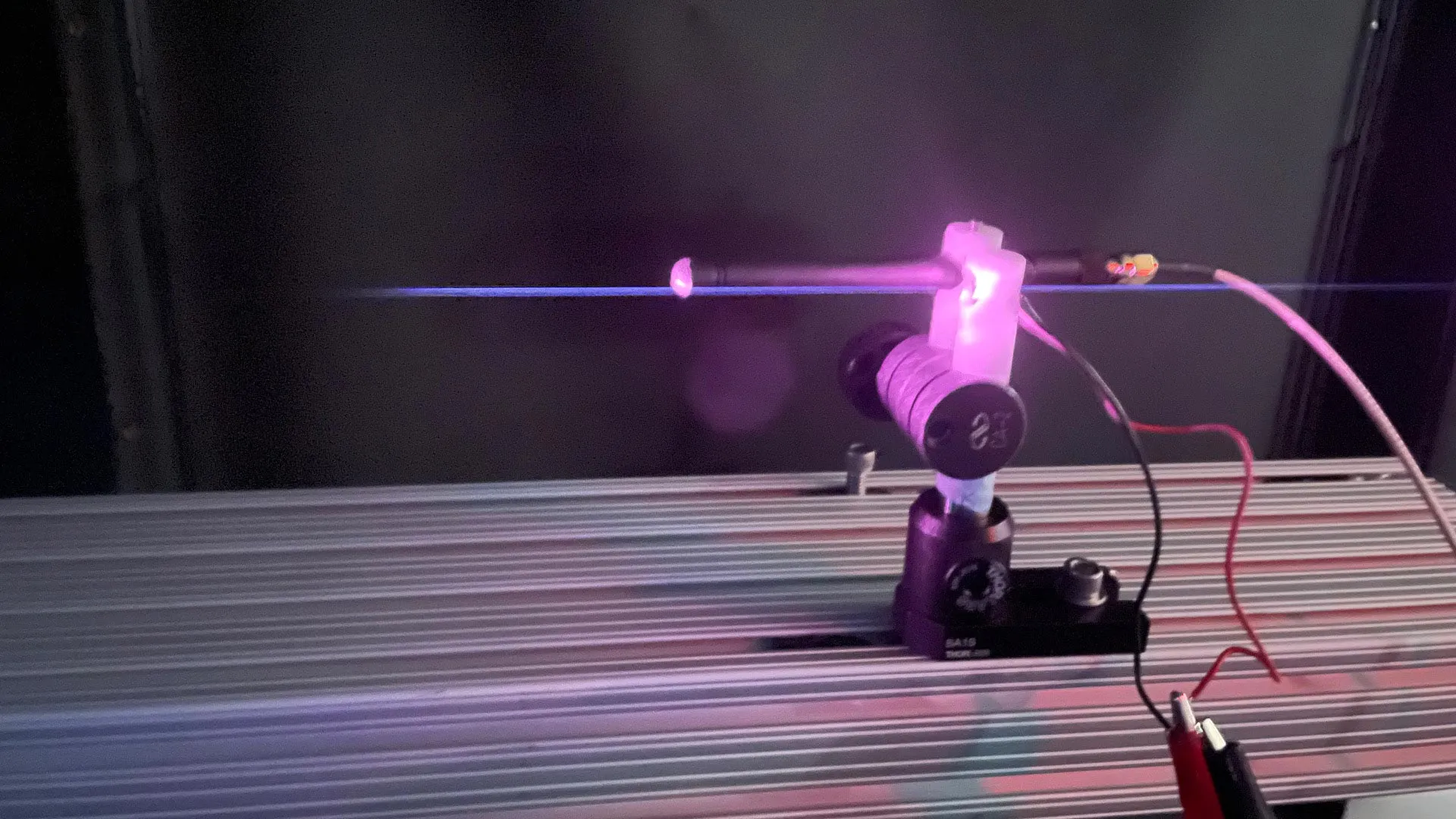
These clusters were then sent through a sophisticated "near-field" interferometer. Unlike traditional double-slit experiments that use physical barriers, this experiment employed three diffraction gratings formed by standing waves of ultraviolet (UV) laser light. This technique, known as Kapitza-Dirac-Talbot-Lau interferometry, is essential for large particles because physical gratings would be too fragile or would cause the particles to stick to the surface via Van der Waals forces.
- The First Grating: The first UV laser pulse effectively "prepares" the clusters, narrowing their position to an accuracy of approximately 10 nanometers. This forces the particles into a state of quantum uncertainty regarding their momentum.
- The Second Grating: As the clusters travel further, they encounter a second laser grating. Here, the "wave" associated with each cluster is split. In quantum terms, each cluster enters a superposition of paths, effectively traveling through multiple points in the grating simultaneously.
- The Third Grating: Finally, the different paths overlap and interfere with one another. A third laser grating is used to "read" the resulting pattern.
The result was a distinct interference pattern—a series of high-density and low-density regions—that could only be explained if each 170,000-amu cluster had behaved as a wave rather than a localized particle. The "Schrödinger cat" state achieved here meant that the center of mass of the metal lump was delocalized over a region dozens of times larger than the physical size of the particle itself.
Defining "Macroscopicity": A New World Record
One of the most critical aspects of the study is the use of a formal metric to quantify the "quantumness" of the experiment. Known as macroscopicity (denoted by the Greek letter $mu$), this scale was developed by co-author Klaus Hornberger and his colleague Stefan Nimmrichter. It provides a standardized way to compare different quantum experiments, taking into account the mass of the particles, the duration of the superposition, and the degree of delocalization.
The Vienna experiment achieved a macroscopicity value of $mu = 15.5$. To put this in perspective, this value is an order of magnitude higher than any previous interference experiment involving matter waves. The researchers noted that to achieve a similar level of "quantum stress" using a single electron, an experimenter would have to maintain the electron’s superposition for roughly 100 million years. The sodium clusters in this experiment reached that same threshold of quantum complexity in just one-hundredth of a second.
This high $mu$ value is significant because it allows physicists to rule out various "alternative" theories of physics. Some theorists have proposed that quantum mechanics is an incomplete theory and that at a certain mass or size, a "spontaneous collapse" occurs, forcing objects to choose a single location. By showing that quantum mechanics still holds at $mu = 15.5$, the team has narrowed the window in which these alternative theories could potentially exist.
Technical Challenges and Data Analysis
The success of the experiment hinged on the team’s ability to minimize decoherence. Large objects are highly susceptible to "measuring" themselves through their environment. For instance, if a nanoparticle collides with a single stray gas molecule or emits a single photon of thermal radiation, its quantum state is destroyed, and it begins to behave classically.
To counter this, the experiment was conducted in an ultra-high vacuum environment. Furthermore, the sodium clusters had to be kept extremely cold. Sodium was chosen specifically because of its optical properties; it interacts strongly with UV light, allowing the laser gratings to act as effective "slits" without requiring the clusters to be heated to high temperatures.
"The fact that we can see interference in a system this large tells us that the environment was sufficiently ‘quiet’ to allow the quantum wave to propagate," explained Sebastian Pedalino, the study’s lead author. "It confirms that there is no fundamental ‘size limit’ to quantum mechanics that we have yet reached."
Broader Impact and Future Applications
While the experiment was primarily a test of fundamental physics, the implications extend into the realm of practical technology. The University of Vienna’s interferometer is not just a tool for observation; it is also an incredibly sensitive force sensor. Because the interference pattern is highly dependent on any external influence, the device can detect forces as small as $10^-26$ Newtons.
This level of sensitivity opens several doors for future research:
- Precision Sensing: Future iterations of this technology could be used to measure extremely weak gravitational, electrical, or magnetic fields with unprecedented accuracy.
- Nanotechnology: Understanding how metallic clusters behave at the quantum level is vital for the development of next-generation electronic components, such as transistors that are reaching the single-digit nanometer scale.
- Testing Gravity: One of the holy grails of physics is understanding how gravity interacts with quantum mechanics. By using even larger masses in future experiments, researchers hope to eventually detect the gravitational pull between two particles in superposition, potentially shedding light on a theory of quantum gravity.
Conclusion and Next Steps
The team led by Arndt and Gerlich is already looking toward the next frontier. Plans are underway to upgrade the experimental infrastructure to accommodate even larger particles, possibly exceeding one million atomic mass units. Such experiments may require longer flight paths or even microgravity environments, such as those found on the International Space Station, to allow the particles more time to exhibit their wave-like nature before falling under the influence of Earth’s gravity.
The study concludes that as far as current technology can probe, the strange rules of the quantum world remain absolute. There is no evidence yet of a "magic boundary" where the quantum world ends and the classical world begins. Instead, it appears that the classical world we perceive is simply the result of massive objects constantly interacting with their environment, masking the underlying quantum reality that the Vienna team has so clearly brought to light.
By pushing the macroscopicity record to 15.5, the researchers have not only set a new benchmark for experimental physics but have also reaffirmed that the most fundamental laws of nature apply to the small and the (relatively) large alike. As Sebastian Pedalino noted, the experiment proves that a lump of metal can indeed be in two places at once—provided we are careful enough to let it.