For more than a century, the scientific community has grappled with the enigmatic nature of cosmic rays—high-energy particles that permeate the universe, traveling at nearly the speed of light. Despite being discovered in 1912, these particles have largely kept the secrets of their origins and acceleration mechanisms hidden. However, a landmark study published in the journal Nature has provided a definitive breakthrough. Utilizing data from the Dark Matter Particle Explorer (DAMPE), an international team of researchers has identified a universal "spectral softening" across various types of cosmic ray nuclei. This discovery suggests that the behavior and movement of these particles are governed by their magnetic rigidity rather than their individual mass or energy per nucleon, providing a vital piece of the puzzle in understanding the high-energy laboratory that is our universe.
The Phenomenon of Cosmic Rays and the DAMPE Mission
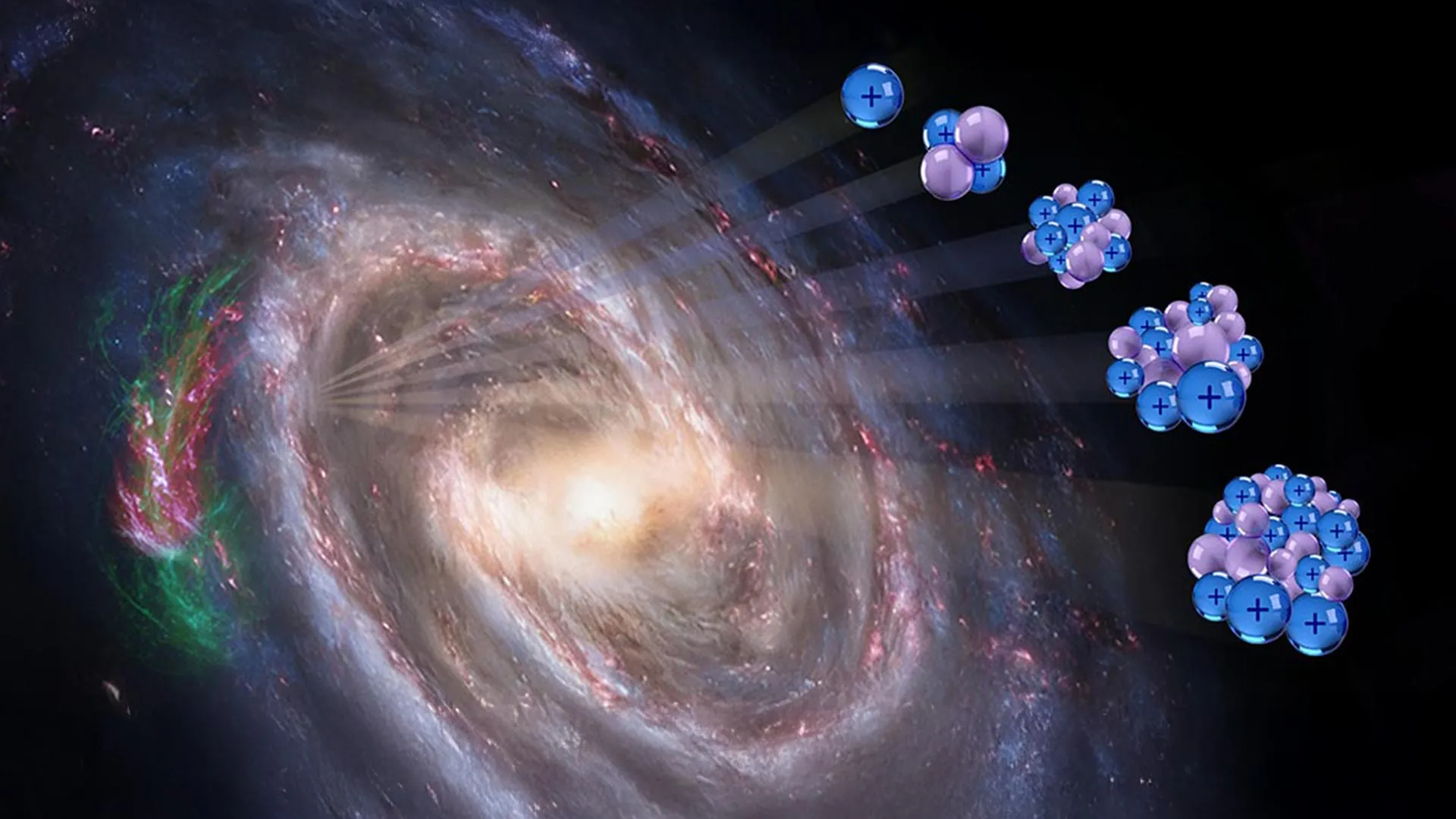
Cosmic rays are not actually rays in the traditional sense, such as light or X-rays; they are the nuclei of atoms—primarily protons, but also heavier elements like helium, carbon, oxygen, and iron—stripped of their electrons and accelerated to incredible velocities. They represent the highest energy particles ever observed, often carrying kinetic energies millions of times greater than what can be achieved in the Large Hadron Collider (LHC) at CERN.
The sources of these particles are believed to be the most cataclysmic events in the cosmos. Supernova remnants, where massive stars explode at the end of their lives, are considered the primary "factories" for cosmic rays within our galaxy. Other potential sources include the powerful jets emitted by supermassive black holes at the centers of distant galaxies and the intense magnetic fields of rapidly rotating neutron stars known as pulsars.
To study these elusive particles, the DAMPE satellite—nicknamed "Wukong" after the Monkey King of Chinese mythology—was launched in December 2015. Positioned in a sun-synchronous orbit approximately 500 kilometers above the Earth, DAMPE was designed with a specific set of objectives: to search for signatures of dark matter annihilation, to study high-energy gamma rays, and to measure the spectra of cosmic ray nuclei with unprecedented precision. The mission is a collaborative effort involving the Chinese Academy of Sciences (CAS), the University of Geneva (UNIGE) in Switzerland, and several Italian research institutions.
A Universal Pattern in Particle Acceleration
The core of the recent discovery lies in the analysis of the energy spectra of various cosmic ray nuclei. Traditionally, scientists expected that as the energy of cosmic rays increases, their abundance would decrease following a smooth, predictable power-law curve. However, the DAMPE data revealed a distinct deviation from this expectation.
As particles reach a certain energy threshold, the number of detected particles begins to drop significantly faster than predicted. This phenomenon, known as "spectral softening," was observed by the DAMPE team across a wide range of nuclei, from the lightest (protons) to the heavier (iron). Crucially, the researchers found that this softening occurs at a consistent "rigidity" of approximately 15 teravolts (TV).
In astrophysics, rigidity is a measure of a charged particle’s momentum relative to its electric charge. It describes how effectively a particle can resist being deflected by magnetic fields. The fact that the softening occurs at the same rigidity for all nuclei—regardless of their mass—is a game-changing observation. It strongly implies that the processes responsible for accelerating these particles and the mechanisms by which they propagate through the interstellar magnetic fields of the Milky Way are fundamentally tied to their magnetic rigidity.
According to Andrii Tykhonov, associate professor at the Department of Nuclear and Particle Physics (DPNC) at the University of Geneva and a co-author of the study, this finding effectively narrows down the theoretical possibilities for cosmic ray origins. The data provides a confidence level of 99.999%—the "five-sigma" gold standard in physics—against alternative models that suggest acceleration is based on energy per nucleon (the total energy divided by the number of protons and neutrons).
The Role of Advanced Technology and AI in Discovery
The precision of the DAMPE findings was made possible by the Silicon-Tungsten Tracker (STK), an instrument developed largely by the Geneva group. The STK is responsible for reconstructing the precise trajectories of incoming particles and identifying their electric charge. Because cosmic rays are charged, their paths are bent by galactic magnetic fields, making it impossible to "point" back to their source like a telescope does with light. Instead, researchers must rely on the STK’s ability to differentiate between species of nuclei and measure their entry angles with extreme accuracy.
Furthermore, the sheer volume of data collected by DAMPE—billions of events over several years—required the development of sophisticated machine learning algorithms. The University of Geneva team spearheaded the creation of artificial intelligence models capable of filtering out "noise" and accurately reconstructing complex particle interactions within the detector. These AI tools allowed the researchers to distinguish between primary cosmic rays (those accelerated at the source) and secondary cosmic rays (those created when primary rays collide with interstellar gas), a distinction vital for understanding the true nature of the 15 TV softening.
A Chronology of Cosmic Ray Exploration
To appreciate the magnitude of the DAMPE discovery, one must look at the timeline of cosmic ray research:
- 1912: Victor Hess discovers cosmic rays during a series of high-altitude balloon flights, proving that ionizing radiation increases with altitude and must originate from outer space.
- 1930s-1950s: Researchers identify that cosmic rays are mostly protons and discover the "primary" and "secondary" components of the flux.
- 1958: The discovery of the "knee" in the cosmic ray spectrum at roughly 3 peta-electronvolts (PeV) suggests a limit to the acceleration power of galactic sources like supernovae.
- 2011: The Alpha Magnetic Spectrometer (AMS-02) is installed on the International Space Station, providing high-precision data on cosmic ray composition at lower energies.
- 2015: DAMPE is launched, specifically targeting the "intermediate" to "high" energy range (GeV to TeV) where previous detectors lacked sufficient resolution.
- 2017-2021: DAMPE publishes groundbreaking measurements of proton and helium spectra, hinting at the spectral features now confirmed as universal.
- 2024: The current study in Nature confirms the 15 TV rigidity softening across the full spectrum of nuclei, providing a unified theory for galactic cosmic ray behavior.
Scientific Implications and Expert Reactions
The confirmation of rigidity-dependent softening has profound implications for our understanding of the "Galactic Accelerator." If the softening is indeed a universal feature, it suggests one of two things: either the sources themselves (such as supernova remnants) have a physical limit to how much they can accelerate particles based on their magnetic field strength, or the way these particles escape the galaxy is more efficient at higher rigidities.
Dr. Tykhonov noted that these results "place much tighter limits on existing models of particle acceleration." For decades, theorists have debated whether the observed changes in cosmic ray flux were due to local "bubbles" in the interstellar medium or intrinsic properties of the sources. The DAMPE data points toward a more fundamental, universal physical process.
While the scientific community has reacted with excitement, some researchers emphasize that this is not the end of the journey. "While we have found a common pattern at 15 TV, we still need to bridge the gap between these energies and the ‘knee’ at 3 PeV," stated an independent astrophysicist familiar with the study. "DAMPE has given us the map; now we need to find the engine."
Broader Impact on Dark Matter and Future Research
Beyond the study of nuclei, the DAMPE mission remains a critical tool in the hunt for dark matter. Dark matter is thought to make up about 85% of the matter in the universe, yet it does not emit light and has never been directly detected. Some theories suggest that dark matter particles might annihilate or decay, producing high-energy cosmic rays (specifically electrons and positrons) in the process.
By establishing a "baseline" for how normal matter (protons and nuclei) behaves at high energies, the DAMPE team is better equipped to spot anomalies that could signal the presence of dark matter. If the team observes an excess of particles that cannot be explained by the rigidity-dependent models confirmed in this latest study, it could provide the first indirect evidence of the universe’s most mysterious substance.
As DAMPE continues its mission, the focus will shift toward even higher energies and rarer nuclei. The success of the STK instrument and the AI reconstruction methods has also set a new standard for future space-based observatories. Plans are already being discussed for next-generation detectors that will carry even larger "calorimeters" to stop and measure the most energetic particles in the galaxy.
In conclusion, the DAMPE telescope’s discovery of a shared 15 TV rigidity threshold marks a turning point in high-energy astrophysics. It transforms cosmic rays from a collection of individual mysteries into a cohesive field of study governed by universal laws of electromagnetism and motion. As these particles continue to rain down on Earth, scientists are finally beginning to speak their language, bringing us one step closer to understanding the violent, high-energy foundations of the cosmos.