Quantum entanglement, a phenomenon Albert Einstein famously dismissed as "spooky action at a distance," has transitioned from a foundational mystery of physics to the bedrock of a burgeoning technological revolution. In the quantum realm, particles such as photons can become so intrinsically linked that the state of one cannot be described independently of the others, regardless of the distance separating them. This non-classical correlation is the essential fuel for quantum computing, ultra-secure communication, and the eventual realization of a global quantum internet. However, utilizing these states requires more than just their creation; it requires the ability to identify and verify them with precision.
A major hurdle in this field has been the "measurement problem." While scientists have long been able to generate various forms of entanglement, verifying the specific nature of a multi-photon state has remained computationally expensive and technically grueling. A collaborative research effort between Kyoto University and Hiroshima University has recently overcome a significant portion of this challenge by successfully demonstrating the first-ever "entangled measurement" for the W state, a specific and robust class of multi-photon entanglement. This breakthrough, coming more than a quarter-century after similar methods were developed for other states, provides a vital tool for the next generation of quantum information processors.
The Complexity of Quantum State Verification
To understand the significance of the Kyoto-Hiroshima breakthrough, one must first look at the traditional methods used to analyze quantum systems. The gold standard has long been quantum state tomography. Much like a medical CT scan creates a three-dimensional image of an organ by taking multiple two-dimensional X-rays from different angles, quantum tomography estimates a quantum state by performing a vast array of independent measurements on identical copies of the state.
While effective for small systems, tomography suffers from the "curse of dimensionality." As the number of photons in an entangled system increases, the number of measurements required to verify the state grows exponentially. For a system of only a few dozen photons, the time and computational power required for tomography would exceed the age of the universe. This "bottleneck," as researchers describe it, has hindered the scaling of quantum networks.
The alternative is an "entangled measurement." Unlike tomography, which looks at particles one by one to piece together the whole, an entangled measurement interacts with the system as a single entity. It allows researchers to identify specific entangled states in a "single shot," significantly reducing the resources required. While this was achieved for the Greenberger-Horne-Zeilinger (GHZ) state in the late 1990s, the W state remained elusive due to its more complex mathematical structure and lower degree of symmetry.
Distinguishing the W State from the GHZ State
In the landscape of quantum mechanics, not all entanglement is created equal. The two primary "species" of multi-partite entanglement for qubits are GHZ states and W states.
The GHZ state is often described as an "all-or-nothing" form of entanglement. In a three-photon GHZ state, all three particles are deeply linked; however, if one photon is lost or measured, the entanglement between the remaining two vanishes instantly. This makes GHZ states highly sensitive, which is useful for certain types of high-precision sensing but problematic for long-distance communication where particle loss is common.
The W state, by contrast, is remarkably robust. If one photon is lost from a three-photon W state, the remaining two photons retain a degree of entanglement. This resilience makes the W state the preferred candidate for quantum communication protocols and distributed quantum computing, where maintaining a link despite hardware imperfections or signal attenuation is critical. Despite its utility, the W state lacks the simple bit-flip symmetry of the GHZ state, making it far more difficult to design a measurement device capable of identifying it directly.
The Path to the Breakthrough: Cyclic Shift Symmetry
The research team, led by corresponding author Shigeki Takeuchi of Kyoto University, realized that the key to unlocking the W state lay in a property known as cyclic shift symmetry. In a W state, the quantum information is distributed such that shifting the position of the photons in a cycle (e.g., photon 1 to position 2, photon 2 to position 3, and photon 3 to position 1) leaves the overall state essentially unchanged.
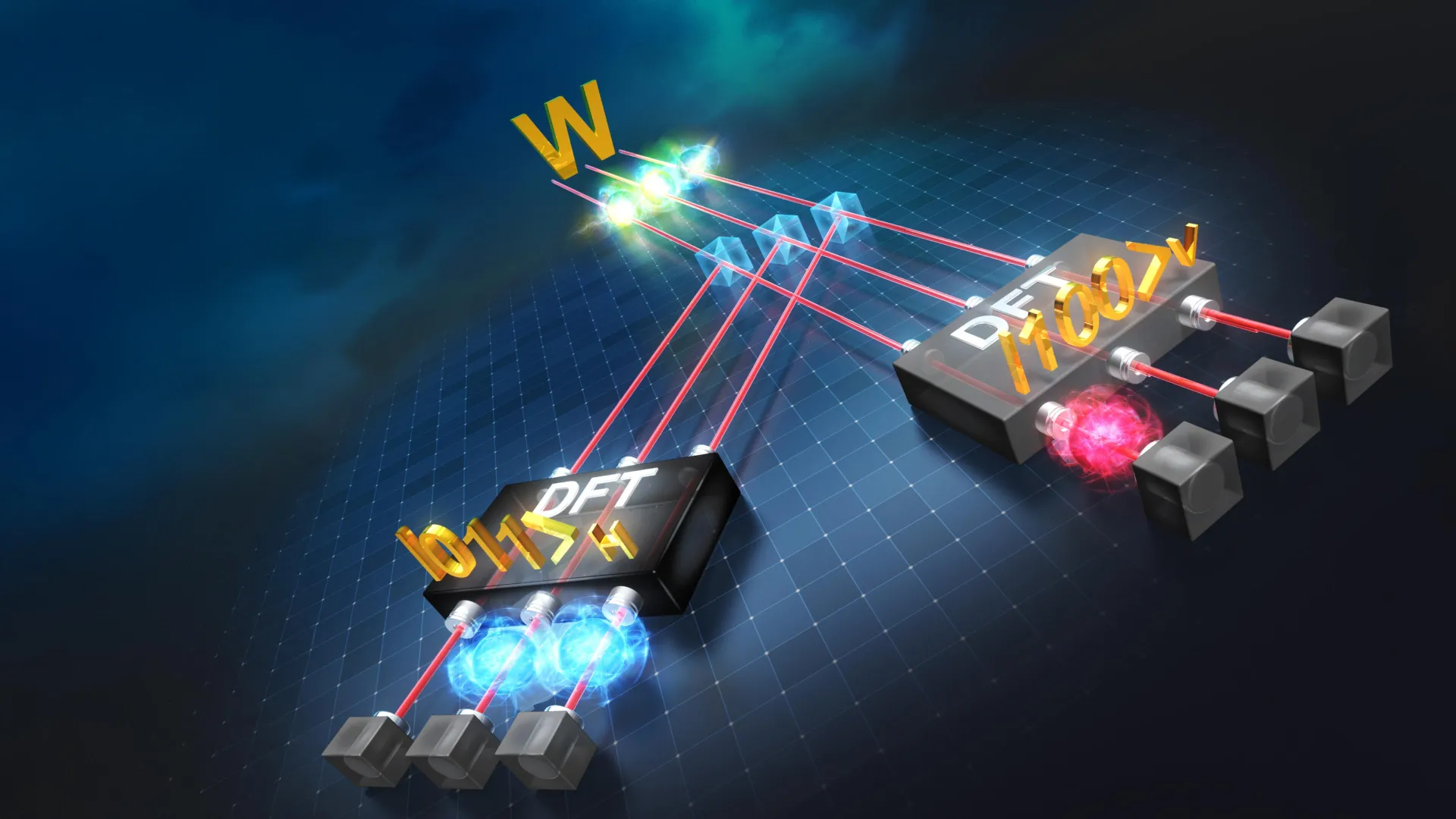
By leveraging this symmetry, the team proposed and constructed a specialized photonic quantum circuit. This circuit performs a quantum Fourier transformation specifically tailored for W states. In essence, the device acts as a filter or a prism: it takes incoming photons and, based on their collective entangled properties, routes them toward specific detectors.
"More than 25 years after the initial proposal concerning the entangled measurement for GHZ states, we have finally obtained the entangled measurement for the W state as well," stated Takeuchi. "This is a genuine experimental demonstration for 3-photon W states that turns a hidden quantum structure into a measurable, macroscopic signal."
Experimental Execution and Stability
The experimental setup involved the use of highly stable optical quantum circuits. Stability is a paramount concern in quantum optics; even the slightest vibration or temperature fluctuation can decohere a quantum state, turning a sophisticated entangled system into random noise.
The Kyoto and Hiroshima team engineered a device that could operate for extended periods without the need for active, high-frequency adjustments. This move away from "fragile" laboratory setups is a necessary step for the commercialization of quantum technology. In the experiment, three single photons were prepared in specific polarization states—the direction in which the light waves vibrate—and injected into the circuit.
The researchers then evaluated the "fidelity" of the measurement. In quantum mechanics, fidelity is a measure of how close a realized state (or measurement) is to the theoretical ideal. The team’s device successfully distinguished between different types of three-photon W states, confirming that the non-classical correlations were correctly identified. This success proves that the quantum Fourier transform approach is a viable pathway for reading complex multi-particle information.
Timeline of Entanglement Milestones
The journey to this discovery is part of a century-long timeline of quantum exploration:
- 1935: Albert Einstein, Boris Podolsky, and Nathan Rosen publish the "EPR paper," highlighting the "paradox" of entanglement.
- 1964: John Bell proposes Bell’s Theorem, providing a way to experimentally test if quantum mechanics or classical "hidden variables" govern the universe.
- 1980s: First successful experimental tests of Bell’s inequalities using photon pairs.
- 1999: Scientists propose and demonstrate entangled measurements for GHZ states, paving the way for quantum secret sharing.
- 2024-2025: The Kyoto and Hiroshima team develops and demonstrates the W state entangled measurement.
- 2026 and Beyond: Integration of these measurements into urban quantum networks and on-chip photonic devices.
Broader Impact: From New York to Hybrid Networks
The achievement by the Japanese team does not exist in a vacuum. It is a critical piece of a global puzzle currently being assembled by researchers worldwide. For instance, in late 2025, a separate milestone was reached when researchers demonstrated all-photonic quantum teleportation using photons generated by quantum dots within a hybrid urban network. This experiment proved that quantum information could be moved across real-world city infrastructure.
Similarly, in 2026, a team in the United States successfully tested a three-node quantum network across existing fiber-optic cables in New York City. By using a process called entanglement swapping, they were able to connect separate quantum links into a cohesive network.
The Kyoto-Hiroshima breakthrough provides the "diagnostic tool" these networks need. As these infrastructures grow from three nodes to hundreds, the ability to verify W states—the very states that provide the robustness needed for fiber-optic transmission—will be indispensable. Without the ability to perform single-shot entangled measurements, verifying the health of a city-wide quantum network would be mathematically impossible.
Analysis of Implications for Quantum Computing
Beyond communication, this work has profound implications for measurement-based quantum computing (MBQC). In traditional quantum computing, gates are applied to qubits in a controlled sequence. In MBQC, the process begins with a highly entangled "cluster state," and the computation is performed by making successive measurements on the particles.
The ability to perform entangled measurements on W states expands the toolkit available for MBQC. It allows for more complex "resource states" to be used, potentially leading to more efficient error-correction codes. Because W states are more resilient to the loss of a qubit than GHZ states, computers based on W-state logic could theoretically be more "fault-tolerant," requiring less overhead to correct for the inevitable errors that occur in quantum hardware.
Future Directions: Scaling and On-Chip Integration
The team at Kyoto University and Hiroshima University is already looking toward the next horizon. The current experiment utilized three photons, but the mathematical framework based on cyclic shift symmetry is scalable. The researchers plan to extend the method to four, five, and eventually dozens of photons.
Furthermore, the team aims to transition from bulky, table-top optical setups to integrated photonic chips. In 2026, related research reported the creation of a chip capable of generating and manipulating multipartite entanglement on a single substrate. Integrating the W-state measurement circuit onto such a chip would allow for the creation of "plug-and-play" quantum sensors and routers.
"In order to accelerate the research and development of quantum technologies, it is crucial to deepen our understanding of basic concepts to come up with innovative ideas," Takeuchi emphasized.
As the world moves toward the "Quantum Age," the ability to read the language of entanglement with the same ease that we read binary code will be the defining factor of success. By mastering the elusive W state, researchers have brought the dream of a reliable, scalable quantum internet one significant step closer to reality. This work ensures that when the first global quantum network is switched on, we will have the tools necessary to verify that the "spooky" links connecting us are exactly what they are supposed to be.