

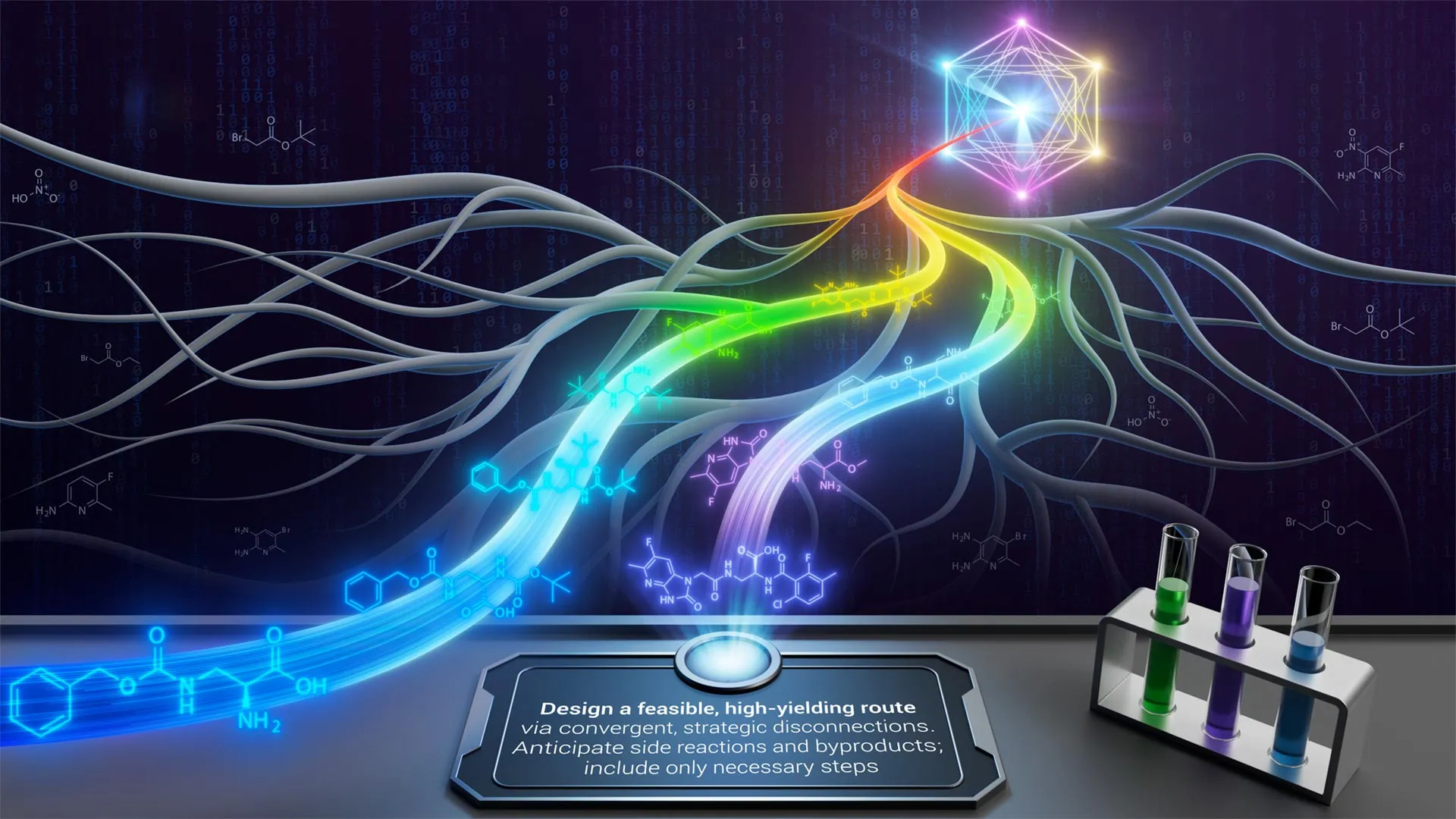
The process of molecular synthesis stands as one of the most intellectually demanding frontiers in modern science, requiring a sophisticated blend of rigorous logic, deep theoretical knowledge, and intuitive strategy. Whether the objective is the development of a novel pharmaceutical compound to combat a burgeoning health crisis or the engineering of advanced polymers for sustainable technology, the path from concept to physical molecule is fraught with complexity. Historically, this path has been navigated through "retrosynthesis," a strategic methodology where chemists work backward from a target structure to identify simpler, commercially available precursors. However, the sheer volume of potential chemical transformations—often referred to as "chemical space"—presents a combinatorial explosion that has long challenged both human experts and traditional computational tools.
In a significant leap for the field of molecular informatics, researchers at the École Polytechnique Fédérale de Lausanne (EPFL), led by Professor Philippe Schwaller, have introduced a transformative framework named Synthegy. This system leverages the reasoning capabilities of Large Language Models (LLMs) to act as an intelligent bridge between natural language instructions and complex computational chemistry algorithms. By allowing scientists to guide synthetic planning through everyday language, Synthegy addresses a long-standing bottleneck in the digital transformation of chemistry: the rigid and often unintuitive nature of traditional software interfaces.
The Evolution of Computational Retrosynthesis
To understand the impact of Synthegy, one must first consider the historical context of retrosynthetic analysis. The concept was formalized in the mid-20th century, most notably by Nobel Laureate Elias James Corey, who introduced systematic rules for breaking down complex molecules. For decades, the primary tools for this task were rule-based expert systems. These programs relied on vast databases of known chemical reactions, manually curated by chemists. While groundbreaking, these systems were limited by their inability to generalize beyond the specific rules encoded within them.
The advent of machine learning and deep learning in the 2010s introduced a new era of "data-driven" retrosynthesis. These models could predict reaction outcomes by learning patterns from millions of published reactions. Yet, even with these advancements, a critical gap remained. Chemistry is not merely about predicting a single step; it is about the strategic orchestration of a multi-step sequence. Traditional AI tools often suggested "chemically valid" steps that were strategically nonsensical—for instance, suggesting a reaction that would inadvertently destroy a sensitive part of the molecule elsewhere.
Furthermore, the user interface for these tools remained a barrier. Chemists were often required to navigate complex parameter settings, cumbersome filters, and rigid input formats. Synthegy shifts this paradigm by positioning the LLM not as a generator of molecules, but as an evaluator and strategic guide that understands the nuances of chemical intent.
The Synthegy Framework: Natural Language as a Strategic Tool
Synthegy operates on the principle that while specialized algorithms are excellent at searching through millions of possibilities, LLMs are uniquely adept at reasoning and following complex instructions. The framework functions as a multi-layered system. When a chemist provides a target molecule and a set of strategic constraints—such as "avoid using toxic reagents" or "prioritize routes that form the central ring system in the early stages"—Synthegy translates these instructions into a guided search.
The process begins with a traditional retrosynthesis engine generating a wide array of potential synthetic pathways. In a standard setup, a chemist would have to manually sort through hundreds of these routes, many of which might be impractical. Synthegy automates this by converting each proposed pathway into a text-based representation. The LLM then analyzes these descriptions against the user’s original natural language prompt.
This "reasoning" step is where the LLM excels. It can identify functional group incompatibilities, assess the elegance of a synthetic sequence, and determine if the proposed route aligns with the overarching strategy. By scoring and ranking these pathways, Synthegy provides the chemist with a refined list of the most viable options, complete with explanations for why certain routes were prioritized over others.
Expanding Into Reaction Mechanisms
Beyond the macro-level planning of retrosynthesis, Synthegy also tackles the micro-level intricacies of reaction mechanisms. Understanding a mechanism—the step-by-step movement of electrons that transforms reactants into products—is essential for optimizing yields and predicting the behavior of new reactions.
Computational chemistry has traditionally relied on high-level quantum mechanical calculations to explore these pathways. While accurate, these methods are computationally expensive and time-consuming. Synthegy offers a more agile alternative by breaking down reactions into elementary electron-pushing steps. The LLM evaluates these steps to ensure they adhere to established chemical principles, such as the octet rule or the stability of intermediates like carbocations.
This capability allows researchers to incorporate expert hypotheses directly into the computational search. If a chemist suspects that a reaction proceeds through a specific intermediate, they can state this in plain English. Synthegy will then steer its mechanical exploration to validate or refute that specific pathway, effectively serving as a digital sounding board for experimental theories.
Data-Driven Validation and Performance Metrics
The efficacy of Synthegy was put to the test in a rigorous double-blind study involving 36 professional chemists. The objective was to determine if the AI’s strategic judgments aligned with those of human experts. The participants were presented with various synthetic routes and asked to evaluate them based on feasibility, efficiency, and adherence to specific strategic goals.
The results, published in the journal Matter, demonstrated a high level of synergy between man and machine. On average, the assessments provided by the chemists agreed with Synthegy’s internal scoring 71.2% of the time. This level of agreement is particularly noteworthy given that synthetic organic chemistry is often subjective, with different experts preferring different "styles" of synthesis.
The study also revealed insights into the scaling of AI models in chemistry. The researchers found that larger models, which possess more extensive training data and better reasoning capabilities, significantly outperformed smaller iterations. These larger models were able to flag unnecessary protecting group steps—a common inefficiency in synthesis—and accurately judge the feasibility of complex ring-closing reactions. This suggests that as LLMs continue to evolve, their utility in specialized scientific domains will only increase.
Official Responses and Industry Perspectives
The development of Synthegy has been met with optimism from the academic and industrial sectors. Andres M. Bran, the first author of the study and a researcher at EPFL, emphasized the importance of the user experience in scientific software. "When making tools for chemists, the user interface matters a lot," Bran stated. "With Synthegy, we’re giving chemists the power to just talk, allowing them to iterate much faster and navigate more complex synthetic ideas."
Industry analysts suggest that this technology could have a profound impact on the early stages of drug discovery. In the pharmaceutical industry, the "hit-to-lead" phase involves synthesizing hundreds of analogs of a promising compound to test their biological activity. If Synthegy can reduce the time spent planning these syntheses by even 20%, it could save millions of dollars in research costs and accelerate the timeline for bringing new medicines to market.
Furthermore, Professor Philippe Schwaller noted that the framework’s ability to bridge the gap between synthesis planning and reaction mechanisms is a key milestone. By providing a unified natural language interface for both tasks, Synthegy allows for a more holistic approach to molecular design, where the "how" of a reaction informs the "what" of the synthesis.
Broader Implications and the Future of AI-Augmented Chemistry
The introduction of Synthegy represents a shift in the role of AI in the laboratory. Rather than attempting to replace the chemist, the system acts as a sophisticated assistant that handles the "heavy lifting" of data processing and initial screening, leaving the high-level decision-making to the human expert.
One of the most significant implications of this research is the democratization of advanced chemical tools. Currently, high-end retrosynthesis software requires significant training to use effectively. By lowering the barrier to entry through a natural language interface, Synthegy could allow biologists, materials scientists, and junior chemists to engage with complex synthetic planning that was previously the sole domain of specialized organic chemists.
As the framework continues to be refined, several future directions are evident. The integration of real-time laboratory data could allow Synthegy to learn from failed experiments, further sharpening its predictive accuracy. Additionally, the incorporation of "green chemistry" metrics into the natural language reasoning could help scientists prioritize more sustainable and less hazardous synthetic routes automatically.
In conclusion, Synthegy stands as a testament to the power of interdisciplinary innovation. By combining the linguistic flexibility of Large Language Models with the precision of chemical algorithms, the researchers at EPFL have created a tool that mirrors the way chemists actually think. As the chemical industry continues to grapple with the challenges of the 21st century—from climate change to global health—tools like Synthegy will be indispensable in the quest to build the molecules that define our future.















Leave a Reply