


The quest to understand the fundamental building blocks of reality has led physicists from the tangible world of macroscopic objects to the enigmatic realm of subatomic particles. If one were to take a common apple and divide it continuously, the journey would pass through cells, molecules, and atoms, eventually reaching the protons and neutrons that constitute the nucleus. Deeper still lie quarks and gluons, the elementary particles of the Standard Model. However, for decades, theoretical physicists have proposed that the journey does not end there. At the Planck scale—a realm roughly a billion billion times smaller than a proton—the universe may not be composed of point-like particles at all, but of unimaginably small, vibrating filaments known as strings.
A new study titled "Strings from Almost Nothing," recently accepted for publication in the journal Physical Review Letters, marks a significant milestone in validating this perspective. Researchers from the California Institute of Technology (Caltech), New York University (NYU), and the Institut de Física d’Altes Energies (IFAE) in Barcelona have utilized a mathematical strategy known as the "bootstrap" to demonstrate that the core features of string theory emerge naturally from a few basic physical principles. This discovery suggests that string theory may not just be one possible model of the universe, but perhaps the only mathematically consistent way to reconcile the laws of physics at extreme energies.
The Convergence of Quantum Mechanics and General Relativity
The fundamental motivation behind string theory is the resolution of the greatest schism in modern science: the incompatibility between quantum mechanics and general relativity. Quantum mechanics provides an exceptionally accurate framework for understanding the three non-gravitational forces—electromagnetism, the strong nuclear force, and the weak nuclear force—which govern the behavior of subatomic particles. Conversely, Albert Einstein’s general relativity describes gravity as the curvature of spacetime, providing the framework for understanding planets, stars, and the large-scale structure of the cosmos.
The conflict arises when physicists attempt to apply gravity to the quantum scale. In the standard framework of point-like particles, the equations describing gravitational interactions at extremely high energies result in "mathematical infinities." These infinities signal a breakdown in the theory, suggesting that our understanding of physics is incomplete. String theory offers a resolution by replacing zero-dimensional points with one-dimensional strings. Because strings have a finite length, they "smear" out interactions in spacetime, preventing the mathematical singularities that plague traditional quantum gravity models.
In string theory, every particle in the universe—including the hypothetical graviton, the messenger particle of gravity—is simply a different vibrational mode of a single type of fundamental string. Much like a guitar string produces different musical notes depending on its tension and vibration, these cosmic strings manifest as different particles depending on their frequency.
A Historical Timeline: From Hadrons to the Theory of Everything
To understand the significance of the "Strings from Almost Nothing" study, it is essential to trace the chronological development of the theory.
- 1968: The Birth of the Theory. Gabriele Veneziano, a theoretical physicist at CERN, discovered a mathematical formula (now known as the Veneziano amplitude) that described the interaction of hadrons—particles like protons and neutrons. He noticed that the particles appeared in an "infinite tower" where their mass and spin increased in a specific, orderly sequence.
- 1970: The String Interpretation. Leonard Susskind, Holger Bech Nielsen, and Yoichiro Nambu independently realized that Veneziano’s mathematical "tower" could be physically explained if the particles were actually tiny vibrating strings.
- 1974: The Inclusion of Gravity. Caltech’s John Schwarz and Joël Scherk of the École Normale Supérieure made the groundbreaking discovery that one of the vibrational modes of a closed string possessed the exact properties required for a graviton. This transformed string theory from a niche theory of hadrons into a candidate for a "Theory of Everything."
- 1984: The First Superstring Revolution. Schwarz and Michael Green proved that string theory was free of the mathematical anomalies that had previously hindered its progress, sparking an explosion of interest in the field.
- 1995: The Second Superstring Revolution. Edward Witten proposed M-theory, suggesting that the five competing versions of string theory were actually different limits of a single, eleven-dimensional master theory.
- 2024: The "Strings from Almost Nothing" Study. Modern researchers revisit the "bootstrap" origins of the theory to prove its inevitability using advanced computational and mathematical tools.
The Renaissance of the Bootstrap Approach
The primary challenge facing string theory has always been its lack of direct experimental evidence. To observe a string directly, a particle collider would need to reach energies near the Planck scale. Current technology, such as the Large Hadron Collider (LHC) at CERN, operates at energies trillions of times lower than what would be required. Building a collider capable of testing string theory directly would require a machine roughly the size of the Milky Way galaxy.
In the absence of direct experimentation, physicists have turned to the "bootstrap" method. This approach, pioneered in the 1960s by Geoffrey Chew and Steven Frautschi, operates on the philosophy of self-consistency. Instead of starting with a specific model and testing it, the bootstrap begins with a set of fundamental axioms that any physical theory must satisfy—such as causality (effects cannot precede causes) and unitarity (the sum of all probabilities must equal one). The goal is to see which theories are mathematically allowed by these constraints.
"The deep irony is that this bootstrap idea that we’re pursuing now with modern tools and modern ideas is super retro," says Clifford Cheung, professor of theoretical physics and director of the Leinweber Forum for Theoretical Physics at Caltech. "The original discovery of the Veneziano spectrum took a similar approach. They didn’t start with string theory models but rather the solutions came out of basic principles."
Mathematical Constraints: The Minimal Zeros and Scattering Amplitudes
The recent study focused on "scattering amplitudes," which are the mathematical functions used to calculate the probability of particles bouncing off one another during a collision. In a traditional quantum field theory, these amplitudes are calculated by summing up all possible paths particles can take. However, when gravity is included, these sums often spiral into infinity at high energies.
The research team, which included Cheung, Grant N. Remmen of NYU, Francesco Sciotti of IFAE, and Michele Tarquini of Caltech, began with two primary assumptions:
- Ultrasoftness: At extremely high energies, the probability of particles scattering off each other must decrease rapidly. In string theory, particles effectively "pass through" each other or interact so gently that the math remains stable.
- Minimal Zeros: The team assumed that the scattering amplitudes should have the minimum number of "zeros"—mathematical points where the probability of an interaction is exactly zero—allowed by the laws of physics.
"Remarkably, consistency requires scattering amplitudes not only to interact but also to not interact at special kinematic points called ‘zeros,’" Cheung explains. "The assumption of ‘minimal zeros’ demands the sparsest number of such vanishing points mathematically allowed by the equations."
By applying these two constraints, the researchers found that the equations could only be solved in one way. The solution that emerged was not a generic particle theory, but the specific mathematical structure of string theory.
The Infinite Tower and the Music of the Universe
One of the most striking results of the study was the automatic emergence of the "string spectrum." When the researchers solved the equations based on their bootstrap assumptions, they found an infinite sequence of particles with increasing mass and spin.
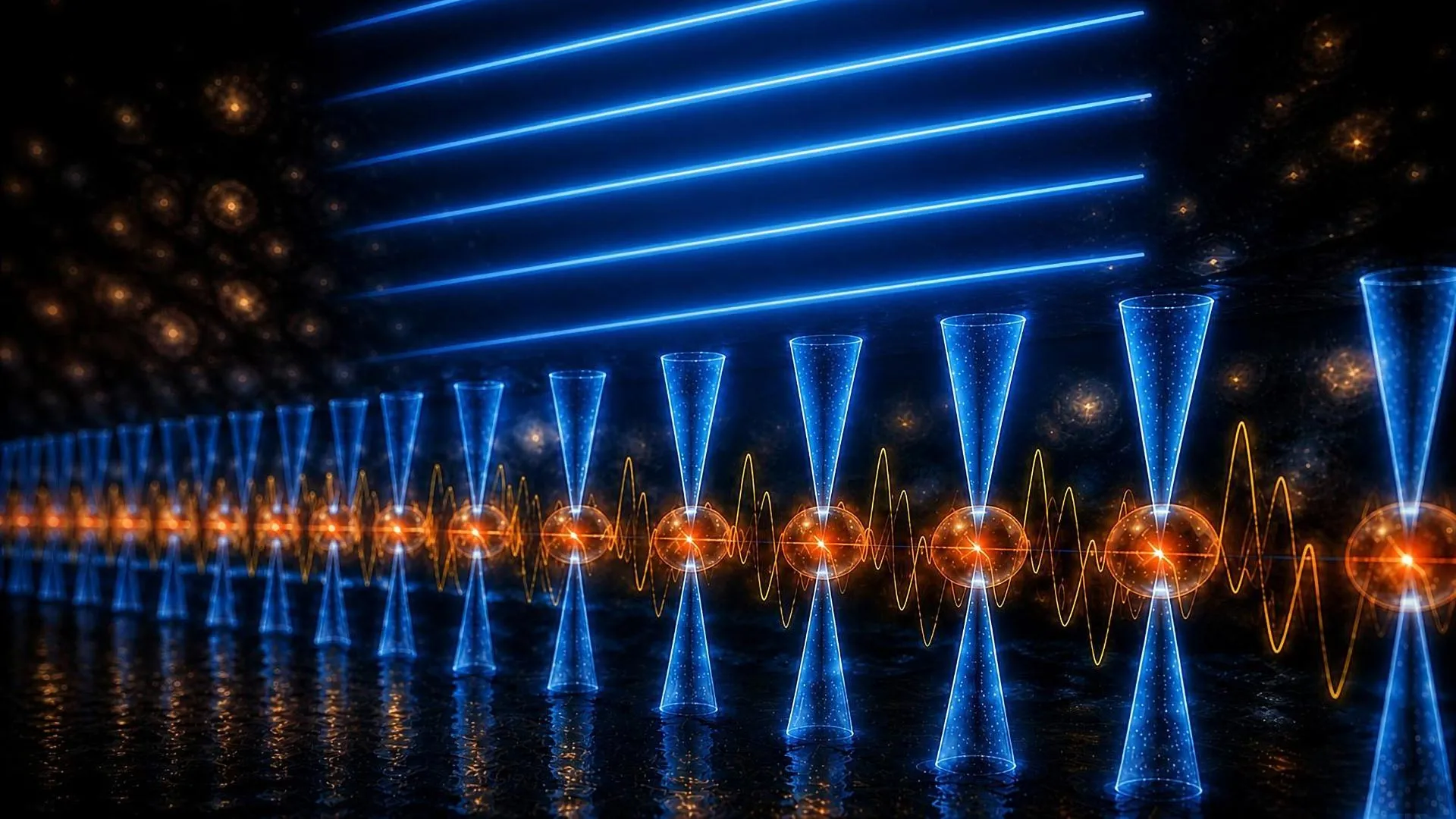
This "infinite tower" is the hallmark of string theory. It mirrors the harmonics of a musical instrument. When a violin string is plucked, it vibrates at a fundamental frequency, but it also produces a series of higher-pitched overtones. In the context of the universe, these overtones manifest as heavier, higher-spin particles.
"The precise details of string theory emerged automatically, including the infinite tower of massive spinning particles that form the ‘harmonics’ of the string that the theory is famous for," says co-author Grant N. Remmen.
The fact that this complex structure "fell out" of the math without being programmed in initially provides powerful evidence for the theory’s internal consistency. It suggests that if one wants a universe that behaves predictably at high energies (the "ultrasoftness" requirement) and follows the simplest possible mathematical rules (the "minimal zeros" requirement), that universe must be made of strings.
Solving the Infinity Problem through Ultrasoftness
The study also sheds light on why general relativity fails at the Planck scale. In Einstein’s theory, gravity is attractive and grows stronger as particles get closer or as energies increase. At the Planck scale, the energy density becomes so high that the theory predicts the formation of singularities—points of infinite density where time and space cease to exist.
String theory avoids this "ultraviolet catastrophe" through the property of ultrasoftness. Because strings are extended objects, they cannot be compressed into a zero-dimensional point. As the energy of a collision increases, the strings simply stretch. This stretching distributes the energy over a larger area, preventing the concentration of force that would otherwise lead to mathematical infinities.
"In a string theory framework, as you increase the energy transfer between particles, you will see a swift fall off in the probability that the particles will scatter," Cheung says. "It’s like the particles don’t even want to scatter off one another, but rather pass freely. The scattering amplitudes don’t go to infinity. It’s better behaved."
Implications for the Future of Theoretical Physics
While the findings do not constitute an experimental "discovery" of strings in the way the Higgs boson was discovered at the LHC, they provide a new kind of proof: a proof of inevitability. The study suggests that string theory is the "unique" solution to the problem of quantum gravity under the most basic assumptions of high-energy physics.
This revival of the bootstrap method is being hailed by leaders in the field. Hirosi Ooguri, the Fred Kavli Professor of Theoretical Physics and Mathematics at Caltech, notes that the modern iteration of this 1960s idea is far more powerful than its predecessor. "We now have a better understanding of the basic assumptions we can make, as well as stronger techniques for translating these assumptions into properties of scattering amplitudes and other observables," Ooguri says.
The broader implications of the study touch upon the very nature of physical law. If string theory is the only mathematically consistent framework for a universe with gravity and quantum mechanics, it implies that the laws of nature are not arbitrary. Instead, they may be dictated by mathematical necessity.
The research was supported by a diverse array of institutions, including the US Department of Energy, the Walter Burke Institute for Theoretical Physics, the Leinweber Forum for Theoretical Physics, and the Next Generation EU. As physicists continue to refine the bootstrap approach, the hope is that they can eventually bridge the gap between these abstract mathematical proofs and the observable world, finally confirming whether the music of the strings is indeed the underlying melody of the cosmos.












Leave a Reply