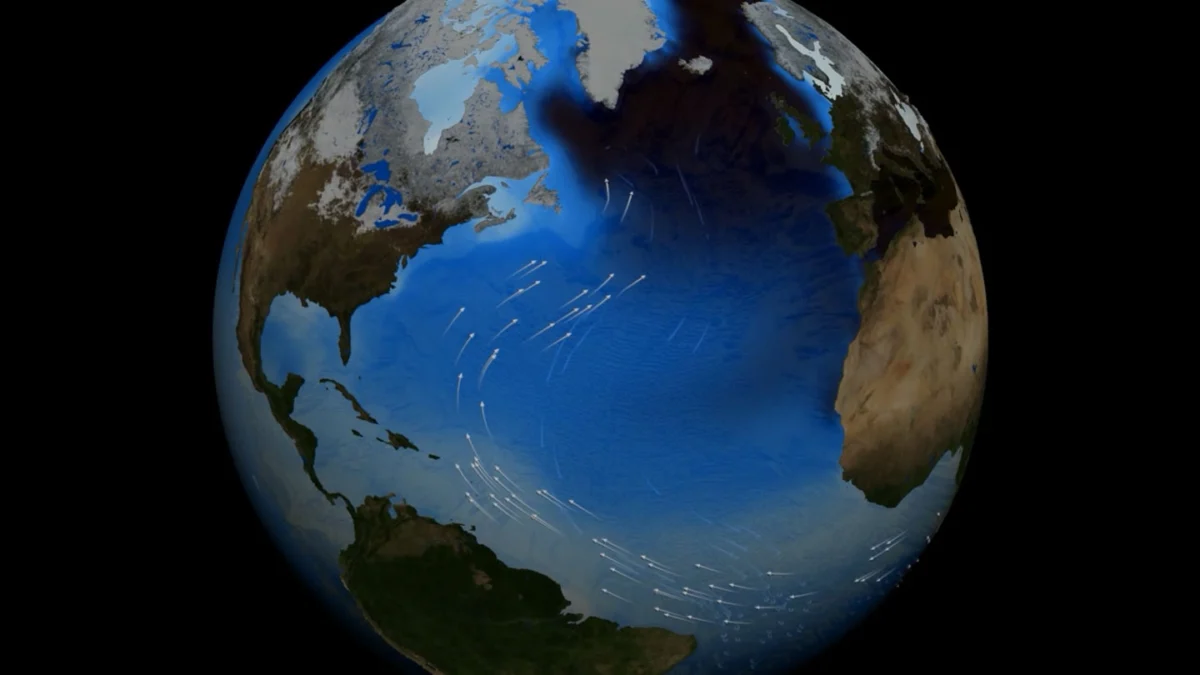
The Atlantic Meridional Overturning Circulation, commonly known as the AMOC, a vast system of ocean currents that plays a critical role in regulating global climate, particularly for Europe, is showing signs of unprecedented weakening. Recent scientific analyses suggest a potential decline of up to 50 percent by the year 2100, a scenario that has prompted not only scientific concern but also the controversial consideration of a megadam project designed to potentially counteract its slowdown. This potential weakening has profound implications for weather patterns, sea levels, and ecosystems across the Atlantic basin.
The AMOC: A Global Thermostat
The AMOC is a complex conveyor belt of ocean currents, driven by differences in water temperature and salinity. In the North Atlantic, surface waters become colder and saltier as they move northward, increasing their density. This dense water then sinks to the ocean floor and flows southward, while warmer, less dense water from the tropics is pulled northward to replace it. This continuous circulation system acts as a global thermostat, transporting enormous amounts of heat from the equatorial regions towards the poles, significantly moderating the climate of Western Europe. Without the AMOC, Western Europe would experience significantly colder winters, akin to those in parts of Canada at similar latitudes.
The scientific consensus, built over decades of research, points to a gradual weakening of the AMOC, with some studies indicating that it may be approaching a critical tipping point. This weakening is primarily attributed to the influx of freshwater into the North Atlantic, largely due to melting ice sheets in Greenland and increased precipitation. This influx dilutes the salt content of the surface waters, making them less dense and thus less likely to sink, disrupting the engine of the AMOC.
Timeline of Concern and Scientific Scrutiny
The potential weakening of the AMOC has been a subject of scientific inquiry for many years. Early concerns were primarily theoretical, based on climate models. However, observational data has increasingly supported these models.
- 1950s-1970s: Initial oceanographic surveys begin to map and understand the major ocean currents, including the precursors to detailed AMOC studies.
- 1980s-1990s: Climate models start to incorporate ocean circulation more robustly, highlighting the potential sensitivity of the AMOC to changes in freshwater input. Research begins to focus on the role of North Atlantic Deep Water formation.
- 2000s: The Intergovernmental Panel on Climate Change (IPCC) reports begin to acknowledge the possibility of AMOC weakening and its potential consequences, though with varying degrees of confidence in their models.
- 2010s: The development of more sophisticated ocean observation systems, including Argo floats and satellite altimetry, provides more direct evidence of changes in ocean properties that could affect the AMOC. Several studies suggest a noticeable slowdown compared to historical records.
- 2020s: A groundbreaking study published in Science Advances in February 2021 by researchers at Utrecht University in the Netherlands presented evidence that the AMOC might be closer to a tipping point than previously understood. Using complex climate models and analyzing salinity data, the study suggested that the AMOC could collapse entirely within the 21st century, with potentially devastating consequences. This study reignited widespread debate and concern.
- Present: Ongoing research continues to refine projections, with new analyses suggesting a significant weakening by 2100, as indicated by the Science article’s accompanying video, which states a potential 50 percent weakening.
Supporting Data and Projections
The evidence for AMOC weakening is multifaceted, drawing from various observational and modeling techniques.
- Salinity Anomalies: Studies have observed a significant decrease in salinity in the subpolar North Atlantic, a key region for deep water formation. This freshening is consistent with increased meltwater from Greenland and increased precipitation.
- Sea Surface Temperature: While global sea surface temperatures are rising, some regions in the North Atlantic have shown a relative cooling trend or a slower warming rate, which could be indicative of reduced heat transport by the AMOC.
- Ocean Current Velocity: Direct measurements of ocean currents, while challenging to maintain long-term, have shown some evidence of reduced flow in certain parts of the AMOC system.
- Climate Model Simulations: Sophisticated climate models, when forced with projected increases in greenhouse gas concentrations and associated meltwater, consistently predict a weakening of the AMOC. The degree of weakening varies between models, but the trend is robust. The projection of a 50 percent weakening by 2100 is a significant figure, highlighting the urgency of the scientific findings.
The Controversial Megadam Proposal
In response to the perceived threat of AMOC weakening, a highly controversial proposal has emerged: the construction of a massive dam across the Strait of Gibraltar. The idea, championed by some engineers and climate scientists, is to restrict the flow of less salty Atlantic surface water into the Mediterranean Sea. The Mediterranean is a region of high evaporation, leading to saltier surface waters that are denser and sink. This sinking water then flows out into the Atlantic at deeper levels. The proponents argue that by limiting the influx of fresh Atlantic water, they could increase the salinity and density of the Mediterranean’s outflow, potentially stimulating the sinking of water and thus bolstering the AMOC.
The theoretical basis for this proposal is rooted in understanding the mechanics of the AMOC. By altering the salinity balance of the Mediterranean, the aim is to create a stronger density gradient that encourages more vigorous overturning circulation.
Reactions and Criticisms
The megadam proposal has been met with widespread skepticism and strong criticism from many in the scientific community and environmental circles.
- Scientific Uncertainty: Critics argue that the proposal is based on a highly speculative understanding of a complex system. The AMOC is influenced by numerous factors, and the precise impact of altering Mediterranean salinity is far from certain. Many oceanographers believe that the freshwater input from melting ice sheets is a far more dominant factor driving AMOC weakening.
- Environmental Impact: The construction of such a colossal dam would have immediate and profound environmental consequences for the Mediterranean ecosystem. It would fundamentally alter the salinity, temperature, and nutrient cycles of the entire basin, potentially leading to mass extinctions and ecosystem collapse. The ecological impact on marine life, fisheries, and coastal communities dependent on the Mediterranean would be devastating.
- Engineering Feasibility and Cost: The engineering challenges of constructing a dam across the Strait of Gibraltar, a major shipping route with deep waters and strong currents, are immense. The cost would be astronomical, potentially running into trillions of dollars, making it an economically unviable solution.
- Focus on Mitigation: Many scientists argue that the focus should instead be on addressing the root cause of AMOC weakening: anthropogenic climate change. Reducing greenhouse gas emissions to limit global warming and the subsequent melting of ice sheets is seen as the most effective and responsible approach.
Broader Impact and Implications
The weakening of the AMOC, regardless of whether drastic interventions like a megadam are considered, carries significant implications:
- Climate Extremes in Europe: A weakened AMOC could lead to colder winters and more extreme weather events in Europe, including increased storminess and a potential shift in rainfall patterns. This could impact agriculture, energy demand, and infrastructure.
- Sea Level Rise: While counterintuitive, a weakening AMOC could contribute to accelerated sea level rise along the eastern coast of North America. This is because the ocean currents help to “pile up” water on the western side of the Atlantic. A slowdown in this process could lead to a redistribution of ocean mass, causing sea levels to rise faster in some areas.
- Marine Ecosystems: Changes in ocean temperature and circulation patterns would profoundly affect marine ecosystems, impacting fish populations, plankton distribution, and the overall health of the Atlantic Ocean.
- Global Climate Patterns: The AMOC is a critical component of the global climate system. Its disruption could have cascading effects on weather patterns far beyond the Atlantic basin, potentially influencing monsoons in Africa and Asia, and even impacting El Niño cycles in the Pacific.
The debate surrounding the AMOC’s weakening and the audacious megadam proposal underscores the profound interconnectedness of Earth’s climate systems and the immense challenges posed by anthropogenic climate change. While the megadam concept highlights the desperation some feel to find solutions, the overwhelming scientific consensus points towards the necessity of mitigating greenhouse gas emissions as the primary strategy to safeguard against the potentially catastrophic consequences of a faltering AMOC. Further research and robust, evidence-based policy decisions are crucial to navigating this complex and critical environmental challenge.