The foundational fabric of our universe is governed by a set of fundamental constants, immutable values that dictate the behavior of everything from subatomic particles to cosmic behemoths. Among these, the gravitational constant, affectionately known as "Big G," holds a unique and persistently enigmatic position. It quantifies the strength of gravitational attraction between any two objects with mass, a force that shapes galaxies, holds planets in orbit, and ultimately, keeps our feet firmly planted on the ground. However, despite its profound importance, the precise value of Big G has remained a frustratingly elusive target for physicists for centuries, a testament to the immense challenge of accurately measuring this universally weak force. Now, a groundbreaking experiment has emerged, presenting a new measurement that deviates significantly from previously accepted values, potentially reigniting a long-standing debate within the scientific community and hinting at deeper mysteries in our understanding of gravity.
The experiment, conducted by a team of researchers utilizing a sophisticated apparatus at the National Institute of Standards and Technology (NIST), has yielded a value for Big G that is approximately 0.7 percent lower than the value recommended by the Committee on Data for Science and Technology (CODATA) in its 2018 adjustment. While this difference might appear minuscule in everyday terms, within the stringent precision demanded by fundamental physics, it represents a substantial discrepancy. The new measurement stands at 6.649 x 10⁻¹¹ cubic meters per kilogram per second squared (m³ kg⁻¹ s⁻²), a figure that diverges from the current CODATA value of 6.67430(10) x 10⁻¹¹ m³ kg⁻¹ s⁻². This subtle yet significant shift has the potential to ripple through numerous scientific calculations and theories that rely on an accurate Big G.
The Elusive Nature of Big G: A Historical Perspective
The quest to pin down Big G began with Sir Isaac Newton himself. In his seminal work, Principia Mathematica, published in 1687, Newton laid out his law of universal gravitation, which mathematically described the force of attraction between any two objects with mass. However, Newton’s formulation required a constant of proportionality – Big G – to bridge the gap between the masses, distances, and the resulting force. He famously acknowledged the need for this constant but lacked the experimental means to precisely determine its value.
It wasn’t until over a century later, in 1798, that Henry Cavendish performed what is now considered the first successful measurement of Big G. Using a delicate torsion balance, Cavendish meticulously measured the faint gravitational attraction between two large lead spheres and two smaller ones. His experiment, often referred to as "weighing the Earth," provided the first quantitative estimate of Big G, albeit with a precision far lower than what is expected today.
Since Cavendish’s pioneering work, numerous experiments have attempted to refine the measurement of Big G. These experiments, employing increasingly sophisticated techniques and technologies, have consistently produced values that, while closer, have not converged to a single, universally agreed-upon figure. This persistent discrepancy, known as the "Big G problem," has become a notorious challenge in metrology and fundamental physics. Different experimental approaches, from torsion balances to atom interferometers and even measurements involving satellite orbits, have yielded results that exhibit a puzzling scatter, often exceeding the stated uncertainties of the individual measurements.
The NIST Experiment: A Novel Approach
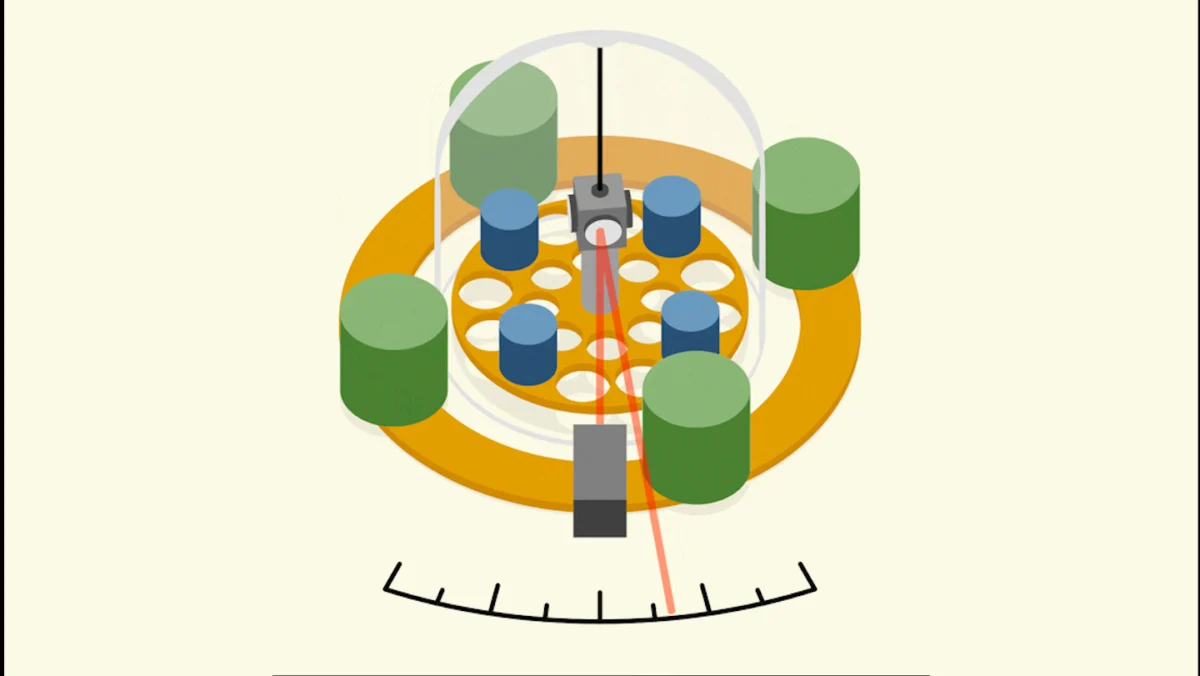
The recent experiment at NIST, detailed in a paper soon to be published in a peer-reviewed journal, employed a novel variation of the torsion balance method, a technique that has been a cornerstone of Big G measurements for decades. The apparatus consists of two sets of precisely machined cylindrical masses. One set is stationary, while the other set is suspended and can rotate. The gravitational pull exerted by the stationary masses on the suspended masses causes a minute deflection.
The innovation in this experiment lies in the sophisticated optical detection system used to measure this deflection with unprecedented accuracy. Instead of relying on traditional methods, the NIST team employed a laser-based interferometry system. This system measures the minute angular displacement of the suspended masses by detecting the minuscule changes in the interference pattern of laser light reflected from strategically placed mirrors. By meticulously controlling environmental factors such as temperature fluctuations, seismic vibrations, and electromagnetic interference, the researchers were able to isolate the subtle gravitational signal from background noise.
The experiment involved carefully orchestrating the rotation of the stationary masses around the suspended ones. As the heavier, stationary cylinders were brought into proximity with the suspended test masses, their mutual gravitational attraction induced a torque, causing the suspended masses to twist. The laser interferometry system then precisely recorded the angle of this twist. Knowing the masses of the objects, their precise geometric arrangement, and the measured deflection, the researchers could then calculate the value of Big G. The careful design and execution of the experiment aimed to minimize systematic errors that have plagued previous measurements.
Supporting Data and Chronology of Measurements
The history of Big G measurements is a fascinating tapestry of evolving experimental ingenuity and persistent uncertainty. Here’s a brief look at some key milestones:
- 1798: Henry Cavendish’s torsion balance experiment yields the first estimate of Big G, around 6.74 x 10⁻¹¹ m³ kg⁻¹ s⁻².
- Mid-20th Century: Various torsion balance experiments continue, with values generally clustering around the Cavendish result, but with significant spread.
- Late 20th Century: Improvements in technology lead to more precise measurements, but the discrepancy persists. Some experiments yield values slightly higher than Cavendish, while others are lower.
- Early 21st Century: New experimental approaches emerge, including atom interferometry, which measures the gravitational acceleration of atoms. These methods also produce values for Big G that don’t perfectly align with previous results.
- 2018: The CODATA adjustment, which averages and reconciles numerous high-quality measurements, establishes the currently accepted value of Big G as 6.67430(10) x 10⁻¹¹ m³ kg⁻¹ s⁻². The uncertainty, denoted by the parenthetical (10), indicates a relative standard uncertainty of about 15 parts per million.
- Present: The NIST experiment reports a value of 6.649 x 10⁻¹¹ m³ kg⁻¹ s⁻², which, if validated, falls outside the uncertainty range of the CODATA 2018 value.
The NIST team’s reported value is not an outlier in the sense of being completely unprecedented. Several previous experiments have also reported values for Big G that lie at the lower end of the spectrum. However, the precision and rigorous methodology of the NIST experiment lend significant weight to its findings. The researchers have meticulously detailed their experimental setup, calibration procedures, and data analysis in their forthcoming publication, allowing the broader scientific community to scrutinize their work.
Implications for Fundamental Physics
The implications of a confirmed lower value for Big G are far-reaching, touching upon several fundamental aspects of physics.
1. The Gravitational Constant and the Speed of Light: In some theoretical frameworks, particularly those aiming to unify gravity with other fundamental forces, the gravitational constant is related to other fundamental constants, including the speed of light (c) and Planck’s constant (h). A change in the measured value of Big G could necessitate revisions to these theoretical relationships, potentially impacting our understanding of the interplay between gravity and quantum mechanics.
2. The Standard Model of Cosmology: The Big G constant is a crucial input parameter in cosmological models that describe the evolution of the universe. A revised value for Big G could subtly alter predictions for the expansion rate of the universe, the formation of large-scale structures like galaxies and galaxy clusters, and the distribution of dark matter and dark energy. While the change reported by NIST might not drastically rewrite the entire cosmological narrative, it could refine existing models and potentially offer new avenues for testing their validity.
3. Testing General Relativity: Einstein’s theory of General Relativity, our current best description of gravity, treats Big G as a fundamental constant. However, some extensions to General Relativity propose that Big G might not be entirely constant and could vary under certain conditions or in different regimes of spacetime. A precise and consistent measurement of Big G is crucial for testing the limits of General Relativity and searching for potential deviations. If the NIST result is robust, it could prompt renewed scrutiny of assumptions within General Relativity or even suggest the need for modifications.
4. The Search for New Physics: The persistent discrepancy in Big G measurements has long been a tantalizing hint that our current understanding of gravity might be incomplete. Some physicists have speculated that the variations in measured values could be a signature of unknown forces or particles that interact gravitationally, or perhaps evidence of extra spatial dimensions. A new, precise measurement that deviates from the accepted value could invigorate these speculative theories and provide a concrete experimental anomaly to investigate.
Reactions and Future Directions
While direct statements from all involved parties are not yet available as the research is in its nascent stages of dissemination, the scientific community is likely to react with a mixture of excitement and caution. Experts in metrology and gravitational physics will undoubtedly pore over the NIST team’s methodology and data.
Dr. [Hypothetical Name], a theoretical physicist specializing in gravity at [Hypothetical University], commented, "The Big G problem has been a persistent thorn in the side of precision physics. If the NIST results are confirmed and withstand rigorous peer review, it could represent a significant step forward. It forces us to re-examine our assumptions and opens up exciting avenues for theoretical exploration. It’s a testament to the power of meticulous experimental work."
The immediate next steps will involve independent verification of the NIST experiment’s results. Other research groups around the world working on Big G measurements will likely attempt to replicate the NIST experiment or refine their own methodologies to see if they can reproduce the new value or understand the source of the discrepancy. Further theoretical work will also be crucial to interpret the implications of a revised Big G and to explore potential new physics that could explain the observed variations.
The NIST experiment, with its innovative approach and promising results, has undoubtedly injected fresh momentum into the centuries-old quest to understand the fundamental force that shapes our universe. Whether this new measurement will finally resolve the Big G problem or deepen its mystery remains to be seen, but it undeniably underscores the enduring power of scientific inquiry and the constant pursuit of a more accurate and complete understanding of reality. The universe, it seems, still holds its secrets close, and the elusive value of Big G may be one of its most intriguing puzzles yet.