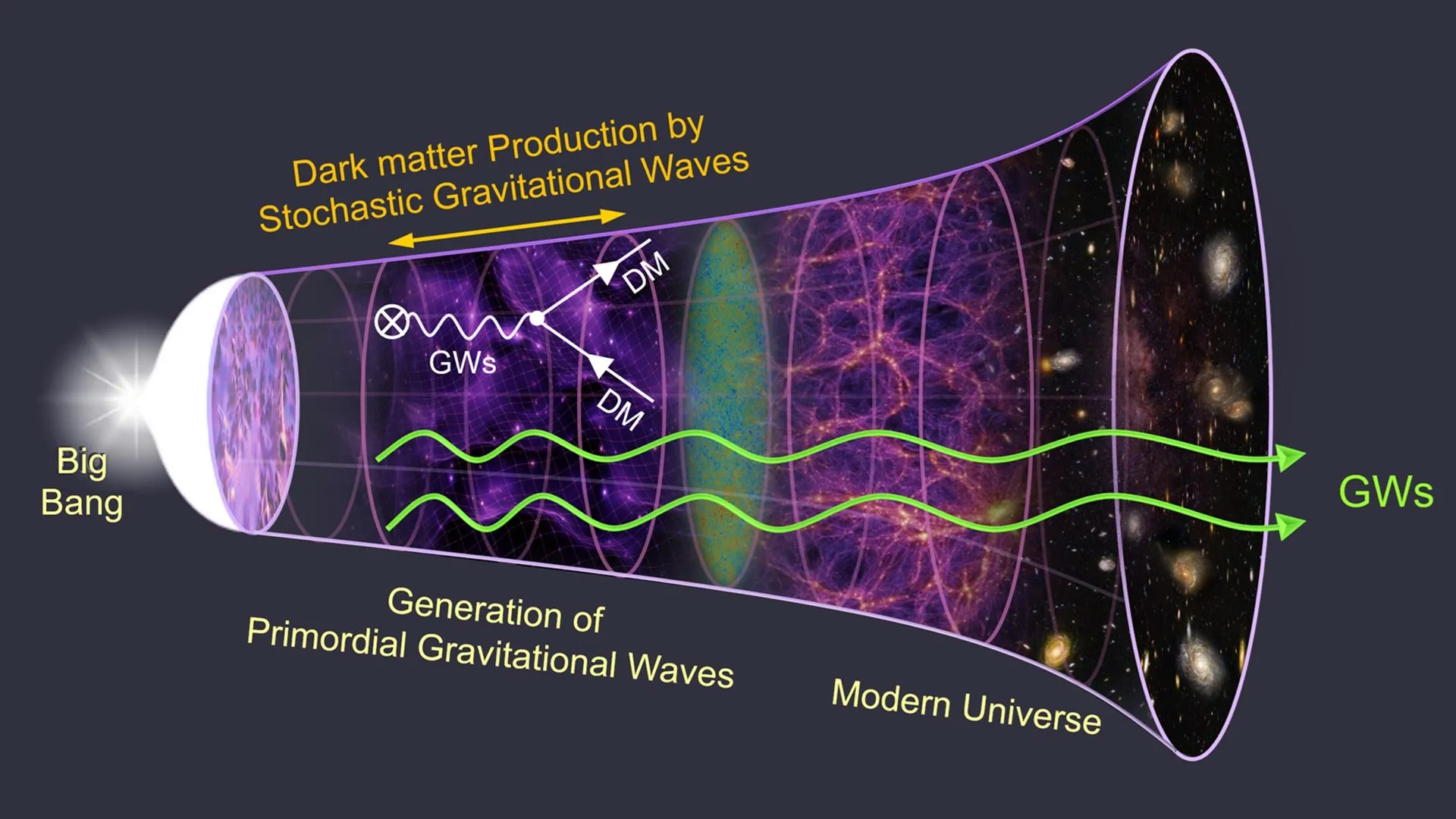
In a significant development for the field of theoretical physics, a newly published study suggests that gravitational waves—the ripples in the fabric of spacetime—may have been the primary catalyst for the creation of dark matter during the universe’s most formative moments. The research, led by Professor Joachim Kopp of Johannes Gutenberg University Mainz (JGU) and the PRISMA++ Cluster of Excellence, in collaboration with Dr. Azadeh Maleknejad from Swansea University, offers a provocative new solution to one of the most enduring mysteries in modern science. Published in the prestigious journal Physical Review Letters, the study introduces a mechanism where stochastic gravitational waves, rather than massive cosmic collisions, facilitated the emergence of dark matter particles in the high-energy environment of the early cosmos.
For decades, the scientific community has grappled with the "missing mass" problem. Observations of galactic rotation speeds and the bending of light around massive clusters indicate that the visible matter we see—stars, planets, gas clouds, and organic life—comprises a mere four percent of the total energy density of the universe. The remainder is composed of dark energy, which drives the expansion of the universe, and dark matter, which acts as the invisible "glue" holding galaxies together. While dark matter accounts for approximately 23 to 27 percent of the universe, it has remained stubbornly elusive, as it does not emit, absorb, or reflect light, making it detectable only through its gravitational influence.
The Mechanism of Stochastic Gravitational Waves
The core of the research lies in the distinction between different types of gravitational waves. Most public attention regarding gravitational waves has focused on the dramatic signals detected by observatories like LIGO and Virgo, which originate from violent events such as the merger of two black holes or the collision of neutron stars. However, the study by Kopp and Maleknejad focuses on "stochastic" gravitational waves. These are not the result of isolated, massive events but are instead a background hum of spacetime ripples that permeate the entire universe.
These stochastic waves are believed to be remnants of the extreme conditions present shortly after the Big Bang. As the universe underwent rapid expansion and subsequent cooling, various phase transitions and primordial magnetic fields likely generated a turbulent sea of gravitational radiation. According to the new calculations, these ubiquitous waves possessed sufficient energy to interact with quantum fields, leading to the production of fermions.
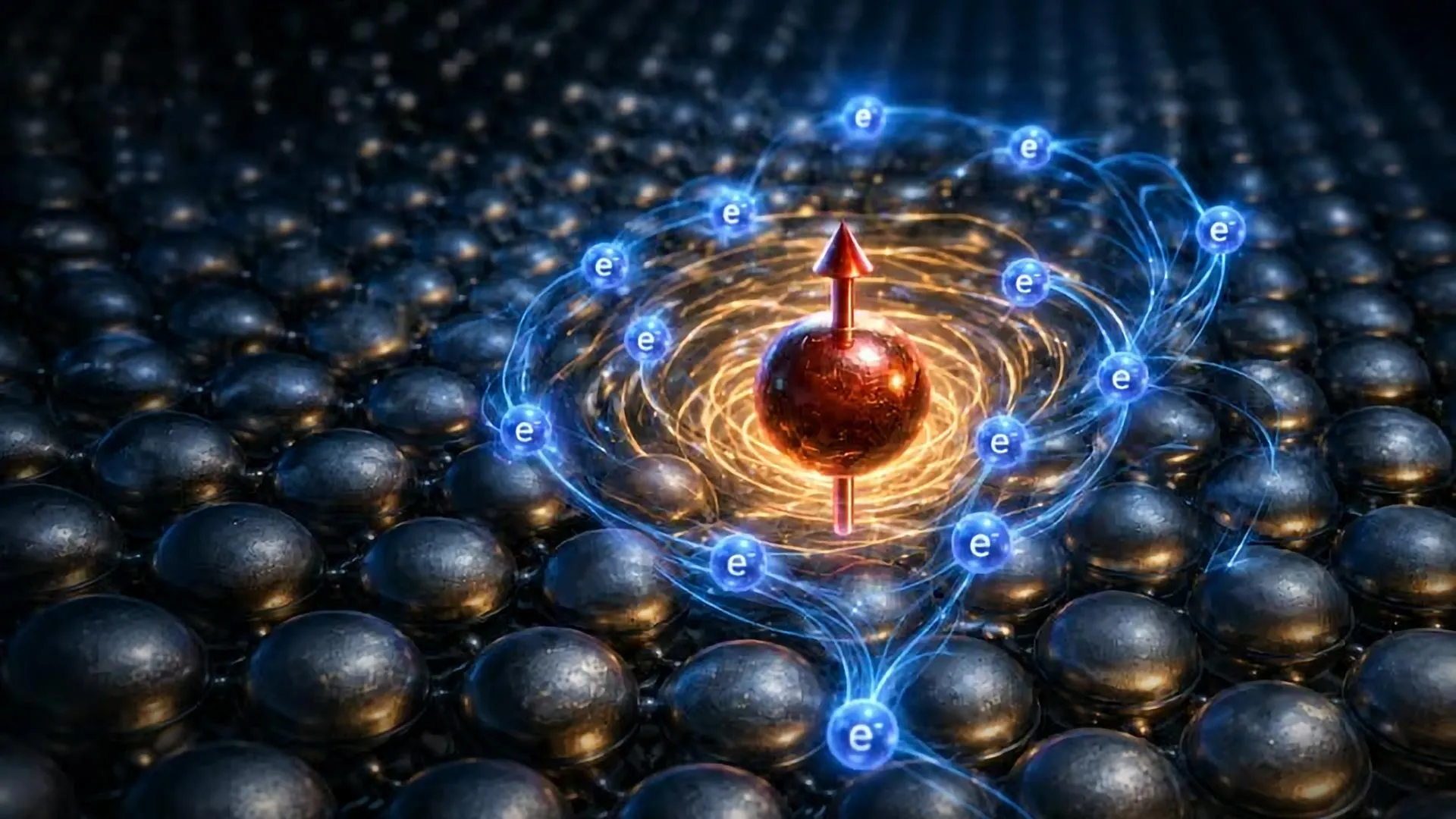
Fermions are a fundamental category of subatomic particles that include electrons, protons, and neutrons—the building blocks of atoms. The researchers propose that in the early universe, these gravitational waves induced the creation of a specific type of fermion that was initially massless. As the universe evolved and temperatures dropped, these particles are theorized to have acquired mass through mechanisms yet to be fully defined, eventually stabilizing into the dark matter particles that populate the modern universe.
Chronology of the Early Universe and Dark Matter Formation
To understand the context of this theory, it is essential to look at the timeline of the early universe, a period characterized by rapid transitions and extreme energy densities.
- The Inflationary Epoch (approx. 10^-36 to 10^-32 seconds after the Big Bang): The universe underwent an exponential expansion. This period likely generated the initial seeds of gravitational waves as quantum fluctuations were stretched to cosmic scales.
- The Radiation-Dominated Era: As inflation ended, the universe was filled with a hot, dense plasma. During this stage, phase transitions—similar to how steam condenses into water—occurred as the fundamental forces of nature began to separate.
- The Generation of Stochastic Waves: These phase transitions, along with turbulence in primordial magnetic fields, created a background of stochastic gravitational waves.
- The Fermion Interaction (The New Theory): It is during these initial fractions of a second that the researchers believe the energy from gravitational waves was converted into massless fermions.
- Mass Acquisition: As the universe continued to cool, these fermions gained mass. This transition transformed them from highly energetic, fast-moving particles into "cold" dark matter, which began to clump together under the force of gravity.
- The Formation of Large-Scale Structure: Millions of years later, these dark matter clumps provided the gravitational wells necessary for hydrogen gas to accumulate, eventually igniting the first stars and forming the first galaxies.
Supporting Data and Theoretical Foundations
The research utilizes complex analytical estimates to bridge the gap between General Relativity and Quantum Field Theory. Professor Kopp and Dr. Maleknejad focused on how gravity, usually considered a very weak force at the particle level, can become a dominant player in particle production when the energy density of the gravitational field is sufficiently high.
Supporting this theory is the fact that current dark matter candidates, such as WIMPs (Weakly Interacting Massive Particles), have yet to be detected despite decades of high-sensitivity experiments like those at the Gran Sasso National Laboratory in Italy. The failure to find WIMPs has forced theorists to look toward "gravity-only" or "gravitationally produced" dark matter models.
The JGU and Swansea study provides a mathematical pathway for this. By calculating the "cross-section" or probability of gravitational wave energy exciting a fermion field, the researchers demonstrated that the resulting particle density could match the observed density of dark matter in the universe today. This alignment with observed cosmic data provides a strong foundation for the hypothesis.
Official Responses and Academic Context
The research has been received with significant interest within the PRISMA++ Cluster of Excellence, a world-leading research center dedicated to exploring the fundamental building blocks of matter and their role in the evolution of the universe. Professor Kopp, a central figure in the cluster, emphasized that this work represents a paradigm shift in how we view the "dark sector" of physics.
"In this article, we investigate the possibility of gravitational waves being partially converted into dark matter particles," Kopp stated. "This leads to a new mechanism of dark matter production that has not been researched before."
Colleagues in the field of cosmology have noted that if this theory holds, it could change the requirements for future dark matter detectors. Rather than looking for particles that interact with light or the weak nuclear force, scientists might need to look for correlations between the stochastic gravitational wave background and the distribution of dark matter.
Dr. Maleknejad’s contributions from Swansea University highlight the international nature of the collaboration, bringing together expertise in early-universe cosmology and particle physics. The researchers suggest that the "background hum" of the universe may contain the fingerprints of dark matter’s birth, potentially detectable by next-generation observatories such as the Laser Interferometer Space Antenna (LISA), a space-based gravitational wave detector planned by the European Space Agency.
Broader Impact and Future Implications
The implications of this study extend beyond the identity of dark matter. It touches upon one of the most significant imbalances in the universe: the baryon asymmetry, or the reason why there is more matter than antimatter.
In the standard model of cosmology, matter and antimatter should have been created in equal amounts and subsequently annihilated each other, leaving an empty universe. However, we live in a matter-dominated cosmos. Professor Kopp suggested that the same gravitational wave mechanisms that produced dark matter might also explain this asymmetry. If gravitational waves interact differently with particles and antiparticles in the high-energy environment of the early universe, it could provide the "tilt" required to leave behind the surplus of matter we see today.
The next phase of this research involves moving from analytical models to high-resolution numerical simulations. These simulations will allow the team to account for more variables, such as the exact frequency spectrum of the gravitational waves and the specific mass-generation scales of the fermions.
"The next step is to go beyond our analytical estimates and conduct numerical calculations to improve the accuracy of our predictions," Kopp said. "Another avenue for future research is the investigation of further possible effects of gravitational waves in the early universe."
Conclusion: A New Frontier in Cosmology
The theory proposed by Kopp and Maleknejad represents a bold step toward unifying the study of gravity with the search for dark matter. By positioning gravitational waves as a generative force rather than just a byproduct of cosmic events, the research opens a new window into the "Dark Ages" of the universe—the period before the first light was emitted.
If the stochastic gravitational wave background is indeed the progenitor of dark matter, it would confirm that the very fabric of spacetime is more active and influential in particle physics than previously assumed. As numerical simulations progress and next-generation detectors come online, the scientific community may finally be on the verge of identifying the invisible substance that dictates the structure of the cosmos. This research does not just offer a new particle; it offers a new history of the universe, where the ripples of the Big Bang itself crystallized into the matter that makes the existence of galaxies, stars, and life possible.