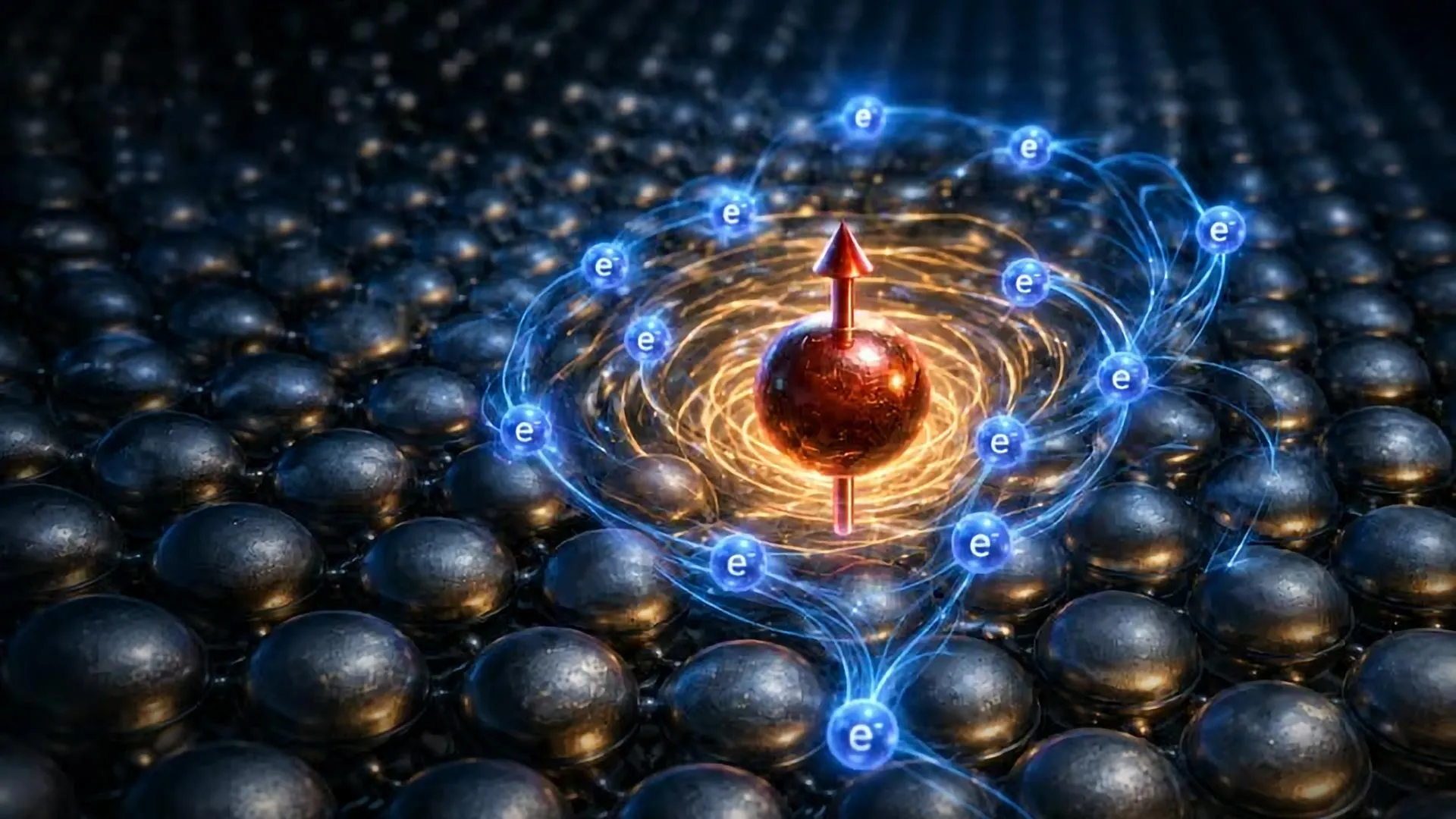
In a landmark achievement for the field of subatomic physics, an international collaboration of researchers has announced the first experimental evidence for the existence of the η’-mesic nucleus, a rare and exotic state of matter that has long been predicted by theoretical models. The findings, published in the prestigious journal Physical Review Letters, represent a significant step forward in understanding one of the most profound mysteries in science: the origin of mass in the visible universe. By observing the interactions of a specific type of meson—the η’ (eta-prime) particle—within the dense environment of an atomic nucleus, scientists are beginning to unravel how the fundamental structure of the vacuum influences the properties of matter.
The research, led by an international team including senior author Kenta Itahashi from the RIKEN Nishina Center for Accelerator-Based Science and lead author Ryohei Sekiya from Kyoto University, utilized the high-precision facilities at the GSI Helmholtzzentrum für Schwerionenforschung in Darmstadt, Germany. Their results suggest that the η’ meson, a short-lived particle usually existing for only a fraction of a nanosecond, can become bound to an atomic nucleus, creating a temporary "mesic nucleus" that serves as a microscopic laboratory for studying the strong nuclear force and the nature of the physical vacuum.
The Mystery of Mass and the QCD Vacuum
To understand the significance of this discovery, one must look beyond the traditional view of the vacuum as "empty space." In modern quantum chromodynamics (QCD), the theory describing the strong interaction, the vacuum is a dynamic and complex environment filled with fluctuating fields and condensates. While the Higgs boson is famous for providing mass to fundamental particles like quarks and electrons, the Higgs mechanism only accounts for about one percent of the mass of the visible universe. The remaining 99 percent of the mass of protons and neutrons—and thus the mass of humans, planets, and stars—emerges from the energy of the strong interactions within the vacuum.
A central concept in this framework is "chiral symmetry breaking." In the high-temperature conditions of the early universe, particles were nearly massless. As the universe cooled, the vacuum underwent a phase transition, breaking this symmetry and causing particles to acquire significant effective mass. Physicists believe that by placing particles like mesons into the extremely dense environment of a nucleus, they can partially "restore" this symmetry, causing the particle’s mass to change. The η’ meson is particularly valuable for this research because it is unusually heavy compared to its counterparts, a phenomenon attributed to a complex interaction with the vacuum known as the U(A)1 anomaly.
Experimental Methodology at GSI Darmstadt
The search for the η’-mesic nucleus required an experimental setup of extraordinary precision. The team conducted their study at the GSI Helmholtzzentrum, utilizing the SIS18 synchrotron to accelerate protons to high energies. The experiment focused on a (p, d) reaction, where a high-energy proton beam was directed at a target composed of carbon-12.
When a proton strikes a carbon nucleus, the collision can produce an η’ meson. In specific kinematic conditions, this meson is produced with almost zero velocity relative to the remaining nucleus, allowing the strong nuclear force to "trap" it before it can escape or decay. The resulting system is a carbon-11 nucleus with an η’ meson bound to it. To confirm this happened, the researchers looked for "deuterons"—particles consisting of one proton and one neutron—that were ejected during the reaction. By measuring the momentum and energy of these deuterons using the Fragment Separator (FRS), a high-resolution magnetic spectrometer, the team could calculate the "missing mass" and determine the excitation spectrum of the residual system.
A critical component of the experiment was the integration of the WASA (Wide Angle Detector for SSB and Associated Processes) detector. Originally developed at the Uppsala University in Sweden and later used at the Forschungszentrum Jülich, WASA was moved to GSI specifically for this project. This detector allowed the team to perform "coincidence measurements," detecting not just the deuterons but also the high-momentum protons produced when the η’ meson eventually decayed inside the nucleus. This dual-layered detection strategy was essential for distinguishing the signal of the mesic nucleus from the vast amount of background noise generated in high-energy collisions.
Chronology of the Search for Mesic Nuclei
The discovery of the η’-mesic nucleus is the culmination of decades of theoretical and experimental effort. The concept of mesic nuclei was first proposed in the mid-20th century, shortly after the discovery of mesons themselves.
- 1980s-1990s: Theoretical physicists began to predict that certain mesons, such as the pion (π) and the eta (η) meson, could form bound states with nuclei. Initial experiments focused on pionic nuclei, which were successfully observed and provided the first hints of how meson properties change in dense matter.
- 2000s: Attention shifted to the η meson. Experiments at facilities like MAMI in Germany and J-PARC in Japan sought evidence for η-mesic nuclei. While some signals were found, they remained difficult to distinguish from non-bound interactions.
- 2010-2015: Theoretical models regarding the η’ meson’s mass in nuclear matter were refined. Predictions suggested that the η’ meson would experience a significant mass reduction (around 100-150 MeV) when inside a nucleus, making it an ideal candidate for trapping.
- 2014-2022: The international collaboration at GSI designed and executed the current experiment. This period involved the complex task of transporting the WASA detector and integrating it with the FRS spectrometer.
- 2024: After years of rigorous data analysis, the team published their findings in Physical Review Letters, confirming the observation of structures consistent with η’-mesic bound states.
Supporting Data and Statistical Significance
The data presented by the research team shows a clear enhancement in the excitation spectrum of the carbon-11 system near the threshold of η’ meson production. This enhancement is a "signature" of the meson becoming bound to the nucleus.
According to the published analysis, the team observed that the η’ meson’s mass appears to decrease by approximately 15% when immersed in the nuclear environment. This shift is a direct experimental indication of the partial restoration of chiral symmetry. The statistical significance of the signal, combined with the coincidence detection of decay protons, provides the strongest evidence to date for this exotic state.
"The combination of the FRS’s resolution and WASA’s detection capabilities allowed us to see what was previously invisible," said lead author Ryohei Sekiya. "The patterns we observed in the energy spectrum match the theoretical predictions for a bound η’ meson with remarkable accuracy."
Scientific Reactions and Analysis
The physics community has reacted with cautious optimism and excitement. Dr. Hiroshi Nagahiro, a theoretical physicist not directly involved in the experiment but whose models predicted these states, noted that the results provide a crucial benchmark. "For years, we have had various models for how the U(A)1 anomaly behaves in dense matter," Nagahiro explained. "This data allows us to rule out several theories and focuses our understanding on how the vacuum structure is modified by the presence of nucleons."
The discovery also sheds light on the "mass gap" in QCD. Because the η’ meson is much heavier than other mesons (like the pion or the kaon), it has always been an outlier in particle physics. By showing that its mass is sensitive to nuclear density, the GSI experiment confirms that the η’ mass is largely "environmental"—generated by its interaction with the vacuum condensate.
Broader Impact and Future Implications
The implications of this discovery extend far beyond the laboratory. Understanding how particle properties change in dense environments is essential for astrophysics, particularly in the study of neutron stars. Neutron stars are essentially giant atomic nuclei, with densities far exceeding anything that can be created on Earth. The behavior of mesons within these stars determines their equation of state, which in turn influences their size, cooling rate, and whether they eventually collapse into black holes.
Furthermore, these findings provide insight into the conditions of the early universe. In the microseconds following the Big Bang, the entire universe was a hot, dense plasma. As it expanded and cooled, the vacuum transitions occurred that gave matter its current properties. Studying mesic nuclei allows scientists to "rewind" this process in a controlled environment.
Next Steps in Research
Despite the success of this experiment, the researchers emphasize that this is only the beginning. The current data provides evidence for the formation of the state, but more precise measurements are needed to determine the exact "binding energy" and the lifetime of the η’-mesic nucleus.
The team plans to return to GSI for a second phase of experiments with upgraded detectors and higher beam intensities. They also look toward the future Facility for Antiproton and Ion Research (FAIR), currently under construction in Germany, which will offer even greater opportunities to study exotic matter. Additionally, experiments at J-PARC in Japan are expected to complement these findings by using different reaction mechanisms, such as using kaon beams to produce mesons.
As the scientific community continues to probe the subatomic world, the η’-mesic nucleus stands as a testament to the fact that even the "emptiness" of the vacuum is a rich, complex frontier. The quest to understand mass is moving from theoretical abstraction to tangible experimental reality, bringing us closer to answering the fundamental question of why there is something rather than nothing.