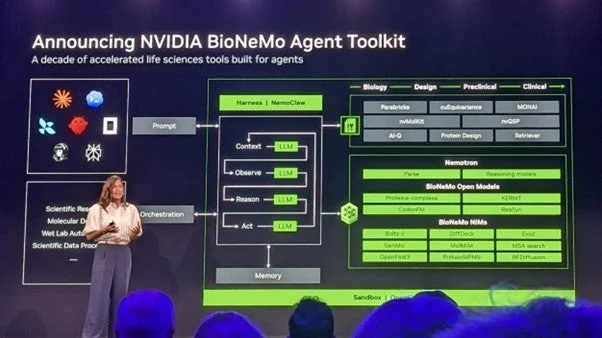
San Diego, CA – NVIDIA has officially launched the BioNeMo agent toolkit, a groundbreaking suite of tools specifically engineered to empower artificial intelligence (AI) agents in conducting research and development within the life sciences sector. The announcement, made by Kimberly Powell, Vice President of NVIDIA Healthcare, at the 2026 BIO International Convention, signals a significant advancement in the integration of AI into scientific discovery, promising to enhance the speed, reliability, and continuity of innovation. The convention, held from June 22nd to 25th, 2026, in San Diego, serves as a pivotal gathering for biotechnology leaders and innovators worldwide.
The life sciences R&D industry, a sector valued at an estimated $300 billion, is currently experiencing a profound transformation, as highlighted by Powell. She articulated the evolving role of AI in science, stating, "The question is no longer whether AI can help science. The question is, does AI have the right instruments to run science?" Powell elaborated that while general-purpose AI agents possess the capacity for research, they often struggle with the complex and time-consuming process of identifying, acquiring, and effectively utilizing the diverse array of specialized tools required for scientific investigation. This often leads to inefficiencies, wasted computational resources, and ultimately, suboptimal research outcomes.
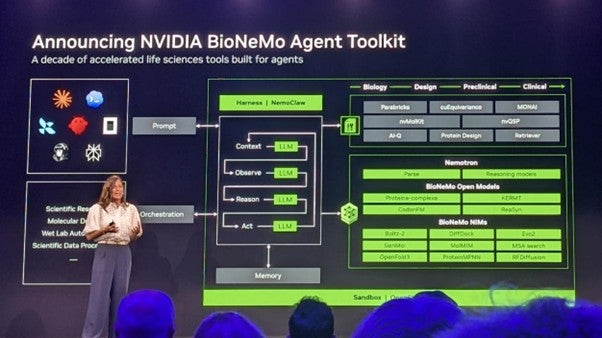
The BioNeMo toolkit aims to directly address these challenges by providing AI agents with a comprehensive ecosystem of research instruments. More crucially, it includes integrated instruction sets that guide AI agents on how to utilize these tools, troubleshoot common issues, and adapt to new methodologies. This pedagogical approach is designed to streamline the R&D process, allowing AI to move beyond mere data analysis to actively participate in experimental design and execution.
Key components of the BioNeMo toolkit, as detailed by Powell, include sophisticated frameworks and software designed for various scientific disciplines. Among these are the MONAI imaging framework, which is essential for the analysis and interpretation of medical imagery; the PaReBrick genomics tool, crucial for understanding and manipulating genetic data; and the cuEquivariance modelling software, which facilitates complex molecular simulations and predictions. The inclusion of these specialized tools underscores NVIDIA’s commitment to providing a holistic solution for AI-driven life sciences R&D.
Driving Continuous Innovation Through Closed-Loop Workflows
A significant feature of the BioNeMo agent toolkit is its capacity to support closed-loop workflows. This innovative approach enables AI agents to engage in iterative cycles of experimentation. Following the execution of experiments and the analysis of results, the AI can autonomously generate new hypotheses, suggest novel scientific questions, and design subsequent experiments to further investigate promising avenues. This continuous feedback loop is anticipated to dramatically accelerate the pace of discovery, moving away from traditional linear research models towards a more dynamic and responsive paradigm.
For instance, in drug discovery, an AI agent equipped with BioNeMo could analyze the efficacy and safety profiles of a candidate compound. Based on these results, it could then propose modifications to the molecule’s structure, design new synthesis pathways, and even suggest novel targets or disease indications where the modified compound might prove effective. This self-optimizing process has the potential to significantly reduce the time and cost associated with bringing new therapies to market.
Broad Adoption and Strategic Partnerships
The BioNeMo agent toolkit is already garnering significant traction within the industry, with nearly 50 partners actively adopting the technology. This widespread adoption highlights the perceived value and potential impact of the toolkit. Powell specifically highlighted four key partners who are leveraging BioNeMo to build new AI agents:
- Dassault Systèmes: Their virtual companion, Marie, is being enhanced with BioNeMo to potentially revolutionize how virtual twins of biological systems are created and interacted with for research.
- Lila Sciences: This partner is integrating BioNeMo into its AI for advanced molecular modeling, aiming to improve the accuracy and efficiency of predicting protein structures and interactions.
- Schrödinger: A leader in computational chemistry and drug discovery, Schrödinger is incorporating BioNeMo into its discovery agent, Bunsen, to expedite the identification of novel drug candidates.
- Tecan: Known for its laboratory automation solutions, Tecan is utilizing BioNeMo to power its automation AI, Introspect, enabling more intelligent and adaptive laboratory workflows.
The involvement of such prominent players underscores the BioNeMo toolkit’s versatility and its ability to integrate seamlessly with existing R&D infrastructure and AI development efforts.
Agnosticism and Global Accessibility
Powell emphasized that the BioNeMo toolkit is designed to be agnostic, meaning it is compatible with a wide range of AI agents and their respective harness software – the underlying frameworks that govern agent behavior and execution. This flexibility ensures that the toolkit can be adopted by diverse organizations without requiring them to overhaul their existing AI development stacks.
Furthermore, NVIDIA is actively collaborating with leading AI cloud developers. This strategic initiative aims to ensure broad accessibility to the BioNeMo toolkit and facilitate the scaling of scientific workflows across global research institutions and enterprises. By making the toolkit readily available on cloud platforms, NVIDIA is democratizing access to advanced AI research capabilities, enabling a wider array of scientists and organizations to benefit from its potential.
Navigating Geopolitical Landscape for Global Reach
NVIDIA’s announcement comes at a time when the technology sector, and particularly chip manufacturers, are navigating complex geopolitical landscapes. In April 2025, the US administration implemented regulations requiring export licenses for certain high-performance processors, including NVIDIA’s H20 processor, impacting its export capabilities.
Despite these international trade considerations, Powell assured attendees and the broader scientific community that the BioNeMo agent toolkit would remain accessible globally, with no international barriers to its use. This commitment extends to major research hubs like China, where the toolkit is expected to be available, allowing scientists worldwide to leverage its capabilities for advancing life sciences R&D. This global accessibility is crucial for fostering international collaboration and accelerating the development of solutions to global health challenges.
The Broader Implications for Life Sciences R&D
The introduction of the BioNeMo agent toolkit represents a paradigm shift in how AI is deployed in life sciences. Traditionally, AI has been primarily used for data analysis, pattern recognition, and predictive modeling. However, BioNeMo moves beyond this by enabling AI to actively participate in the experimental process, acting as a research assistant that can not only process information but also design and execute experiments.
This enhanced capability has profound implications:
- Accelerated Discovery Cycles: By automating and optimizing experimental design and execution, the time required for R&D can be significantly reduced. This could lead to faster development of new drugs, diagnostics, and therapeutic interventions.
- Increased Reliability and Reproducibility: AI agents, guided by a standardized toolkit, can perform experiments with a high degree of precision and consistency, potentially mitigating issues related to human error and improving the reproducibility of scientific findings.
- Unlocking Novel Research Avenues: The ability of AI to continuously learn from experimental results and suggest new hypotheses could lead to the exploration of research avenues that might not have been apparent through traditional human-led investigation.
- Democratization of Advanced Research: By providing accessible tools and cloud-based solutions, NVIDIA is enabling smaller research groups and institutions to leverage cutting-edge AI capabilities, potentially leveling the playing field in scientific innovation.
- Addressing Global Health Challenges: The accelerated pace of R&D facilitated by BioNeMo could be instrumental in addressing urgent global health crises, from developing new treatments for rare diseases to combating emerging infectious diseases.
The success of the BioNeMo agent toolkit will likely depend on its continued evolution, the integration of new scientific tools and methodologies, and the ongoing collaboration between NVIDIA, its partners, and the broader scientific community. As AI agents become more sophisticated and their access to specialized tools expands, the landscape of life sciences R&D is poised for a transformative era of accelerated discovery and innovation.