Thousands of years ago, on the Caribbean island of Hispaniola, a dramatic scene unfolded within the confines of a dark cave. A giant barn owl, a formidable predator, returned to its lair carrying a hutia, a sizable rodent native to the region. The owl’s intention was clear: to feed its hungry offspring. The meal, swift and brutal, concluded with the hutia’s demise, leaving behind a scattering of remains. Unbeknownst to the owl or its prey, this macabre tableau would become the foundation for a remarkable biological innovation. The owl, carrying its prey, and the hutia, its life extinguished, were two of the three creatures that entered the cave. The third, a burrowing bee, would later arrive, drawn by the promise of shelter, and discover a unique opportunity within the skeletal remnants of the unfortunate hutia. The one that stayed behind, the hutia, was the creature that could not fly, its fate sealed within the predator’s domain.
This ancient interaction, preserved through the slow, relentless process of fossilization, has recently come to light, revealing an unprecedented nesting strategy employed by burrowing bees. The discovery, detailed in a groundbreaking study published in the Proceedings of the Royal Society B, challenges existing understanding of insect behavior and highlights the intricate relationships that can form between species across vast stretches of time. Paleontologists, painstakingly excavating the Cueva de Mono in the southern Dominican Republic, unearthed fossilized hutia jaws that, upon closer inspection, revealed not just the remnants of a meal, but a testament to nature’s ingenuity.
The Owl’s Feeding Ground and the Bee’s Ingenuity
The cave’s geological composition and the sheer abundance of hutia fossils strongly suggest it served as a long-term feeding site for giant barn owls. These nocturnal raptors, known for their powerful hunting skills and ability to transport significant prey, would have repeatedly brought hutias back to this protected environment over countless generations. The resulting accumulation of skeletal remains, embedded in the cave’s clay-rich silt, created a unique microhabitat.
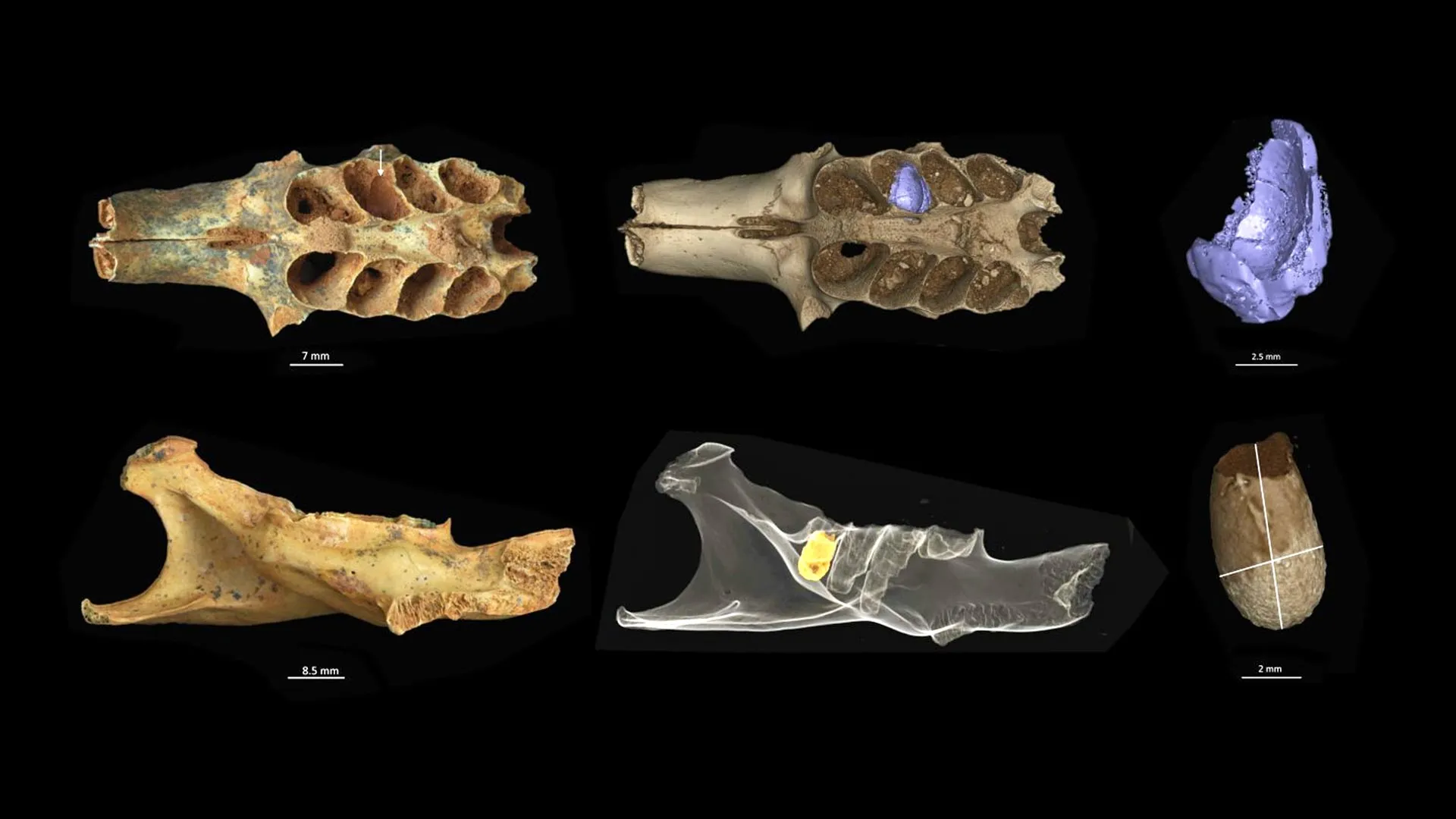
It was within this debris that a solitary burrowing bee, likely seeking a secure location to construct its nest, made a pivotal discovery. While attempting to excavate into the silt, the bee encountered the fossilized remains of a hutia. Its natural instinct to dig led it to the jawbone, where it found not solid bone, but a series of small, hollow sockets known as alveoli. These spaces, once occupied by the hutia’s teeth, were now empty. The size and shape of these natural cavities proved to be remarkably suitable for the bee’s nesting needs.
This initial discovery was far from an isolated incident. Over time, subsequent generations of bees, encountering similar conditions, began to utilize these pre-existing cavities within fossilized bones as ready-made nesting sites. The smooth, stable interiors of the alveoli offered a protected environment, shielded from the elements and potential predators. This behavior, the use of fossilized bone structures as a nesting medium, is exceptionally rare, with this Hispaniola cave providing a vivid and unprecedented example.
A Fortuitous Observation and a Challenging Correction
The significance of this discovery hinges on the meticulous observation of Lazaro Viñola Lopez, a doctoral student at the Florida Museum of Natural History, who led the excavation. During the process of collecting fossils, the standard procedure involves thoroughly cleaning out any sediment from the alveoli to present the specimen in its purest form. However, Viñola Lopez, driven by a particular interest in this specific species of hutia, which was infrequently found elsewhere on the island, adopted a more detailed approach.
He noticed that one particular cavity within a hutia jawbone exhibited a strikingly smooth inner surface, a stark contrast to the typically rough texture of bone. This anomaly immediately piqued his curiosity. His initial hypothesis, drawing from a prior experience in Montana while excavating dinosaur fossils in 2014, led him to believe he had found wasp cocoons embedded within the fossil material. At that time, he and his colleagues had documented wasp nests coexisting with fossilized remains, and he considered publishing a short paper on this occurrence.
He shared this initial assessment with fellow doctoral student Mitchell Riegler. Riegler, initially skeptical, described the project as a "niche" endeavor, given his own extensive research commitments. The idea, however, lingered, resurfacing when Riegler accepted a challenge from a former advisor to complete a scientific paper within a week. This friendly competition spurred the re-examination of the smooth-walled cavities.
Unraveling the True Identity of the Nest Builders
The team’s initial belief that they were documenting wasp nests began to unravel as they delved deeper into the scientific literature, particularly focusing on ichnofossils – traces of past biological activity. Wasp nests, typically constructed from chewed plant material mixed with saliva, are characterized by rough, irregular walls. The structures found within the hutia jaws, however, were uniformly smooth. This crucial difference led them to reconsider their initial identification.
Further research revealed that many species of burrowing bees employ a different construction technique. They often line their nests with a waxy secretion, a byproduct of their metabolic processes. This secretion creates a waterproof, polished interior, providing insulation and protection for their developing young. The smooth surfaces observed in the fossilized alveoli precisely matched this characteristic of bee nests. The realization dawned: they were not studying wasps, but bees.
This correction elevated the discovery from an interesting observation to a scientifically significant find. The use of pre-existing fossil structures without modification for nesting purposes by burrowing bees was, at the time, unprecedented. While there was one prior documented instance of burrowing bees nesting within a cave environment, and another report of bees drilling into human bones, the act of simply occupying natural cavities within fossils represented a novel behavioral adaptation.
A Rescue Mission and Expanded Discoveries
The researchers understood the profound implications of their revised findings and decided to broaden their investigation. They consulted with experts in contemporary bee behavior and undertook an exhaustive review of existing scientific literature. Viñola Lopez even returned to the Cueva de Mono to conduct a more detailed examination of its geological stratigraphy, seeking to contextualize the fossil evidence.
The research faced an unexpected hurdle when plans emerged to develop the land surrounding the cave, with proposals that included converting the cave itself into a septic tank. Recognizing the potential threat to this invaluable scientific site, the team mobilized a "rescue mission" to recover as many fossils as possible before any irreversible damage could occur. This urgent effort proved successful, yielding a significant collection of fossilized remains.
The subsequent analysis of these recovered fossils revealed that the unusual nesting behavior was not confined to hutia jaws. Nests were discovered within the pulp cavities of sloth teeth, remnants of a time when these large mammals roamed the Caribbean before human arrival. Another nest was found nestled within a hutia vertebra, occupying the space that once housed the animal’s spinal cord.
A Multi-layered Phenomenon: The "Russian Doll" Nests
CT scans of the fossilized structures provided further astonishing insights. The scans revealed that some cavities contained multiple, distinct layers of nests, stacked one inside another. This indicated that certain bee species, rather than excavating entirely new tunnels, would reuse existing ones if they became vacant. In one remarkable instance, six individual bee nests were found meticulously arranged within a single hutia alveolus, resembling a set of "Russian dolls." This behavior suggests an efficient adaptation to resource scarcity, where available nesting spaces are maximized.
Environmental Drivers for Cave Dwelling
The study also proposes a compelling explanation for why these bees gravitated towards such an unconventional nesting environment. The region surrounding the Cueva de Mono is characterized by karst topography – a landscape of sharp, eroded limestone formations. This type of terrain typically lacks stable, deep soils necessary for burrowing insects.
"The area we were collecting in is karst, so it’s made of sharp, edgy limestone, and it’s lost all of its natural soils," Riegler explained. "I actually fell on it at one point, so I can tell you all about it."
In such environments, any soil that does accumulate on the surface is prone to being washed away, often finding its way into caves. These subterranean deposits can create pockets of suitable material, potentially offering some of the only viable nesting conditions for burrowing bees in the region. The cave, therefore, became a sanctuary, providing a stable and protected alternative to the challenging surface conditions.
Implications for Understanding Life’s Adaptability
The discovery of these fossilized bee nests within the Cueva de Mono holds significant implications for our understanding of evolutionary adaptation and the resilience of life. It demonstrates how organisms can exploit novel resources and environments when traditional options are limited. The study underscores the importance of ichnofossils, not just as indicators of past movement or feeding, but as records of complex behavioral strategies.
The continued research into other fossils recovered from the cave promises further revelations about the ecological dynamics of ancient Hispaniola. This remarkable finding serves as a potent reminder that even the most seemingly inhospitable environments can harbor thriving ecosystems, and that the intricate dance of life can unfold in ways far beyond our initial imaginings. The Cueva de Mono, once a silent repository of skeletal remains, has become a vibrant testament to the enduring power of adaptation, where the remnants of a prehistoric meal have given rise to a new generation of life.