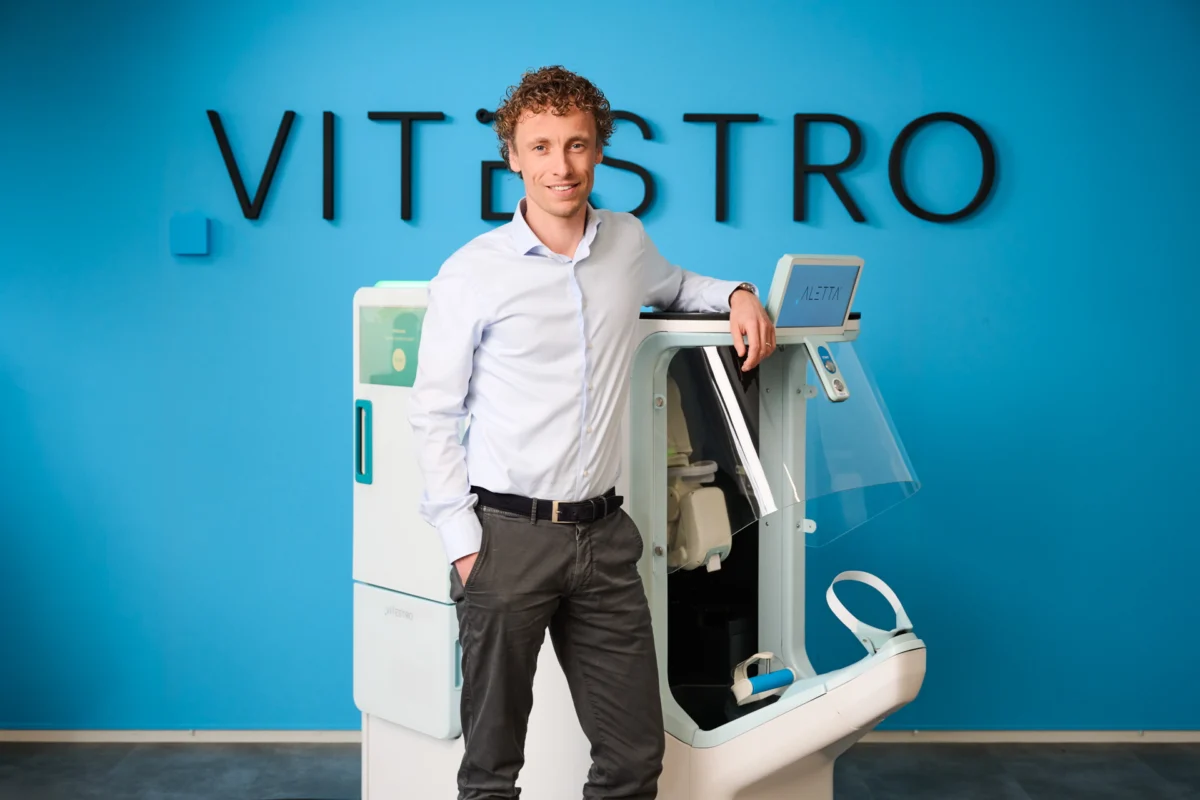
Vitestro, a pioneering Dutch medical technology firm, has successfully closed an oversubscribed Series B financing round, securing an impressive $70 million. This substantial capital infusion is earmarked to significantly accelerate the clinical validation, manufacturing scale-up, and market preparation of its groundbreaking Aletta Autonomous Robotic Phlebotomy Device (ARPD). The funding paves the way for Vitestro to expand its reach, aiming for broader adoption of its innovative autonomous blood-draw technology across hospitals and laboratories, addressing critical challenges within the healthcare ecosystem.
The successful Series B round underscores a growing industry confidence in automated solutions for routine clinical procedures. Vitestro’s Aletta ARPD platform is specifically engineered to automate the often-labor-intensive and variable process of routine blood collection in diverse clinical settings. This development marks a pivotal step toward transforming one of healthcare’s most common invasive procedures, promising enhanced efficiency, improved patient experience, and greater standardization of pre-analytical processes.
A Strategic Investment in Healthcare Innovation
The $70 million financing round drew significant strategic backing from a consortium of prominent healthcare organizations, signaling a strong industry endorsement of Vitestro’s vision. Key strategic investors include the Labcorp Venture Fund, Mayo Clinic, and Sutter Health—institutions at the forefront of medical innovation and patient care delivery. Their participation highlights a collective imperative within the healthcare sector to integrate advanced technologies that can alleviate operational pressures, enhance service quality, and improve patient outcomes.
Complementing this strategic support, the funding round also attracted substantial investment from a diverse group of financial investors. These include InterVest, MGFO, PGGM, Puma Venture Capital, and ROM Utrecht, demonstrating broad confidence in Vitestro’s market potential and technological prowess. Existing investors, such as Invest-NL, the EIC Fund, Fred Moll, NYBC Ventures, and Sonder Capital, reaffirmed their commitment, further solidifying the company’s financial foundation. The oversubscribed nature of the round is a testament to the compelling value proposition Vitestro offers in a rapidly evolving healthcare landscape.
The Genesis of Aletta: Addressing a Foundational Challenge
The journey towards automated phlebotomy has been driven by persistent challenges inherent in traditional blood collection. For decades, phlebotomy has remained largely a manual procedure, heavily reliant on human skill and experience. This human-dependent process, while fundamental to diagnostics, is susceptible to variability, can be a source of patient anxiety, and contributes to a significant portion of pre-analytical errors that can impact diagnostic accuracy.
In March 2025, The Dark Report, a leading publication focused on the laboratory industry, provided an in-depth look at Vitestro’s development of the ARPD. At that time, the company had recently achieved a critical milestone: CE mark approval in Europe. This regulatory clearance signaled the device’s compliance with European health, safety, and environmental protection standards, allowing its commercialization within the European Economic Area. Concurrently, Vitestro reported highly promising clinical trial results, showcasing a remarkable 95% first-stick success rate. This figure is particularly significant, as it directly addresses one of the most common patient complaints and a major cause of inefficiency in manual phlebotomy. Furthermore, the trials indicated strong patient acceptance, a crucial factor for any technology seeking widespread adoption in patient-facing clinical environments. These early successes firmly positioned the Aletta technology as a potent solution to the burgeoning phlebotomy staffing shortages and the pervasive issue of pre-analytical variability in clinical laboratories.
Toon Overbeeke, chief executive officer and co-founder of Vitestro, emphasized the global significance of their mission. "Closing our Series B financing reflects strong conviction in our mission to establish a new standard in autonomous robotic venous access and diagnostic blood collection," Overbeeke stated. "Diagnostic blood collection remains the highest-volume invasive medical procedure globally, with billions of procedures performed annually." This statement underscores the immense scale of the problem Vitestro aims to solve and the potential impact of its solution. The sheer volume of blood draws performed each year—estimated to be over 5 billion globally—translates into a significant operational burden and a vast opportunity for automation to enhance efficiency and quality.
The Aletta Platform: A Convergence of Advanced Technologies
At its core, the Aletta system represents a sophisticated convergence of cutting-edge technologies: multimodal imaging, advanced robotics, and artificial intelligence (AI). This synergy allows the device to autonomously identify veins with high precision, guide needle insertion accurately, and collect blood samples consistently. The multimodal imaging capabilities provide detailed real-time visualization of the patient’s vascular anatomy, allowing the AI to select the optimal venipuncture site. The robotic arm then executes the insertion with micro-precision, minimizing patient discomfort and the risk of complications.
The platform is meticulously designed to perform routine diagnostic blood draws, a segment of phlebotomy that accounts for the vast majority of procedures. By automating these high-volume tasks, Aletta offers laboratories an unprecedented opportunity to standardize collection quality, significantly reducing human-dependent variability that can lead to pre-analytical errors. Such errors, which can occur at any stage before laboratory analysis, are a well-documented source of diagnostic inaccuracies and can lead to costly redraws, delayed results, and compromised patient care. Automating the collection process provides a controlled, repeatable method, ensuring consistent specimen quality and integrity from the outset.
Addressing the Phlebotomy Staffing Crisis and Operational Imperatives
For clinical laboratory leaders grappling with persistent staffing shortages and ever-increasing specimen volumes, the investment in Vitestro highlights a growing industry consensus on the necessity of automating healthcare’s most common clinical procedures. The United States, like many developed nations, faces a chronic shortage of skilled phlebotomists. The American Society for Clinical Pathology (ASCP) has consistently reported significant vacancy rates in phlebotomy positions, a trend exacerbated by an aging workforce and increasing demand for diagnostic testing. These shortages strain existing staff, lead to longer patient wait times, and can impact the overall efficiency and quality of laboratory services.
Robotic platforms like Aletta offer a compelling strategy to stabilize phlebotomy operations. By assuming the burden of routine blood draws, these systems can allow healthcare organizations to redeploy skilled phlebotomists to more complex cases, training, or patient education roles. This strategic reallocation of human resources can improve workflow predictability, alleviate burnout among existing staff, and maintain high patient throughput, particularly in high-volume outpatient settings where efficiency is paramount. The technology doesn’t aim to replace human phlebotomists entirely but rather to augment their capabilities, enabling them to focus on tasks requiring higher cognitive function, empathy, and problem-solving skills, ultimately elevating the profession.
Beyond staffing, the drive for automation is also deeply rooted in the pursuit of quality and efficiency. Pre-analytical errors, which occur before samples reach the analytical phase, are estimated to account for up to 70% of all laboratory errors. A significant portion of these errors can be attributed to manual blood collection procedures, including incorrect tube filling, hemolysis, and mislabeling. By automating the process, Vitestro’s Aletta system can minimize these human-induced variabilities, leading to more reliable samples, reduced need for redraws, and faster, more accurate diagnostic results. This directly translates to cost savings for healthcare systems and improved patient safety.

A Chronology of Progress and Future Horizons
Vitestro’s journey reflects a methodical approach to medical device development and market entry. Following its establishment, the company meticulously developed its technology, securing initial seed and Series A funding rounds to fuel research and development. The critical CE mark approval in Europe provided the regulatory foundation for market entry, paving the way for initial clinical deployments and further data collection. The positive clinical trial results, demonstrating high first-stick success and patient acceptance, were instrumental in building confidence among investors and potential healthcare partners.
The current Series B funding marks an inflection point. Vitestro plans to strategically deploy this capital to advance the next generation of its Aletta platform, ensuring continuous innovation and refinement of the technology. This includes incorporating user feedback, enhancing AI algorithms, and potentially expanding the system’s capabilities. Concurrently, the company will conduct additional clinical studies, which are vital for gathering more extensive data on performance, safety, and clinical utility across diverse patient populations and healthcare settings. These studies will be crucial for broader commercial acceptance and regulatory submissions.
A significant portion of the funding is also allocated to scaling manufacturing operations. As Vitestro prepares for broader commercial rollout, particularly in Europe, ensuring a robust and efficient production pipeline is paramount. The company’s long-term strategy includes eventual entry into the United States market, a move that will necessitate navigating the rigorous regulatory landscape of the Food and Drug Administration (FDA) through its de novo regulatory pathway. This pathway is designed for novel devices for which no legally marketed predicate device exists, reflecting the truly innovative nature of the Aletta system. Successfully obtaining FDA clearance would open up the largest and most lucrative medical device market globally, solidifying Vitestro’s position as a leader in autonomous phlebotomy.
Investor Perspectives: A Strategic Bet on Automation
The involvement of major healthcare players like Labcorp, Mayo Clinic, and Sutter Health as strategic investors is particularly insightful. Labcorp, a global leader in clinical laboratory services, faces the front lines of specimen collection challenges daily. Their investment underscores a strategic imperative to adopt technological solutions that can enhance efficiency, standardize quality, and mitigate workforce pressures across their vast network of patient service centers and clinical sites. It signifies a proactive approach to future-proofing their operations and maintaining leadership in diagnostic innovation.
Similarly, Mayo Clinic and Sutter Health, both renowned for their commitment to patient-centered care and medical innovation, see the Aletta system as a tool to improve patient experience and operational excellence within their integrated healthcare systems. For patients, the prospect of a robotic blood draw, particularly for those with difficult-to-access veins or a fear of needles (trypanophobia), could significantly reduce anxiety and discomfort. For healthcare providers, it represents an opportunity to streamline workflows, reduce errors, and free up human staff for more complex or empathetic interactions. These investments are not merely financial; they represent a strategic partnership aimed at integrating transformative technology into the very fabric of healthcare delivery.
The Broader Impact: Transforming Diagnostic Blood Collection and Beyond
The implications of autonomous robotic phlebotomy extend far beyond simply replacing a manual task. It represents a paradigm shift in how diagnostic blood collection is perceived and executed.
Firstly, from a patient perspective, the potential for a virtually painless, highly accurate, and consistent blood draw experience is immense. Reducing the need for multiple needle sticks, a common occurrence with difficult venipuncture, can significantly alleviate patient anxiety and improve overall satisfaction with healthcare services.
Secondly, for clinical laboratories, the benefits are multifaceted. Standardized sample collection reduces pre-analytical variability, leading to more reliable test results. This in turn can improve diagnostic accuracy, reduce the need for costly and time-consuming redraws, and potentially shorten turnaround times for critical tests. In an era where rapid diagnostics are increasingly vital, especially for conditions like sepsis or cardiac events, this efficiency gain is invaluable.
Thirdly, the technology offers a robust solution to the persistent healthcare workforce challenges. By automating routine tasks, organizations can optimize their human capital, allowing skilled professionals to focus on higher-value activities. This can also help in training new phlebotomists by providing a consistent baseline for procedures, ensuring that even novice practitioners can achieve high success rates with robotic assistance.
Looking further ahead, the successful deployment and adoption of autonomous phlebotomy could serve as a precedent for automating other routine invasive medical procedures. The principles of precision robotics, multimodal imaging, and AI-driven decision-making demonstrated by Aletta could be adapted to areas such as IV line insertion, medication administration, or even minor surgical procedures, gradually expanding the role of robotics in direct patient care.
The Road Ahead: Commercialization, Regulation, and Market Expansion
As Vitestro prepares for broader commercial rollout in Europe, the focus will be on seamless integration of the Aletta system into diverse clinical environments, from large hospital networks to smaller outpatient clinics. This will involve comprehensive training programs for staff, robust technical support, and continuous refinement based on real-world usage data. The journey into the United States market, while challenging due to FDA regulations, represents a significant growth opportunity. Successfully navigating the de novo pathway will require extensive data, rigorous testing, and a clear demonstration of the device’s safety and effectiveness.
The market for medical robotics and automation in healthcare is experiencing exponential growth, driven by technological advancements, increasing healthcare demands, and cost pressures. Reports from various market research firms project the global medical robotics market to reach tens of billions of dollars within the next decade, with significant contributions from diagnostic and surgical automation. Vitestro, with its innovative Aletta system and strong financial backing, is well-positioned to capture a substantial share of this burgeoning market.
A forthcoming issue of The Dark Report is slated to feature in-depth interviews with Vitestro executives, offering a deeper analysis of what autonomous robotic phlebotomy could mean for clinical laboratories. This will include detailed discussions on its potential impact on staffing models, workflow efficiency, and crucial specimen quality metrics, providing invaluable insights for laboratory professionals and healthcare administrators alike.
In conclusion, Vitestro’s $70 million Series B funding round is more than just a financial milestone; it is a powerful affirmation of the healthcare industry’s commitment to innovation and automation. The Aletta Autonomous Robotic Phlebotomy Device stands poised to redefine diagnostic blood collection, promising a future where precision, efficiency, and an enhanced patient experience are the new standard.
—Janette Wider