

Emory University researchers have announced a significant breakthrough in the field of many-body physics, utilizing a specialized machine learning framework to decode the intricate and often counterintuitive interactions governing particles in complex systems. The study, published in the Proceedings of the National Academy of Sciences (PNAS), marks a departure from traditional "black box" artificial intelligence applications by demonstrating that neural networks can be engineered to derive fundamental physical laws directly from experimental data. By focusing on non-reciprocal forces—interactions where one particle influences another in a manner that is not mirrored in return—the team has provided the most precise description to date of dusty plasma, a state of matter that permeates the universe from the rings of Saturn to the smoke of terrestrial wildfires.
The research was spearheaded by a collaborative team of experimental and theoretical physicists at Emory University, including Justin Burton, a professor of experimental physics, and Ilya Nemenman, a professor of theoretical physics. Their work addresses a long-standing challenge in the physical sciences: how to accurately model systems where individual components interact in asymmetrical ways. These non-reciprocal forces are notoriously difficult to capture using standard mathematical models, yet they are essential for understanding the behavior of everything from industrial fluids to the collective movement of living cells.
Decoding the Complexity of Non-Reciprocal Forces
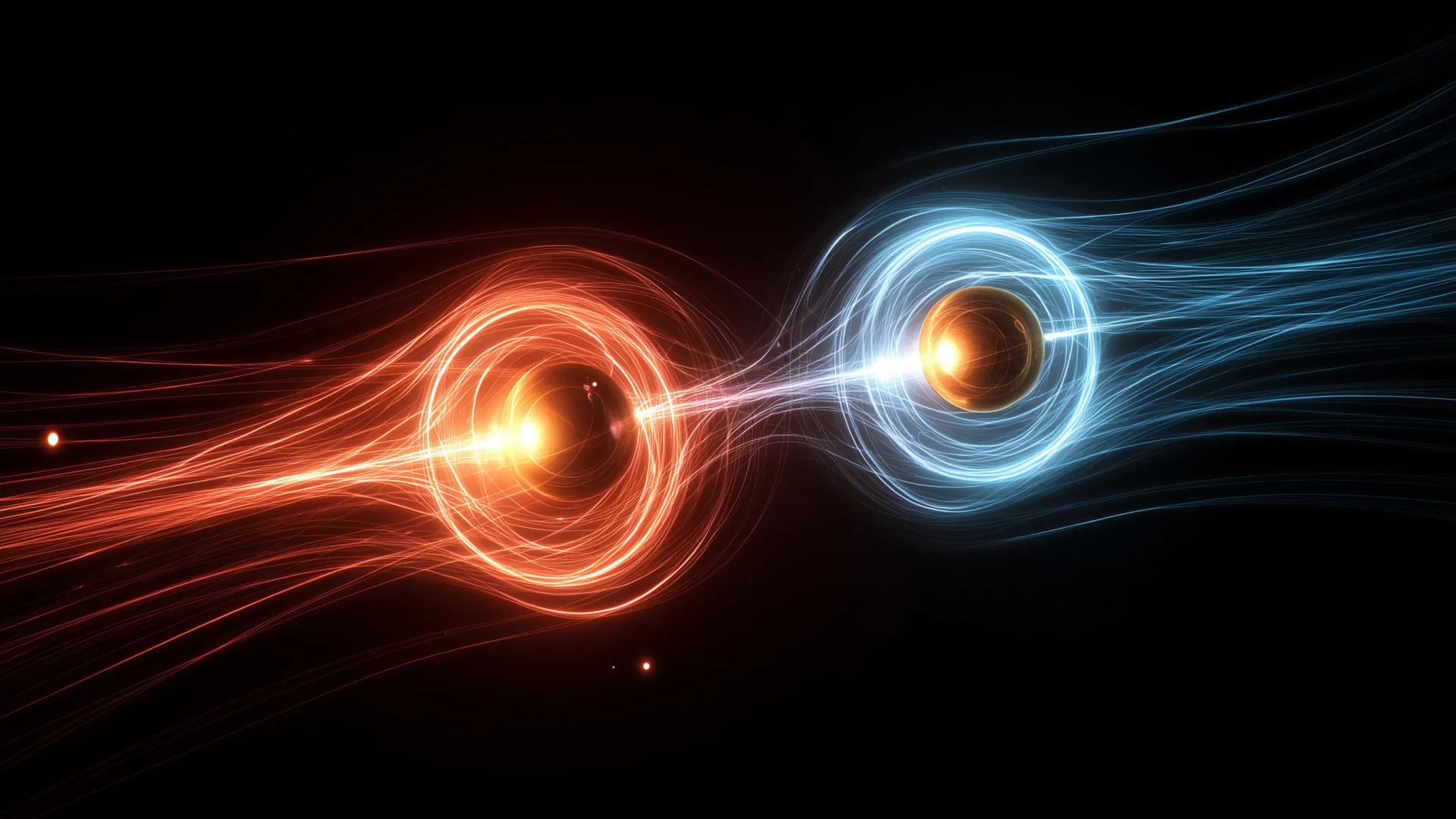
In classical Newtonian physics, the third law states that for every action, there is an equal and opposite reaction. However, in "open" systems or systems out of equilibrium—such as particles suspended in a moving fluid or plasma—this symmetry is often broken. These are known as non-reciprocal forces. To illustrate this, the researchers use the analogy of two boats traveling across a lake. As the lead boat moves, it creates a wake that influences the boat following behind it. Conversely, the trailing boat’s wake may have a negligible or entirely different effect on the lead boat.
In the context of dusty plasma, these interactions are governed by complex electromagnetic fields and the flow of ions. The Emory team’s AI model achieved a staggering 99% accuracy in describing these forces, revealing that a leading particle typically attracts a trailing particle, while the trailing particle repels the leader. While the existence of such asymmetry was hypothesized by some theorists, the new AI-driven approach provided the first precise mathematical approximation of the phenomenon, correcting previous assumptions that had oversimplified these interactions.
Dusty Plasma: A Window into the Universe’s Most Common State
To test their AI framework, the researchers focused on "dusty plasma," often referred to as the fourth state of matter. While solids, liquids, and gases are familiar in daily life, plasma makes up approximately 99.9% of the visible universe. It consists of an ionized gas where electrons and ions move independently, granting the medium unique properties like high electrical conductivity. Dusty plasma specifically includes additional macroscopic charged particles, such as grains of dust or plastic.
The study of dusty plasma has significant implications for both space exploration and terrestrial safety. In the vacuum of space, such as on the Moon’s surface, the absence of a thick atmosphere and the presence of weak gravity allow charged dust particles to hover. This electrostatic levitation is the reason Apollo astronauts found their suits perpetually covered in abrasive lunar dust, which posed risks to both equipment and human health. On Earth, dusty plasma is observed in the ionosphere and during intense wildfires, where soot and smoke particles become charged. These charged clouds can create significant electromagnetic interference, disrupting the radio communications essential for emergency responders and firefighters.
Advanced Tomographic Imaging and Experimental Design
The experimental phase of the project, led by Justin Burton, involved recreating these complex environments within a controlled laboratory setting. The team utilized a vacuum chamber to suspend tiny plastic particles in a plasma field. By manipulating gas pressures and electrical charges, the researchers could simulate various real-world conditions.
The primary challenge lay in tracking these particles in three-dimensional space with enough precision to feed meaningful data into a neural network. To solve this, Burton and lead author Wentao Yu developed a sophisticated tomographic imaging system. This method involves a laser sheet that scans rapidly through the vacuum chamber while a high-speed camera captures thousands of frames per second. By reconstructing these 2D snapshots into a 3D model, the team could track the trajectories of dozens of individual particles simultaneously over time. This high-fidelity spatial data served as the foundational training set for the neural network.
The Neural Network: Moving Beyond the Black Box
The theoretical component of the study, overseen by Ilya Nemenman, involved designing a neural network capable of scientific discovery rather than just pattern recognition. A common criticism of AI in science is the "black box" problem—where a model provides an answer but offers no insight into the underlying logic. The Emory team bypassed this by constraining their neural network with known physical principles while leaving room for the AI to infer unknown variables.
"When you’re probing something new, you don’t have a lot of data to train AI," Nemenman explained. This necessitated a year-long development process to structure a network that could learn from small, experimental datasets. The final architecture separated particle motion into three distinct physical components:
- Drag forces: Influences resulting from the particle’s velocity through the medium.
- Environmental forces: External factors such as gravity and the confinement of the vacuum chamber.
- Inter-particle forces: The complex, non-reciprocal interactions between the particles themselves.
By isolating these variables, the researchers could verify exactly how the AI arrived at its conclusions, ensuring the results were grounded in physical reality.
Challenging Long-Held Theoretical Assumptions
The AI’s high-precision analysis led to the correction of several long-standing theoretical assumptions in plasma physics. One such assumption was the relationship between a particle’s physical size and its electric charge. Traditional models suggested a direct, linear proportion: if a particle was twice as large, it carried twice the charge. However, the AI revealed that this relationship is far more nuanced, influenced heavily by the surrounding plasma’s density and temperature.
Furthermore, the team investigated the "screening length" of forces—the distance at which the electrical influence of one particle on another begins to fade. Previous theories held that this decay happened exponentially and was independent of the particle’s size. The AI model demonstrated that the size of the particle significantly dictates the rate at which these forces weaken over distance. These findings were subsequently confirmed through targeted laboratory experiments, validating the AI’s role as a tool for genuine scientific discovery.
A Cross-Disciplinary Timeline of Collaboration
The project represents years of interdisciplinary effort, beginning as a series of weekly meetings between the experimental and theoretical departments at Emory. The study’s first author, Wentao Yu, conducted the bulk of the work as an Emory PhD student before transitioning to a postdoctoral fellowship at the California Institute of Technology (Caltech). Co-author Eslam Abdelaleem, also a former Emory graduate student, contributed significantly before moving to Georgia Tech.
The research was primarily funded by the National Science Foundation (NSF), with additional support from the Simons Foundation. Vyacheslav (Slava) Lukin, program director for the NSF Plasma Physics program, highlighted the study as a prime example of how AI can bridge the gap between different scientific disciplines. "The dynamics of these complex systems is dominated by collective interactions that emerging AI techniques may help us to better describe, recognize, understand and even control," Lukin stated.
Broader Applications: From Cellular Biology to Industrial Materials
While the study focused on dusty plasma, the researchers emphasize that the framework they developed is "universal." The ability to accurately model non-reciprocal forces has immediate applications in various fields:
- Biophysics: Ilya Nemenman, a specialist in collective motion, notes that the same principles of interaction apply to living cells. Understanding how cells influence one another non-reciprocally could provide breakthroughs in oncology, particularly in understanding how cancer cells detach from a primary tumor and migrate to create metastatic growths.
- Materials Science: In the industrial sector, the behavior of complex fluids like paints, inks, and lubricants is dictated by many-body interactions. More precise models could lead to the development of more stable and efficient materials.
- Sociology and Ecology: The study of collective behavior, such as the flocking of birds or the movement of human crowds, relies on understanding how individual agents respond to the movements of their neighbors.
Nemenman is set to bring these methodologies to the Konstanz School of Collective Behavior in Germany, where he will teach international students how to apply AI to infer the physics of collective motion in biological systems.
The Role of Human Oversight in the Age of AI Discovery
Despite the success of the machine learning model, the Emory team remains firm on the necessity of human expertise. The AI did not "discover" the laws in a vacuum; it required a carefully constructed environment and a neural network designed with physical constraints.
"It takes critical thinking to develop and use AI tools in ways that make real advances in science, technology, and the humanities," Justin Burton noted. The researchers view AI not as a replacement for the scientist, but as a sophisticated lens that allows them to see patterns and details previously obscured by the sheer complexity of many-body systems. As AI continues to integrate into the scientific workflow, the Emory study serves as a blueprint for how researchers can maintain transparency and physical accuracy in the pursuit of new knowledge.
The successful application of this physics-based neural network—which notably can run on a standard desktop computer rather than requiring a supercomputer—suggests a democratized future for high-level physics research. By combining the rigorous standards of experimental physics with the computational power of modern AI, scientists are now poised to "boldly go" into the unexplored territories of the physical world, uncovering the hidden rules that govern the universe’s most complex systems.









Leave a Reply