Western blotting, a fundamental technique in molecular biology, remains indispensable for detecting and quantifying specific proteins within complex biological samples. Its high sensitivity and specificity have solidified its role across diverse research fields, from basic cell biology to pharmaceutical development. However, the integrity of scientific literature, particularly in studies relying on Western blot data, faces persistent challenges rooted in reproducibility concerns. A significant portion of these issues stems from inadequate data normalization strategies, with instances of image manipulation and poor normalization frequently implicated in retractions and corrections of published research, casting a shadow over scientific credibility and progress. The scientific community is now grappling with the urgent need to adopt more robust normalization practices to safeguard the reliability of its findings.
The Bedrock of Reliability: Understanding Data Normalization in Western Blotting
At its core, reliable data normalization is paramount to ensuring that any observed differences in protein band intensity accurately reflect genuine biological variations rather than experimental inconsistencies. Factors such as uneven sample loading, pipetting inaccuracies, or inconsistent protein transfer from gel to membrane can introduce significant non-biological variability. While meticulous experimental design and execution are crucial to minimize such errors, data normalization serves as a critical corrective step, adjusting for these non-biological disparities before comparative analysis of target proteins. Adherence to best practices in Western blotting, coupled with the rigorous application of appropriate data normalization, is not merely a recommendation but an imperative for generating reproducible results and upholding the integrity of the scientific record.
Historically, researchers have predominantly relied on normalizing Western blot data against single "housekeeping proteins" (HKPs). These internal loading controls are selected based on specific criteria: they must not be the target protein of interest, and they should exhibit abundant, ubiquitous, and consistent expression across all samples. Common HKPs include β-actin, GAPDH, and β-tubulin, chosen for their involvement in fundamental cellular processes, their high abundance, and their presumed constitutive expression, which also makes antibodies against them widely available and their detection relatively straightforward.
The Unforeseen Limitations of Single Protein Normalization
Despite their widespread use, a growing body of evidence highlights significant and often underestimated risks associated with HKP-based normalization. The assumption of constant expression for HKPs across various experimental conditions, tissue types, or developmental stages is frequently flawed. For instance, studies have shown that β-actin expression can fluctuate significantly in response to cellular stress, drug treatments, or changes in cell proliferation rates. Similarly, GAPDH, while involved in glycolysis, can be upregulated under hypoxic conditions or in certain cancers, making it an unreliable internal control in such contexts. β-tubulin, a structural component of microtubules, can also exhibit variable expression depending on the cell cycle phase or differentiation state. These biological fluctuations, often subtle and overlooked, can lead to misinterpretation of target protein expression, falsely indicating changes where none exist or obscuring genuine biological effects.
Furthermore, HKP-based normalization introduces its own set of experimental challenges. The process typically requires an additional antibody incubation step, consuming a valuable detection channel in multiplex assays and potentially necessitating stripping and reprobing of membranes. Each additional step increases the risk of experimental variability, from incomplete stripping affecting subsequent antibody binding to inconsistent reprobing efficiency. The linear dynamic range of HKP detection can also be narrower than desired, especially for highly abundant proteins, leading to signal saturation and inaccurate quantification. This issue is compounded by the fact that the optimal loading amount for an HKP may not be optimal for the target protein, requiring careful titration and validation experiments that are often time-consuming and resource-intensive. The effort required to rigorously validate HKP stability for every specific experimental setup, and the inherent risk of subtle biases, underscore the pressing need for more universally robust and less error-prone alternatives. A 2015 study, for example, revealed that a significant percentage of published Western blots failed to adequately validate their HKP, leading to questions about the validity of their conclusions.
A New Standard Emerges: Total-Protein Normalization (TPN)

In response to these pervasive challenges, Total-Protein Normalization (TPN) has emerged as a superior and more reliable strategy. TPN fundamentally shifts the normalization paradigm by measuring the aggregate protein content of each lane and normalizing the target protein signal to this total. Unlike HKP normalization, which relies on a single proxy protein, TPN quantifies all proteins present in a given sample lane, thereby generating a normalization factor that is inherently more comprehensive and stable. This method directly addresses the critical limitations of HKP normalization, offering a more accurate reflection of true biological differences.
The core strength of TPN lies in its resilience to biological fluctuations that can affect individual proteins. Changes in cell cycle, tissue type, disease state, or treatment conditions rarely alter the total protein content of a sample proportionally enough to compromise the normalization process. This makes TPN exceptionally well-suited for comparative studies across diverse and challenging sample types, where HKP expression might be highly variable. For instance, in developmental biology studies involving rapidly changing cellular environments or in oncology research comparing normal and cancerous tissues, TPN provides a stable baseline that HKPs often cannot. This stability ensures that observed changes in target protein levels are genuinely attributable to experimental variables rather than artifacts of normalization.
Beyond its biological robustness, TPN offers significant advantages in workflow efficiency and data quality. Since TPN does not require specific antibodies for total protein measurement, it eliminates the need for multiple antibody incubations and the laborious, potentially damaging stripping and reprobing steps associated with HKP methods. Once an initial sample dilution series is optimized to determine the linear range, a single gel and blot can serve as the reference for all downstream comparisons, streamlining the experimental process. This simplified workflow reduces hands-on time, minimizes potential sources of experimental error, and significantly enhances reproducibility. Moreover, by freeing up valuable detection channels, TPN facilitates multiplex assays, allowing researchers to simultaneously investigate multiple proteins of interest from a single blot, thereby maximizing data yield and efficiency.
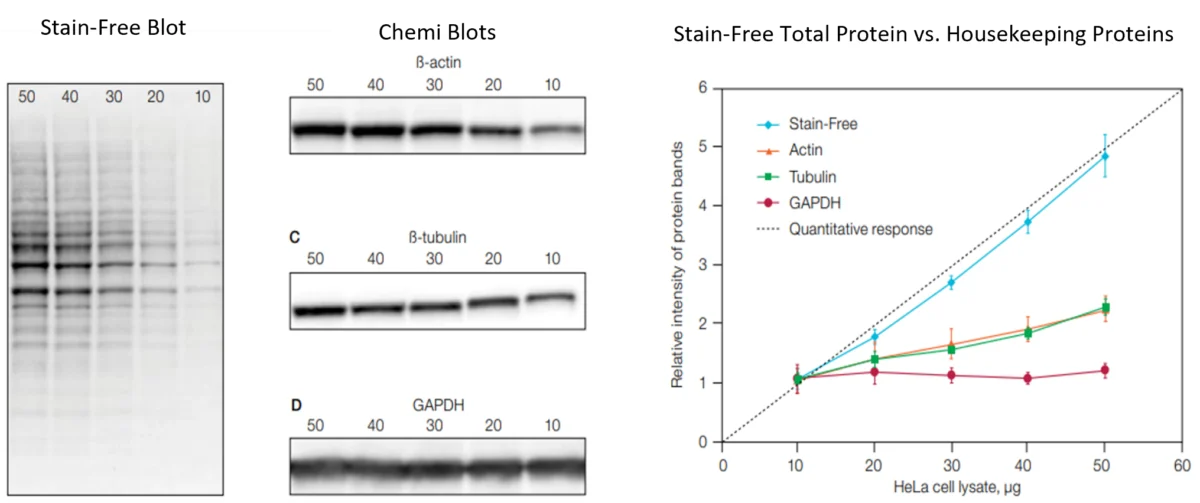
Crucially, TPN establishes a true scalar relationship between the loaded protein amount and signal intensity. By normalizing bands to the total protein in each lane, researchers can accurately quantify both the target protein and the loading control within a linear dynamic range. This transparency and quantitative precision satisfy the increasingly stringent expectations of journal reviewers and contribute significantly to data integrity, ensuring that reported differences in target band intensity genuinely represent biological changes.
Total protein stains, such as Ponceau S or Coomassie Blue, traditionally used for TPN, are typically less sensitive than antibody-based chemiluminescent immunodetection for HKPs. This apparent limitation actually works to the researcher’s advantage by reducing the risk of signal saturation within typical loading ranges (e.g., 10–50 µg of cell lysate). The lower intrinsic sensitivity allows for accurate quantification of both high- and low-abundance proteins within a single experiment, a critical feature for studies investigating proteins with vastly different expression levels.
Table 1: Housekeeping Protein vs. Total Protein Normalization
| Feature | Housekeeping Protein Normalization | Total Protein Normalization |
|---|---|---|
| Reference | Single endogenous protein | Total protein content |
| Antibody Requirement | Yes | No |
| Susceptibility to Biological Variability | High | Very Low |
| Risk of Signal Saturation | Higher | Minimal |
| Control Experiments | Time-consuming, multiple rounds of optimization | Simple workflow, single optimization experiment |
| Effect on Multiplexing | Consumes a detection channel | All channels available for targets |
| Detection of Loading/Transfer Errors | Indirect inference | Direct visualization of total lane protein |
Technological Advancement: Stain-Free Technology for Streamlined Accuracy
The evolution of TPN has been significantly propelled by technological innovations, notably Stain-Free methods. Introduced to overcome variability issues associated with traditional protein stains and different membrane sensitivities, Stain-Free technology provides a non-destructive way to visualize total protein on gels and blots without interfering with subsequent immunodetection. This innovative approach integrates a proprietary trihalo compound directly into the polyacrylamide gel. Upon brief UV activation, this compound covalently modifies tryptophan residues, leading to enhanced protein fluorescence. This enables rapid and robust visualization of total protein content without the need for traditional staining and destaining steps.
A key advantage of Stain-Free TPN is the ability to image protein at every critical step of the Western blot workflow: after electrophoresis, during transfer, and post-transfer on the membrane. This multi-stage imaging capability allows for immediate assessment of protein separation quality and transfer efficiency, providing real-time feedback that traditional HKP methods cannot. This direct visualization of total lane protein also offers a far more immediate and intuitive way to detect loading or transfer errors compared to the indirect inferences made with HKPs.

The workflow for Stain-Free TPN is considerably simplified compared to HKP normalization. A single gel and blot suffice for all control experiments, eliminating the need for additional buffers, reagents, or specialized equipment beyond a compatible imaging system. This seamless integration with existing Western blot workflows makes Stain-Free TPN a highly accessible and efficient solution. As a result, Stain-Free TPN consistently establishes a linear and scalar response across a wide range of protein loads, enabling researchers to accurately quantify both target proteins and total protein within a broad linear dynamic range. Comparative studies, such as that by Hammond et al. (2020), have graphically demonstrated the superior linearity and reliability of stain-free total protein measurement over immunodetection of common HKPs across various cell lysate concentrations.
Aligning with Emerging Editorial Guidelines: A Call for Journal Leadership
The scientific community’s increasing awareness of normalization challenges has spurred a critical reevaluation of reporting standards. Reflecting this growing focus on robust normalization, several influential scientific journals have updated their submission guidelines. Prominent examples include the Journal of Biological Chemistry, the Journal of Cell Biology, and various AACR Journals, which now increasingly highlight TPN as the preferred approach over HKP-based methods. These revisions underscore a collective commitment to enhancing transparency, reproducibility, and the overall rigor of published experimental results. This shift is not merely a preference but a recognition of TPN’s superior ability to provide quantitatively sound data.
This evolving landscape calls for broader adoption of comparable standards across the scientific literature. For journal editors and reviewers, advocating for and recommending TPN establishes a clear, objective standard that significantly streamlines the peer-review process. By setting explicit expectations for authors regarding normalization strategies, journals can reduce the likelihood of post-publication corrections or retractions that often stem from normalization errors. More importantly, this proactive approach ensures that quantitative Western blot data accurately reflect biological relevance, thereby enhancing the overall integrity and trustworthiness of scientific publications. The potential for such a standardized approach to mitigate the reproducibility crisis, which costs research institutions billions annually and erodes public trust in science, is immense.
A Call to Action: Advocating for Transparency and Standardized Data Normalization
Western blotting, despite its challenges, will undoubtedly remain a foundational tool in molecular and cellular biology for the foreseeable future. However, the credibility and impact of the insights derived from this technique are intrinsically linked to the rigor of its data normalization. The widespread adoption of Total-Protein Normalization as the default standard for quantitative Western blot analyses is not merely a technical upgrade; it is a critical step towards safeguarding the scientific record, accelerating the pace of reproducible research, and nurturing the next generation of high-quality scientific discoveries.
The necessary technologies to significantly improve Western blot normalization are not nascent or inaccessible. Commercially available solutions, ranging from established total protein stains to advanced stain-free imaging systems like those offered by Bio-Rad Laboratories, are routinely utilized across research laboratories worldwide. The bottleneck is no longer technological innovation but decisive editorial leadership. By proactively updating submission guidelines to reflect and enforce current best practices in normalization, journal editors possess a unique and powerful leverage point. They can play a pivotal role in strengthening the quality, reproducibility, and overall rigor of published protein research, fostering an environment where scientific findings are not just novel but also unequivocally reliable. This collective action will not only benefit individual researchers but will also solidify the foundation upon which future scientific advancements are built, ensuring that the pursuit of knowledge remains robust and trustworthy. Kenneth J. Oh, Global Marketing Manager for Protein Quantitation at Bio-Rad Laboratories, emphasizes that this is a critical juncture for the scientific community to unite in embracing practices that ensure the highest standards of data integrity.