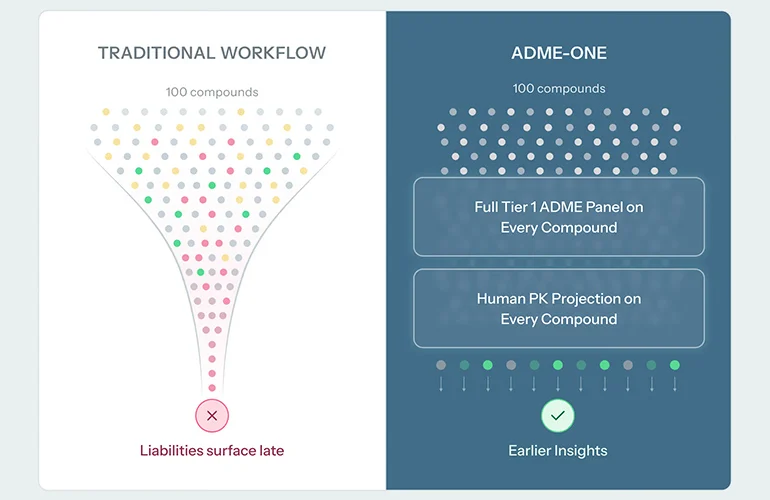
A significant paradigm shift is underway in small-molecule drug discovery, as a pioneering collaboration between Ginkgo Datapoints, Tangible Scientific, and Inductive Bio introduces the ADME-One platform. This innovative service leverages the combined power of artificial intelligence (AI), advanced automation, and streamlined compound logistics to fundamentally alter when critical Absorption, Distribution, Metabolism, and Excretion (ADME) decisions are made. Traditionally, comprehensive ADME profiling has been an intensive, resource-heavy step reserved for lead optimization, often occurring only after a lead series has already been established. The ADME-One platform is designed to pull these crucial pharmacokinetic (PK) insights much earlier into the drug discovery process, specifically to the hit identification stage, promising to accelerate development, reduce costs, and improve the quality of therapeutic candidates.
The Historical Challenge of ADME in Drug Discovery
For decades, the pharmaceutical industry has grappled with the inherent complexities of drug development, a process characterized by high costs, lengthy timelines, and alarmingly low success rates. A primary contributor to this attrition, particularly in preclinical and early clinical stages, has been suboptimal ADME properties. ADME refers to how a drug is absorbed into the body, distributed to its site of action, metabolized by the body, and ultimately excreted. These parameters dictate a drug’s bioavailability, duration of action, potential for toxicity, and ultimately, its efficacy and safety profile in humans.
Historically, comprehensive ADME assessment was a bottleneck. The assays were often slow, expensive, and required significant quantities of compound, making it impractical to test every single compound synthesized in the early hit identification phase. Consequently, medicinal chemistry teams typically prioritized potency and selectivity against a target, deferring detailed ADME profiling until a handful of promising lead compounds had emerged. This "screening-funnel approach," while economically rational given the technology available, often led to the advancement of compounds with excellent target activity but poor drug-like properties. Such compounds would then fail in later stages, necessitating costly redesigns, extensive synthetic efforts, or outright program termination. Estimates suggest that ADME-related issues account for a substantial percentage—often cited between 30% and 50%—of preclinical and clinical failures, underscoring the urgent need for a more integrated approach.
A New Paradigm: Integrating ADME at Hit Identification
The ADME-One platform directly addresses this long-standing challenge by enabling medicinal chemists to gain an early, holistic understanding of a compound’s projected human pharmacokinetics and even an estimated human dose. By integrating these insights at the hit identification stage, researchers can avoid investing months of synthesis cycles and significant resources into compounds that are fundamentally flawed from a drug-like perspective. This proactive approach aims to steer programs toward more viable candidates from the outset, dramatically improving the efficiency and success rate of drug discovery.
The platform is a cohesive offering built upon the specialized expertise of three industry leaders. Ginkgo Datapoints, a division of Ginkgo Bioworks, contributes its extensive automated laboratory infrastructure in Boston, where it executes high-throughput, Tier 1 ADME assays with unprecedented speed and precision. Tangible Scientific provides its advanced compound management workflow, ensuring seamless handling, plating, and real-time tracking of physical samples, a critical component for maintaining data integrity and throughput in automated environments. Finally, Inductive Bio, through its proprietary Compass platform, integrates these individual experimental readouts using sophisticated AI and machine learning algorithms to generate comprehensive human pharmacokinetic projections.
Deep Dive into the ADME-One Components
Ginkgo Datapoints’ automated capabilities are central to the platform’s high-throughput promise. The company’s Boston lab runs five critical Tier 1 assays end-to-end:
- Microsomal Stability: Predicts how quickly a compound is metabolized by liver enzymes, influencing its half-life in the body.
- Cell Permeability: Assesses a compound’s ability to cross biological membranes, crucial for absorption and distribution.
- Kinetic Solubility: Measures how well a compound dissolves over time, impacting its absorption and formulation.
- CYP Inhibition: Identifies potential drug-drug interactions by evaluating a compound’s effect on cytochrome P450 enzymes, which metabolize many drugs.
- Plasma Protein Binding: Determines the extent to which a drug binds to proteins in the blood plasma, affecting its free concentration and availability to target tissues.
These assays, traditionally performed sequentially and often manually, are now executed with robotic precision and automation, ensuring consistency, scalability, and rapid turnaround. This capability is pivotal in generating the foundational experimental data necessary for early-stage decision-making.
Tangible Scientific’s role in compound management is equally critical. In high-throughput drug discovery, the efficient and accurate handling of thousands of unique chemical compounds is a logistical challenge. Tangible Scientific’s workflow ensures that samples are correctly received, prepared, tracked in real-time, and delivered to the automated assays without error. This meticulous approach prevents misidentification, contamination, and delays, which are common pitfalls in less integrated systems. Their expertise in managing the physical samples forms the backbone of the platform’s operational reliability.
Inductive Bio’s Compass platform is where the raw data from Ginkgo’s assays are transformed into actionable insights. Alex Taylor, Ph.D., head of medicinal chemistry at Inductive Bio, highlights the guiding question behind the platform: "Could we pull together all the assays needed to get your first projection of human PK at a price point where you’d now be doing this on most, if not all, of the compounds coming through?" Inductive Bio’s AI-driven models integrate the individual ADME readouts to predict a compound’s overall human PK profile. This includes parameters such as clearance, volume of distribution, bioavailability, and ultimately, an estimated human dose. The ability to predict these complex, interdependent properties from early-stage data represents a significant leap forward, allowing medicinal chemists to rank compounds not just by potency, but by their overall drug-like potential in a human physiological context.
The Imperative of Early Dose Optimization and Safety
A growing consensus in medicinal chemistry emphasizes the importance of optimizing for human dose as early as possible. As Dr. Taylor notes, "Experienced medicinal chemists will tell you up front that dose is ultimately the thing you want to optimize for." High daily doses are not only inconvenient for patients, potentially leading to poor adherence, but they are also associated with increased risks of adverse effects. For instance, a Hepatology analysis involving FDA-affiliated researchers identified a correlation between high daily doses, particularly when combined with high lipophilicity, and an elevated risk of drug-induced liver injury (DILI)—a phenomenon sometimes referred to as the "rule-of-two." While this relationship serves as a risk signal rather than an absolute verdict, DILI remains a significant cause of drug attrition and post-market withdrawal, making its early prediction and mitigation paramount. A separate registry study further supported this, finding that drugs dosed at 50 mg per day or more carried higher rates of liver failure, transplant, and death compared to those below 10 mg. Lower doses also simplify formulation and manufacturing processes, reducing overall development costs.
Traditionally, understanding the interplay of potency, ADME, and projected human PK to estimate dose has been an arduous data integration challenge. The ADME-One platform streamlines this, providing a comprehensive view that can prevent the premature abandonment of potentially good compounds or the wasteful pursuit of inherently problematic ones. Dr. Taylor points out that "sometimes compounds you think aren’t good enough to go forward, because they don’t meet your criteria for potency or metabolic stability, actually have a balance of all the properties such that they could go forward." The examples of triazole antifungals, fluconazole and itraconazole, vividly illustrate this point. Fluconazole is small, polar, weakly plasma protein-bound, and renally cleared, while itraconazole is highly lipophilic, extensively protein-bound, tissue-distributed, and hepatically metabolized. Despite their vastly different ADME profiles, both became successful, widely used oral antifungals, demonstrating that a holistic view, rather than individual assay scores, is often required for effective drug design.
Economic Drivers and Strategic Implications
The pharmaceutical industry operates under immense pressure to control costs and accelerate timelines, a reality further intensified by recent global economic shifts and heightened investor scrutiny. "The mantra in the whole tech and pharma world right now is to stay lean, be cost-competitive, be cost-conscious," Dr. Taylor stated. This economic imperative has historically reinforced the screening-funnel approach, inadvertently delaying crucial ADME data. The ADME-One platform aims to invert this dynamic.
A key factor enabling this shift is the substantial advancement in laboratory automation. The ability to run full plates of compounds through multiple assays on a weekly basis, with automated turnaround, has dramatically reduced the per-compound cost of ADME profiling. This efficiency allows ADME-One to offer pricing competitive with, and often superior to, traditional industry standards and even offshore Contract Research Organizations (CROs).
Furthermore, the platform’s workflow, which runs entirely in the U.S. and delivers results in days rather than weeks, aligns with emerging geopolitical and regulatory trends. The BIOSECURE Act, aimed at reducing reliance on foreign biomanufacturing and safeguarding data sovereignty, has prompted many U.S. and European developers to consider bringing preclinical work back onshore. ADME-One offers a compelling domestic solution that meets these demands while also providing rapid, high-quality data. This strategic positioning could lead to a broader trend of reshoring critical R&D activities, strengthening domestic biopharmaceutical infrastructure.
The Consortium Model and Unwavering Data Security
A crucial aspect of Inductive Bio’s AI-driven approach lies in its unique consortium model, designed to continuously improve its machine learning models without compromising customer confidentiality. This model operates separately from the ADME-One partnership, forming a secure legal framework where partners can pool their anonymized ADME and PK data. Dr. Taylor emphasized the stringent measures in place: "No partner can see anyone else’s data." This pooled, anonymized data is used to train and refine Inductive Bio’s global models, enhancing their predictive accuracy across a broader chemical space.
When a customer contributes its own experimental results to the consortium, Inductive Bio fine-tunes a local model on top of the global one. This personalized refinement typically delivers significant performance gains for that specific customer’s chemistry. Recognizing the paramount importance of intellectual property, the Inductive Bio team has invested substantial engineering effort into making the pooled data impossible to reverse-engineer. This means that a participant cannot analyze similarities to their own compounds as a means of inferring the structures or properties of other compounds within the consortium, providing a robust layer of data security.
Toward a Virtuous Cycle in Drug Discovery
The ADME-One platform, particularly with Inductive Bio’s consortium model, aims to establish a "virtuous cycle" in drug discovery. This cycle is envisioned as a "flywheel" where increased participation and data contribution continuously broaden the chemical matter informing the global models, benefiting all members.
The daily operational loop for medicinal chemists using the platform would involve:
- Design: Chemists design new molecules on the Inductive Bio platform, where they can immediately visualize predicted ADME parameters and how these translate into a human PK curve.
- Predict: The AI models provide rapid predictions, guiding the selection of the most promising candidates.
- Synthesize: Selected compounds are then synthesized.
- Test: These synthesized compounds are submitted to the ADME-One platform, undergoing rigorous experimental ADME profiling at Ginkgo and compound management by Tangible.
- Learn: The experimental results are fed back into Inductive Bio’s models, validating and refining the initial predictions. This continuous feedback loop improves the accuracy and predictive power of the AI for future design iterations.
This iterative process enables medicinal chemists to make more informed decisions earlier, reducing the number of synthesis cycles and the overall time spent on optimizing problematic compounds. It allows them to focus their efforts and limited budgets on compounds with the highest probability of success.
Despite the powerful role of AI, Dr. Taylor underscores that "Drug discovery is science at the end of the day, and science is not engineering." He stresses that AI’s primary function is as a prioritization tool, fundamentally grounded in empirical work. "There’s still so much that needs to happen empirically. You can give your best guess of what a compound is going to do, but at the end of the day you need to reduce it to practice, synthesize it, and test it." AI helps decide which expensive, slow-to-make compounds deserve to be prioritized for synthesis and experimental validation, thereby maximizing the return on investment in a resource-intensive field.
Broader Impact and Future Outlook
The launch of the ADME-One platform marks a significant milestone in the ongoing digital transformation of drug discovery. By democratizing access to high-throughput ADME profiling and predictive human PK, it promises to profoundly impact the industry:
- Reduced Attrition Rates: By identifying problematic compounds much earlier, the platform is expected to significantly reduce late-stage failures due saving immense resources.
- Accelerated Development Timelines: Faster feedback loops and more informed decision-making at the hit identification stage will shorten the overall drug development lifecycle, bringing new therapies to patients more quickly.
- Enhanced Drug Quality: The ability to optimize for human dose and a holistic ADME profile from the outset will lead to the development of safer, more effective, and patient-friendly drugs.
- Democratization of Tools: Making sophisticated ADME/PK prediction accessible to a broader range of drug discovery teams, including smaller biotechs and academic institutions, who may lack the in-house infrastructure for such extensive profiling.
- Strategic Resource Allocation: Pharmaceutical companies can reallocate resources from repetitive synthesis and testing of compounds with poor properties to more innovative design strategies and exploration of novel targets.
The collaboration between Ginkgo Datapoints, Tangible Scientific, and Inductive Bio represents a forward-looking model for innovation in drug discovery. By combining cutting-edge automation, logistical excellence, and advanced AI, they are not just optimizing a single step in the process but fundamentally reshaping the strategic approach to small-molecule development, paving the way for a more efficient, cost-effective, and ultimately, more successful future for new medicines.