The global landscape of immunology has been irrevocably altered by the COVID-19 pandemic, leaving behind a pervasive, population-wide archive of immune memory. Cleveland-based biotechnology firm Celloram, in a strategic partnership with Case Western Reserve University and the University Hospitals Cleveland Medical Center, is now leveraging this biological legacy to pioneer a transformative approach to oncology. As detailed in a study published in Nature Communications, the researchers have developed a dendritic cell vaccine, dubbed Protexi, designed to hijack the human body’s existing memory of the SARS-CoV-2 Spike protein to supercharge the immune system’s ability to detect and eradicate malignant tumors.
The Challenge of Dendritic Cell Immunotherapy
Dendritic cells serve as the "sentinels" of the immune system, responsible for presenting antigens to T cells to initiate a targeted response. While dendritic cell vaccines have long been viewed as a promising frontier in cancer therapy, their clinical performance has historically underwhelmed. Statistics indicate that only approximately 15% of patients demonstrate an objective, meaningful response to traditional dendritic cell-based treatments.
The primary bottleneck in these therapies is the failure to effectively mobilize the full spectrum of T cell activity. While CD8 "killer" T cells are necessary to physically destroy tumor cells, their activation often requires the "helper" signal provided by CD4 T cells. Without this critical support, the CD8 response remains anemic or poorly directed toward the tumor microenvironment. By integrating highly immunogenic, pre-existing memory signals into the vaccine design, the Celloram team aims to overcome this efficacy plateau.
Mechanism of Action: Repurposing Viral Memory
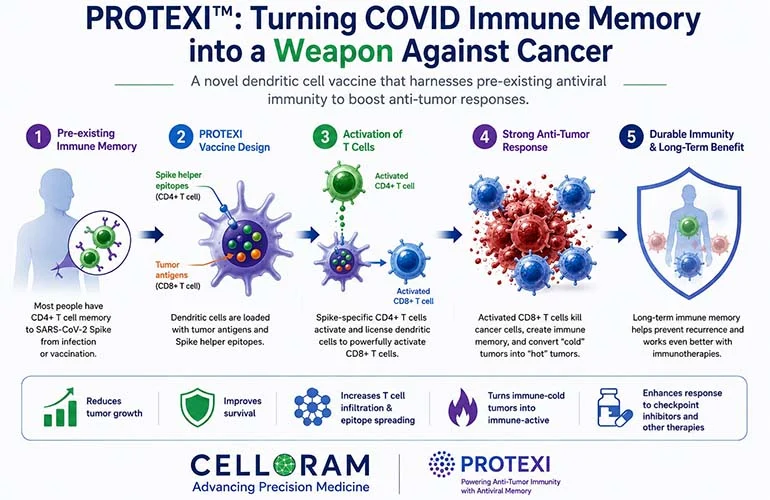
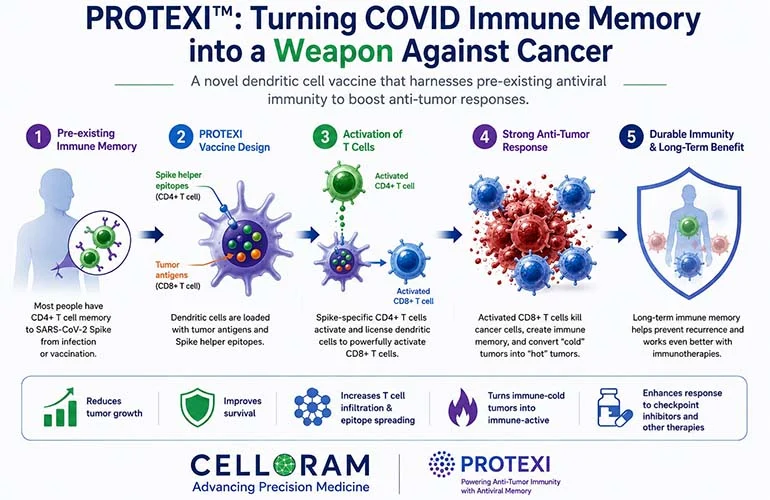
Protexi functions as a sophisticated, dual-action immune primer. The vaccine utilizes specific epitopes—tiny protein fragments—derived from the SARS-CoV-2 Spike protein to stimulate CD4 T cells. Because the vast majority of the global population has either been vaccinated against COVID-19 or exposed to the virus, their immune systems already possess a robust, high-affinity memory for these specific Spike protein fragments.
When Protexi is administered, it presents both the SARS-CoV-2 Spike epitope and a tumor-specific antigen to the immune system. The patient’s pre-existing memory CD4 T cells recognize the viral component, triggering a rapid and powerful expansion. These "awakened" CD4 cells then provide the necessary chemical signals to fully prime and recruit CD8 T cells, directing them with precision toward the tumor. This "hitchhiking" strategy effectively turns the body’s past viral exposure into a present-day weapon against malignancy.
Preclinical Success and Experimental Data
The preclinical data generated by the research team offers a compelling proof-of-concept. In controlled experiments involving murine models, the researchers compared the efficacy of Protexi against conventional dendritic cell vaccines.
The results were statistically significant. In mice receiving CD4 cells engineered to recognize the target, the Protexi-treated group achieved a 100% survival rate through day 40, a stark contrast to the 40% survival rate observed in mice treated with conventional dendritic cell vaccines. Furthermore, in a rigorous melanoma model, five out of seven mice exhibited tumor sizes measuring under 200 cubic millimeters by day 26. These metrics suggest that the inclusion of the "helper" Spike epitope significantly enhances both the durability and the potency of the anti-tumor response.
Addressing concerns regarding patients who may lack pre-existing COVID-19 immunity, Dr. John Letterio, a co-author of the study, noted that the platform includes a "fail-safe" mechanism. "If a given patient’s response turns out to be too weak, the platform has a built-in fallback: in mice, we showed that a short ‘priming’ dose of Spike/ovalbumin-loaded dendritic cells beforehand restores a strong CD4 T-cell response even without pre-existing immunity," Letterio explained. This ensures the therapy remains viable for the minority of the population without prior COVID-19 history.
Historical Context and Scientific Evolution
The conceptual foundation of Protexi rests on two distinct threads of immunological research that have matured over several decades. The first thread dates back to the late 1990s, when researchers established that CD4 T helper cells are essentially mandatory for the optimal induction of CD8 responses against MHC-II-negative tumors. Despite this knowledge, identifying the specific CD4 epitopes required for this helper function has been a computational hurdle, limiting their integration into clinical vaccines.
The second thread emerged during the height of the pandemic. Clinical observations revealed that cancer patients undergoing checkpoint inhibitor therapies experienced improved outcomes if they had also received COVID-19 vaccinations. This serendipitous observation provided the missing link: if viral antigens could accidentally boost cancer therapy, they could theoretically be harnessed intentionally. By choosing the SARS-CoV-2 Spike protein, researchers selected an antigen that has been more extensively mapped and documented than perhaps any other in human history.
Implications for Future Clinical Trials
The research team is currently navigating the regulatory pathway, with sights set on an Investigational New Drug (IND) submission to the U.S. Food and Drug Administration (FDA). The goal is to initiate first-in-human clinical trials focusing on sarcoma patients at the Angie Fowler Adolescent & Young Adult Cancer Institute.
The implications of this technology extend far beyond SARS-CoV-2. The researchers emphasize that the mechanism is modular; any CD4 T-cell epitope that a patient carries in their immune memory—whether from a vaccine, a common childhood infection, or a past viral encounter—could theoretically serve as the "helper" signal. This could eventually allow for personalized "plug-and-play" cancer vaccines, where the immune-stimulating component is tailored to the patient’s specific viral memory profile.
Fact-Based Analysis of the Immunological Landscape
The transition from preclinical success to human application is notoriously difficult in oncology. While the Protexi model demonstrates high efficacy in controlled murine environments, human immune systems are significantly more complex and heterogeneous. Factors such as tumor heterogeneity, the immunosuppressive nature of the tumor microenvironment, and the aging of the immune system (immunosenescence) will pose substantial challenges.
However, the strategy of utilizing memory T cells represents a shift toward "rational" vaccine design. Rather than attempting to force the immune system to recognize a tumor antigen from scratch—a process that is often slow and inefficient—this approach uses an existing, high-velocity immune pathway to bypass early activation delays. If the clinical trials mirror the preclinical results, this platform could provide a much-needed boost to the efficacy of existing immunotherapies, potentially shifting the 15% objective response rate significantly higher.
Conclusion and Future Outlook
As the scientific community continues to digest the long-term immunological effects of the COVID-19 era, the work being conducted at Celloram and Case Western Reserve University stands as a testament to the potential of adaptive research. By repurposing the memory of a global health crisis to address one of humanity’s oldest medical challenges, the researchers are charting a course toward a new generation of precision oncology. With the upcoming transition to human trials, the medical community will be watching closely to see if this marriage of viral immunology and cancer research can successfully translate from the laboratory to the bedside, offering new hope for patients with otherwise treatment-resistant malignancies.