The landscape of pharmaceutical research is undergoing a structural transformation as Schrödinger, a pioneer in scientific software, announced a strategic collaboration with Bristol Myers Squibb (BMS). At the core of this partnership is the deployment of Bunsen, an "agentic AI co-scientist" designed to function as an autonomous execution engine for complex computational chemistry workflows. By integrating this platform, the two companies aim to scale molecular exploration to the trillion-compound range, effectively widening the funnel of drug discovery while sharpening the precision of candidate selection.
The Evolution of Computational Chemistry
To understand the significance of this collaboration, one must look at the evolution of drug discovery technology over the past three decades. Founded in 1990, Schrödinger has long occupied a unique position at the intersection of physics-based simulation and digital molecular design. Historically, the company provided the foundational tools for medicinal chemists to model molecular interactions. However, the advent of massive computing power and generative machine learning has shifted the industry from a "trial-and-error" bench science model toward a "predict-first" computational paradigm.
The partnership with BMS represents a logical progression of this shift. As Pat Lorton, Schrödinger’s Chief Technology Officer and Chief Operating Officer, noted, the collaboration is built upon a longstanding technical rapport. The agreement not only encompasses the deployment of Bunsen but also deepens the integration of RetroSynth, Schrödinger’s AI-driven synthesis planning platform, and LiveDesign, the collaborative interface that serves as the "single source of truth" for medicinal and computational chemists.
Chronology of Progress: From Balsa Wood to Supercomputers
The industry’s current trajectory mirrors the historical transition of the aerospace sector. In the mid-20th century, engineers relied on physical wind tunnels and balsa-wood models to determine aerodynamic drag—a slow, expensive, and limited process. The subsequent shift toward computational fluid dynamics and supercomputing allowed for thousands of iterations before a single physical prototype was built.
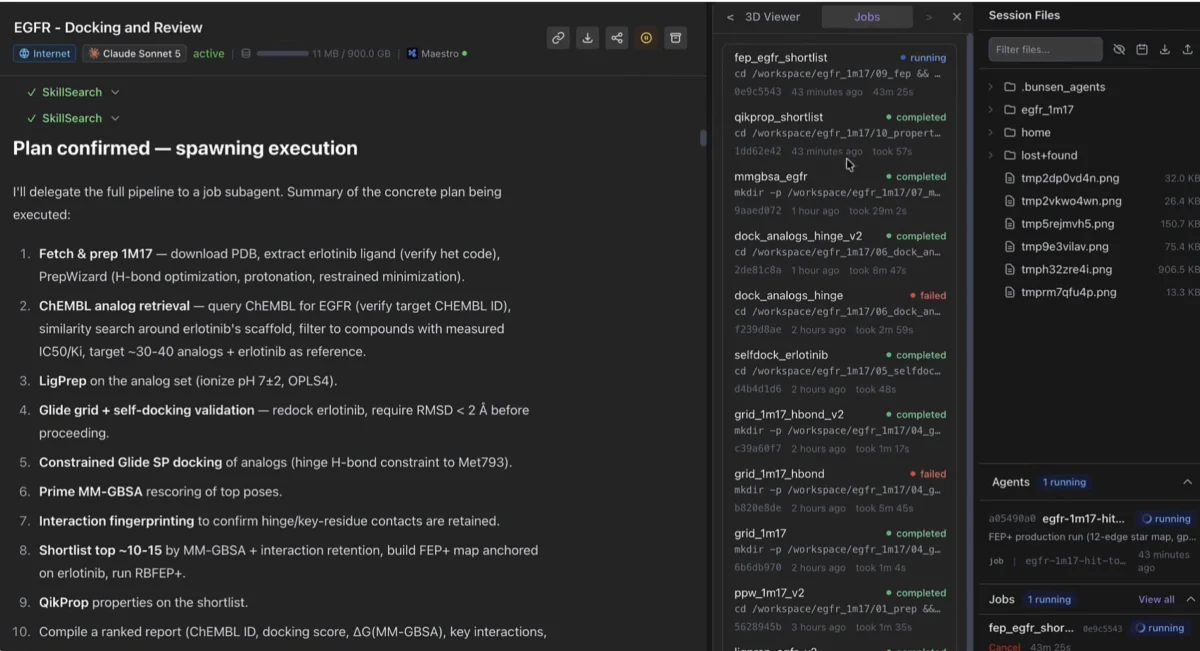
Schrödinger is currently shepherding the pharmaceutical industry through a similar transition. In the early 2010s, the introduction of GPUs served as a turning point, enabling the widespread application of Free Energy Perturbation (FEP) methods. By 2020, Schrödinger was already documenting its "Large-Scale Molecule Exploration" capabilities in its IPO filings, which combined computational enumeration with generative ML. The release of AutoDesigner in 2022 and subsequent workflows coupling active learning with FEP+ in 2024 further refined the process. The arrival of agentic coding tools in early 2025—specifically those inspired by Claude Code—provided the final piece of the puzzle: an "agent" capable of writing, compiling, and iterating on code to execute scientific tasks.
Scaling the Funnel: The Trillion-Molecule Milestone
One of the most profound shifts in this collaboration is the scale of the molecular search space. Five years ago, a typical weekly discovery cycle involved the enumeration of approximately 100 billion compounds. Today, that number has grown to the trillions.
This expansion is not merely for the sake of volume; it is a necessity driven by the increasing complexity of modern therapeutic targets. As researchers aim to optimize for multiple, often competing properties—such as potency, selectivity, metabolic stability, and safety—the "top of the funnel" must be widened to ensure that the final 50 candidates are of the highest possible quality. By using Bunsen to orchestrate these screens, BMS can maintain a high-quality pipeline while simultaneously reducing the time required for lead identification.
The Role of Infrastructure: NVIDIA and Supercomputing
The success of this collaboration relies heavily on the physical infrastructure currently being deployed across the pharmaceutical sector. Big Pharma is currently engaged in an "AI arms race," characterized by the installation of high-performance computing (HPC) clusters.
Bristol Myers Squibb has been particularly aggressive in this regard. Following the deployment of its DGX SuperPOD three years ago, the company has continued to build out its AI capabilities. In July 2026, it was revealed that BMS is leveraging NVIDIA’s latest Vera Rubin NVL72 architecture to support its proprietary foundational models. This hardware enables the company to run sophisticated machine-learning models and large-scale physics simulations locally, providing the necessary compute for Bunsen to operate at peak efficiency.

Schrödinger’s design philosophy for Bunsen has been "LLM agnostic," ensuring that the platform can interface with commercial models like Claude or be deployed on a customer’s own on-premises supercomputer. This flexibility is critical for large pharmaceutical firms that may have stringent security requirements or prefer to maintain control over their internal foundational models.
Addressing the Talent Bottleneck
Beyond the raw power of GPUs and the intelligence of AI agents, there exists a human capital constraint. The shortage of specialized computational chemists is a known limiter for innovation. In many organizations, project teams are under-resourced, forcing experts to spend valuable time on administrative tasks, data assembly, and manual configuration of software workflows.
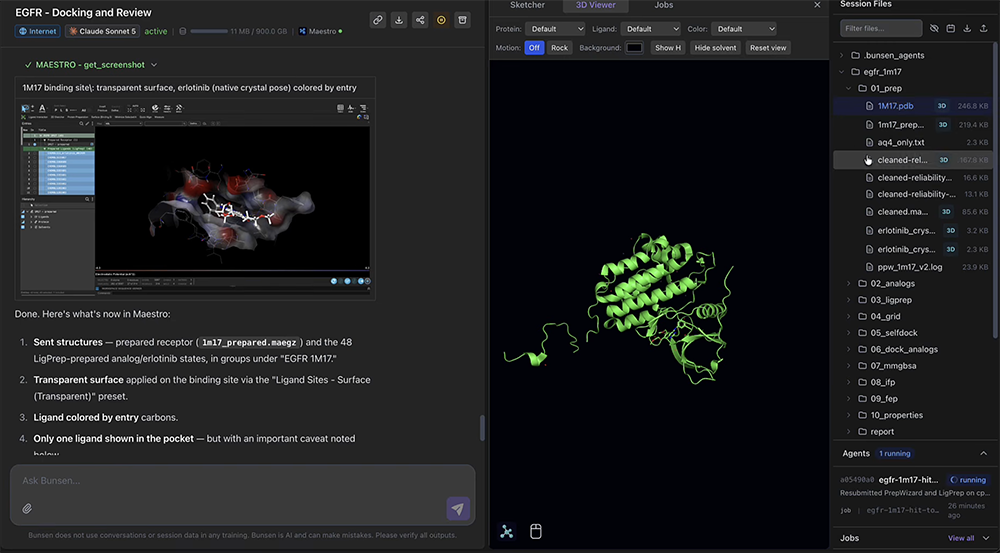
Bunsen functions as a "postdoc-level" assistant, automating the repetitive and arduous aspects of workflow construction. By providing a natural language interface, the platform allows computational modelers to describe their intent—"validate this compound against this pocket"—and allows the agent to build the necessary pipeline, execute the jobs, and return the results. Crucially, the platform maintains a human-in-the-loop requirement, where scientists can review, reject, or steer the agent’s proposed methodology. This balance of automation and oversight ensures that human expertise remains at the helm while technical output is maximized.
Implications for Future Drug Discovery
The collaboration between Schrödinger and BMS serves as a bellwether for the future of the pharmaceutical industry. By offloading complex, multi-step orchestration to an agentic system, companies can shorten the "design-make-test-analyze" cycle.
However, the efficacy of this approach depends on the seamless integration of disparate software tools. Lorton emphasizes that the "compounding effect" of errors in unintegrated workflows can lead to poor outcomes. Consequently, the success of the Bunsen platform will likely be measured by its ability to act as a cohesive "glue" that binds predictive models, physics engines, and experimental databases into a unified, reliable, and transparent system.
For Stephen Johnson, Vice President of Computational Sciences at BMS, the shift is about enabling scientists to think differently. By automating the technical heavy lifting, the partnership aims to liberate researchers to focus on the high-level strategy and intuition that AI cannot replicate. As the industry moves toward this new era of agentic discovery, the focus will increasingly shift from "how to compute" to "what to discover," potentially unlocking therapeutic pathways that were previously considered computationally inaccessible.
While the technology is still in its relative infancy, the combination of trillion-scale simulation and autonomous, expert-level agents represents a paradigm shift. If successful, the Schrödinger-BMS collaboration may provide the blueprint for a new standard in drug discovery, where the bottleneck is no longer the ability to calculate, but the human capacity to define the most promising frontiers of medicine.