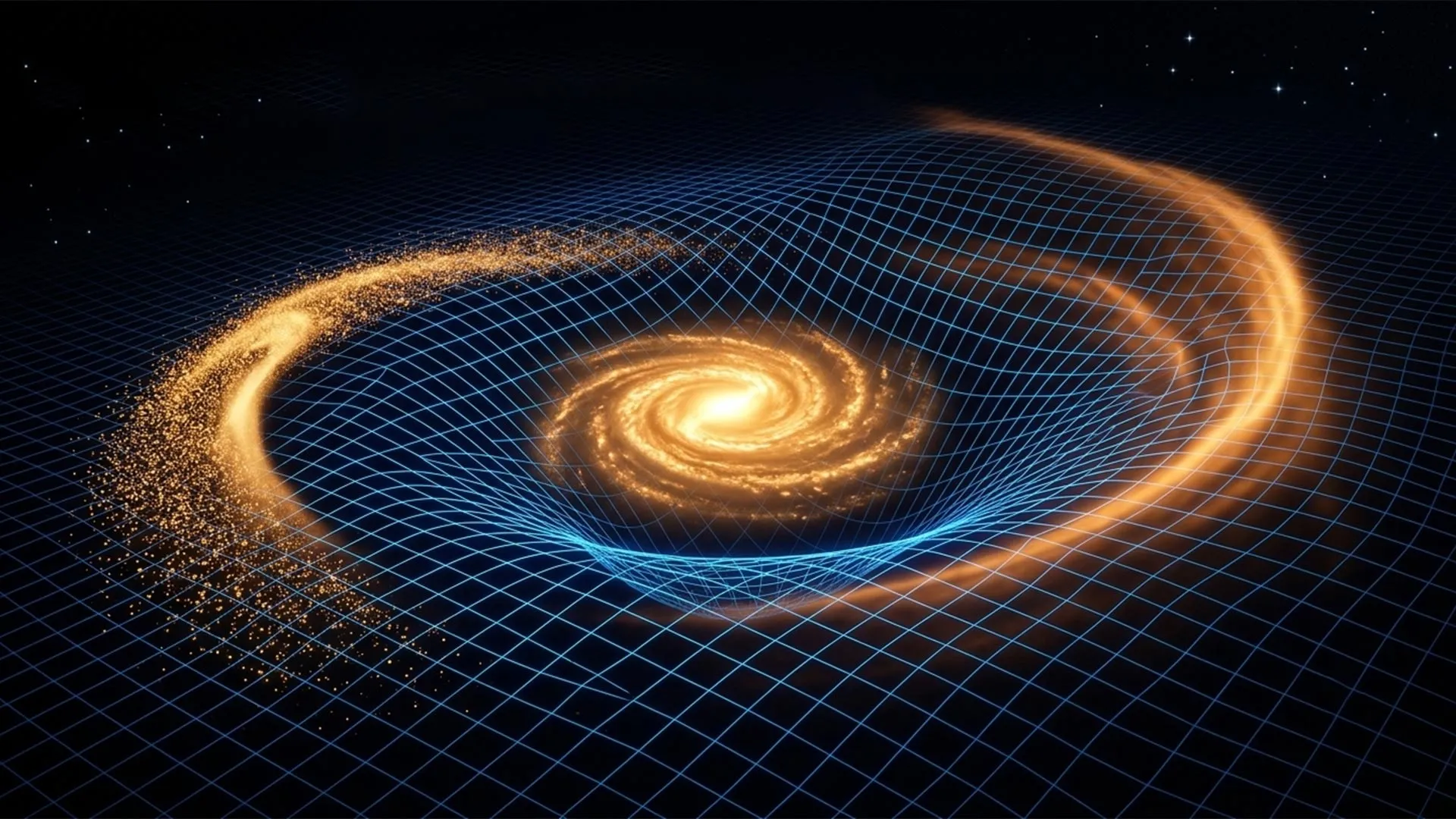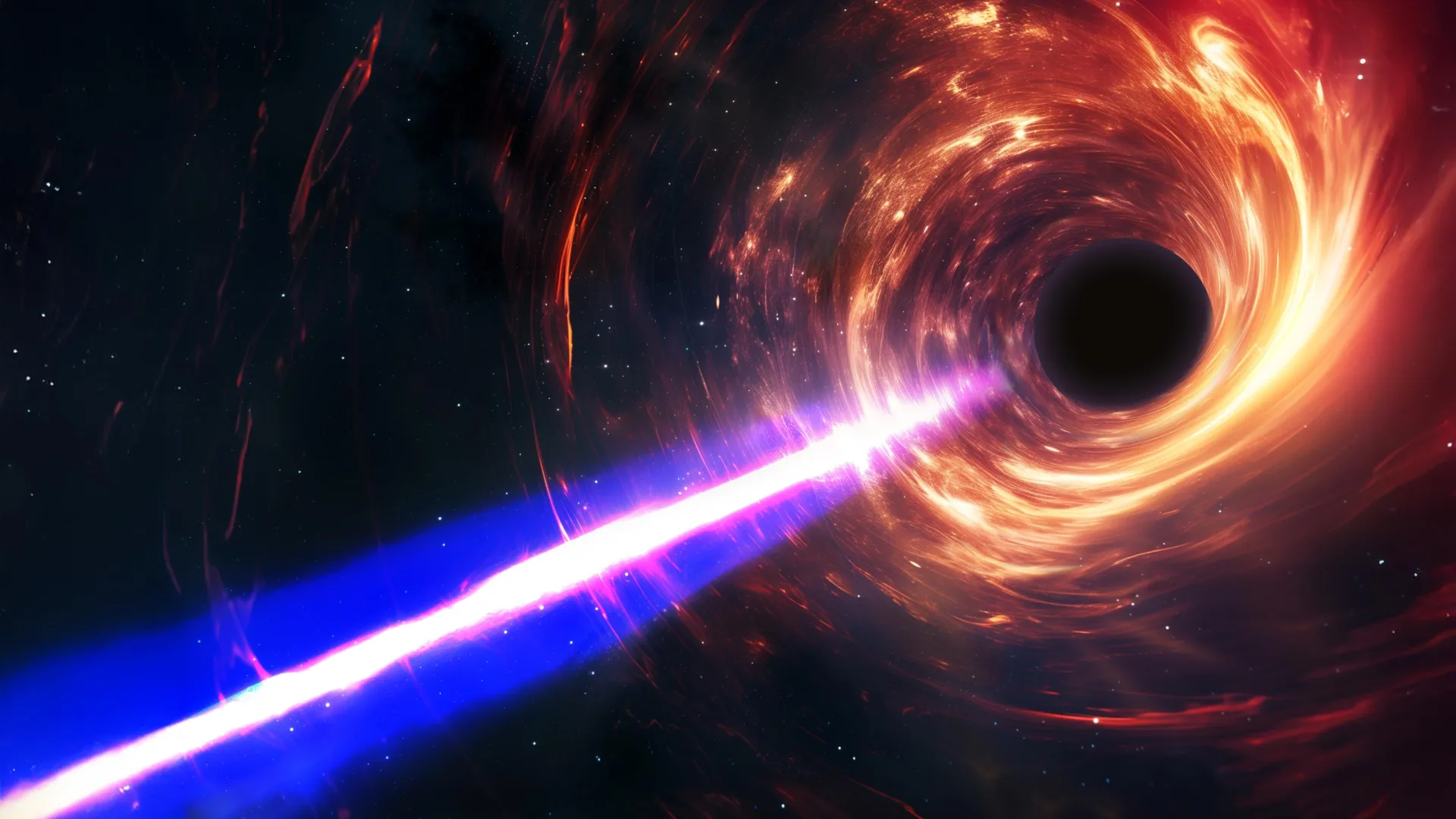
An international collaboration of astronomers has uncovered what appears to be a universal physical law governing the violent, energetic outflows produced by black holes. Co-led by researchers from the Institute for Advanced Study (IAS) and Curtin University’s International Centre of Radio Astronomy Research (ICRAR), a newly published study demonstrates that black holes launch powerful plasma jets at a precise, critical stage in their feeding cycles—regardless of whether the object is a stellar-mass black hole weighing ten times our sun or a supermassive giant millions of times heavier.
The breakthrough research, which bridges a decades-long observational gap between different classes of black holes, was recently published in the scientific journal Nature Astronomy. By synthesizing multi-wavelength data gathered by telescopes spanning America, Australia, India, South Africa, and space-based observatories, the research team successfully decoded the timing of cosmic "burps" that have long baffled astrophysicists. This discovery not only standardizes our theoretical understanding of accretion mechanics but also introduces a predictive framework that will optimize scheduling for next-generation astronomical facilities, including the multi-national Square Kilometre Array.
The Mechanics of Cosmic Destruction and Feeding
To understand the magnitude of this discovery, astronomers must first look at how black holes interact with their surrounding environments. Often described colloquially as cosmic vacuum cleaners, black holes do not simply tidy up space by swallowing everything in their paths with gentle efficiency. Their feeding habits are, by contrast, intensely chaotic and messy. When a massive celestial body—such as an unsuspecting star—strays too close to a supermassive black hole stationed at the center of a galaxy, it encounters extreme gravitational tidal forces.
These forces exert differential pull across the diameter of the star, stretching it vertically and compressing it horizontally until the stellar structure fails completely. This cataclysmic event is known in astrophysics as a tidal disruption event (TDE). During a TDE, the star is violently shredded into a long, thin stream of hot gas and stellar debris. While a fraction of this material is eventually consumed by the black hole, a significant portion is violently expelled back out into the surrounding interstellar medium via powerful, highly collimated jets of plasma traveling at nearly the speed of light.
These enormous outflows carry vast amounts of energy and matter across cosmological distances. Astrophysicists believe that these energetic outbursts play a fundamental role in regulating star formation within host galaxies, acting as a cosmic thermostat that dictates how galaxies evolve over billions of years. Yet, despite their importance, predicting when a black hole would initiate these dramatic eruptions remained an elusive goal. Why do some supermassive black holes blast out radio jets immediately after tearing apart a star, while others remain dormant for months or even years before suddenly firing up? This was the central enigma that prompted the international research team to re-examine archival data through a novel theoretical lens.
A Breakthrough Born of Collaboration
The research effort was spearheaded by Andrew Mummery, a Martin A. and Helen Chooljian Member in the School of Natural Sciences at the Institute for Advanced Study, alongside Adelle Goodwin, a Forrest Research Foundation Fellow at Curtin University’s ICRAR in Western Australia. The conceptual breakthrough behind the study, however, did not originate in a high-tech laboratory or a quiet university office. Instead, it was conceived in a casual setting during an international astrophysics conference in Madrid, Spain.
Over a conversation in a local establishment, Mummery and Goodwin began discussing the known behaviors of smaller, stellar-mass black holes residing within our own Milky Way galaxy. For decades, observational data had established that smaller black holes launch radio jets at a very specific threshold in their accretion cycle—specifically, when their feeding rate drops to approximately two percent of the Eddington limit. The Eddington limit represents the theoretical maximum luminosity a body can achieve when there is a balance between the inward gravitational force pulling matter inward and the outward radiation pressure pushing matter away.
As the two scientists compared notes, a realization struck them: could this strict mathematical threshold, previously thought to apply only to stellar-mass systems, also dictate the behavior of supermassive black holes millions of times their size? Testing this hypothesis presented a formidable historical challenge. Supermassive black holes evolve on geological timescales. Changes in their accretion states typically unfold over thousands or millions of years, making it practically impossible for human astronomers to track these transitions in real time.
Tidal disruption events provided the ideal natural laboratory to bypass this limitation. Because a TDE introduces a sudden, finite supply of stellar material to an otherwise dormant supermassive black hole, the entire feeding and jet-production cycle accelerates dramatically. Instead of taking millennia, the evolutionary cycle of a TDE plays out over the course of just a few years. This temporal compression gave the research team a rare window to observe processes that would otherwise remain entirely inaccessible.
Rigorous Data Analysis Across the Electromagnetic Spectrum
To rigorously test their hypothesis, Mummery, Goodwin, and their global colleagues assembled a comprehensive sample of twenty tidal disruption events. They utilized data collected across multiple wavelengths of the electromagnetic spectrum, incorporating optical light, ultraviolet light, X-rays, and radio waves. This multi-wavelength approach is essential in black hole astronomy, as different regions of the accretion disk and its outflows emit distinct signatures. Optical and ultraviolet observations track the initial thermal radiation from the shredded star, X-rays probe the innermost regions of the accretion disk immediately surrounding the event horizon, and radio telescopes detect the synchrotron radiation emitted by the relativistic jets as they plow into the surrounding gas.
Following a stringent data-filtering process, the researchers narrowed their sample down to ten exceptionally high-quality events. For these specific ten systems, the team possessed reliable measurements of both the instantaneous feeding rate of the black hole and the precise timing of the associated radio outflows.
The subsequent analysis revealed a remarkably consistent pattern across all ten events. The data exposed two distinct periods during which black holes are capable of forming jets. The first window occurs early in the lifecycle of the event, while the black hole is gorging itself on stellar material at an extremely high, unstable rate. The second period—and the primary focus of the study—emerges much later, anywhere from hundreds to thousands of days after the initial disruption of the star.
At this later stage, the frantic initial feeding frenzy has subsided, and the black hole’s accretion rate drops steadily until it reaches a precise tipping point: roughly two percent of its Eddington limit. Upon hitting this exact threshold, the black hole reliably launches a powerful, delayed radio jet.
Implications for Astrophysical Theory and Future Observations
The identification of this universal two percent threshold carries profound implications for theoretical astrophysics. By demonstrating that both stellar-mass black holes and supermassive giants obey the exact same critical accretion rate for jet formation, the study provides definitive evidence that the fundamental physics governing black hole accretion disks is scale-invariant. Gravity and fluid dynamics operate under identical rules across an astonishing mass range, spanning six to ten orders of magnitude.
Beyond its theoretical value, this discovery introduces significant practical applications for observational astronomy. Telescope time on major global facilities is intensely competitive, heavily oversubscribed, and tightly scheduled. Historically, catching a delayed black hole jet required long-term, speculative monitoring campaigns that frequently resulted in wasted observation time directed at dormant or inactive targets.
Armed with a predictive mathematical threshold, astronomers can now calculate precisely when a tidal disruption event is likely to cross the two percent Eddington limit. This capability allows research teams to schedule targeted radio observations with unprecedented precision, maximizing scientific yield while minimizing the expenditure of valuable telescope resources.
This predictive power will become increasingly critical with the advent of next-generation astronomical infrastructure. Chief among these is the Square Kilometre Array (SKA) radio telescope project, a sprawling international initiative spanning South Africa and Australia that is slated to begin gathering pioneering scientific data by 2028. The SKA will possess unprecedented sensitivity and survey speed, capable of detecting faint radio transients across the observable universe. Knowing when and where to look for delayed black hole jets will allow researchers to capitalize fully on the SKA’s capabilities, capturing ephemeral cosmic phenomena that previously slipped past detection.
As the scientific community digests these findings, the research team anticipates that their work will serve as a foundational stepping stone for future explorations into high-energy astrophysics. By stripping away the apparent complexity of black hole behavior and revealing an underlying universal law, this international collaboration has brought a degree of predictable order to one of the most violent and enigmatic phenomena in the cosmos.