Physicists at the University of Oxford, working in tandem with the international ATLAS collaboration at CERN, have successfully demonstrated that quantum entanglement—one of the most perplexing and counterintuitive phenomena in modern physics—can endure within some of the heaviest and most ephemeral elementary particles ever observed. Published in the prestigious journal Physical Review Letters, the landmark study breaks new ground by confirming that this delicate quantum mechanical link survives the violent, high-energy environment of particle collisions inside the world’s largest machine.
The breakthrough bridges two traditionally distinct branches of physics: high-energy particle physics, which explores the fundamental constituents of matter at microscopic scales, and quantum information science, the burgeoning field driving the development of quantum computing and ultra-secure communications. By demonstrating that quantum correlations remain robust even among massive gauge bosons generated at velocities approaching the speed of light, researchers have opened an entirely new observational window into the fundamental laws of nature.
Understanding Quantum Entanglement and its Historical Context
Quantum entanglement occurs when a group of particles is generated, interacted with, or shares spatial proximity in such a way that the quantum state of each particle cannot be described independently of the state of the others, even when the particles are separated by vast distances. Measuring a physical property of one entangled particle instantly determines the corresponding property of its partner, a phenomenon that famously troubled Albert Einstein. Einstein famously dismissed the implication as "spooky action at a distance," as it appeared to challenge the principle of locality, which dictates that information cannot travel faster than the speed of light.
For decades, experimental verification of entanglement was limited to relatively stable, low-energy systems. Scientists routinely observed the effect in photons, electrons, and trapped ions under highly controlled, cryogenic, or vacuum conditions in specialized optics and atomic physics laboratories. In recent years, this theoretical curiosity transitioned into a transformative technological asset. Entanglement serves as the foundational resource for quantum computing, where multi-qubit systems can process exponential volumes of data simultaneously, as well as for quantum cryptography and advanced sensor technologies.
However, a fundamental question persisted within the physics community: could this seemingly delicate phenomenon survive the most extreme conditions in the universe, such as the blistering thermal and kinetic energy states found inside particle accelerators? Until recently, standard scientific assumption held that high-energy collisions would instantly decohere or disrupt fragile quantum correlations, rendering entanglement undetectable among short-lived particles.
The Experimental Apparatus: Unleashing the Large Hadron Collider
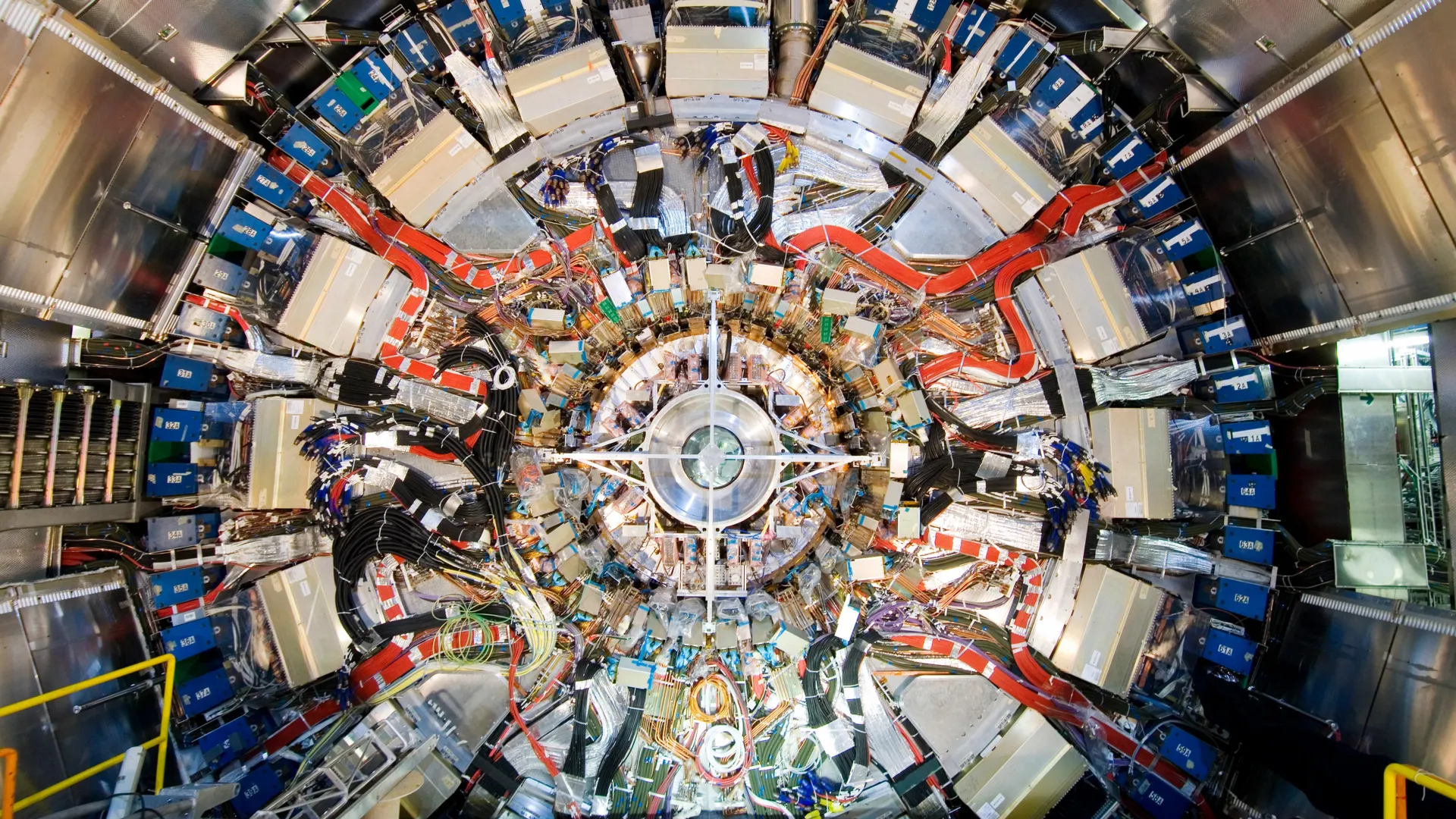
To test the boundaries of quantum mechanics under extreme duress, researchers turned to the ATLAS detector at the Large Hadron Collider (LHC), situated in a 27-kilometer circular tunnel straddling the Franco-Swiss border near Geneva, Switzerland. Managed by the European Organization for Nuclear Research (CERN), the LHC accelerates protons to 99.999999% of the speed of light, steering them into head-on collisions that generate unprecedented energy levels reaching up to thirteen trillion electron volts (13 TeV).
Rather than focusing on long-lived photons or electrons, the international research team targeted pairs of Z bosons—massive elementary particles that mediate the weak nuclear force. Z bosons are notoriously short-lived, existing for only an infinitesimal fraction of a second (approximately $3 times 10^-25$ seconds) before decaying into other subatomic debris.
The specific Z boson pairs investigated in this experiment were birthed through the decay of Higgs bosons, the scalar bosons famously discovered at the LHC in 2012. During high-energy proton-proton collisions, a Higgs boson is occasionally produced, which then rapidly decays into a pair of Z bosons. These Z bosons subsequently and instantaneously decay into secondary cleaner leptons, specifically pairs of electrons or muons, which can be tracked by the sophisticated electronics of the ATLAS detector.
Tracing Fleeting Signatures: Methodology and Data Analysis
Because Z bosons vanish almost instantaneously after creation, physicists cannot measure their quantum states directly. Instead, the ATLAS collaboration employed an indirect reconstruction methodology, analyzing the precise spatial trajectories, momentum, and angular distributions of the electrons and muons resulting from the Z boson decays.
By examining the angular correlations between these decay products, scientists were able to mathematically reconstruct the quantum spin states of the parent Z bosons. The analytical framework allowed the team to evaluate whether the joint probability distributions of the particle spins violated classical statistical bounds, thereby confirming the existence of quantum entanglement.
The resulting data provided robust, statistically significant evidence that the Z boson pairs were indeed entangled at the moment of their creation. This achievement marks the observation of quantum entanglement at the highest energy threshold ever recorded, surpassing previous limits and extending the domain of quantum mechanics into realms previously thought hostile to such correlations.
Chronology of High-Energy Quantum Investigations
The success of the recent Z boson entanglement analysis represents the culmination of a methodological evolution that began more than a decade ago:
- July 2012: CERN physicists announce the discovery of the Higgs boson using data from the ATLAS and CMS experiments at the Large Hadron Collider.
- Mid-2010s: Theoretical physicists, including Oxford’s Professor Alan Barr, begin formulating hypotheses suggesting that high-energy colliders could be repurposed to test fundamental quantum information principles, such as entanglement and Bell inequalities, at unprecedented energy scales.
- 2023: Building upon these theoretical frameworks, the ATLAS collaboration publishes a breakthrough study demonstrating quantum entanglement between pairs of top quarks—the heaviest known elementary particles in the Standard Model.
- Present: The publication in Physical Review Letters details the successful detection of entanglement in Z boson pairs generated via Higgs boson decays, validating the applicability of quantum information metrics to gauge bosons and paving the way for high-luminosity collider experiments.
Perspectives from the Research Frontline
The intersection of quantum information theory and high-energy particle physics has energized researchers across multiple academic disciplines, forging unique collaborations between theoretical physicists, experimentalists, and philosophers of science.
Professor Alan Barr of Oxford’s Department of Physics, a co-author of the study and one of the early pioneers of collider-based quantum tests, reflected on the philosophical and physical significance of the findings. "We’re used to thinking of entanglement as something delicate, seen in laboratory experiments with single photons," Professor Barr noted. "Finding it alive and well among particles as heavy and short-lived as Z bosons, created in some of the most violent collisions we can produce on Earth, shows just how fundamental and robust this quantum effect really is. It’s a nice reminder that the same strange rules of quantum mechanics that may one day power quantum computers are at work everywhere in nature, even at the extreme energies of the Large Hadron Collider."
This sentiment is shared by interdisciplinary partners exploring the ontological implications of high-energy quantum mechanics. Professor Chris Timpson of Oxford’s Faculty of Philosophy, a co-principal investigator on an initiative examining quantum foundations, emphasized the pioneering nature of the research. "Entanglement is both the most promising and the most puzzling aspect of quantum reality," Professor Timpson stated. "These collider experiments detecting entanglement present a new frontier in investigations of the foundations of quantum mechanics."
Broader Implications for Particle Physics and Beyond
Beyond confirming theoretical predictions under extreme physical conditions, the integration of quantum information science into high-energy physics provides researchers with a powerful new diagnostic tool. Modern particle colliders generate petabytes of complex data, traditionally analyzed using standard statistical methods to identify known particles and search for deviations predicted by supersymmetry or string theory.
By applying quantum information metrics—such as entanglement monotones and spin correlation matrices—to massive datasets, physicists can extract subtle, hidden patterns that traditional analyses might overlook. This enhanced sensitivity could potentially expose tiny anomalies or new physics phenomena that do not conform to the Standard Model, offering crucial clues toward a unified theory of quantum gravity.
Furthermore, the methodologies validated in this study establish a framework for probing fundamental symmetries of nature under conditions that mimic the early universe, fractions of a second after the Big Bang.
Future Horizons: The High-Luminosity LHC Upgrade
As the scientific community digests these findings, preparations are already underway at CERN to push observational boundaries even further. The Large Hadron Collider is currently undergoing major technical upgrades to transition into the High-Luminosity LHC (HL-LHC). Slated to come online later this decade, the upgraded accelerator will drastically increase the rate of proton-proton collisions, yielding datasets up to ten times larger than those currently available.
Researchers at the University of Oxford are actively contributing to these international hardware enhancements, specifically playing a leading role in the development and construction of advanced pixel detector modules for the upgraded ATLAS tracking system. These technological improvements will allow scientists to collect higher-resolution data from rarer collision events, enabling more refined measurements of quantum entanglement and multi-particle correlations at extreme energies.
Professor Daniela Bortoletto, UK coordinator for the ATLAS pixel system upgrade at Oxford’s Department of Physics, underscored the collaborative scale of the ongoing scientific enterprise. "This measurement demonstrates the scientific power of the ATLAS collaboration and the unique capabilities of CERN’s Large Hadron Collider," Professor Bortoletto remarked. "Oxford researchers have played a leading role in developing these new approaches to studying quantum phenomena at the highest energies, and we are proud to contribute to an international effort that is opening new ways to explore the fundamental laws of nature."
As CERN prepares for the next era of particle physics, the marriage of quantum information science and high-energy experimentation continues to redefine the boundaries of human knowledge, ensuring that the deepest mysteries of the quantum realm remain fertile ground for discovery.