In the rapidly evolving landscape of generative artificial intelligence, a fundamental semantic and functional confusion has emerged between prompt engineering and prompt optimization. While prompt engineering traditionally focuses on designing prompts from a blank slate, prompt optimization is the systematic refinement of existing prompts through precision, structural enhancements, and iterative testing—all without altering the underlying large language model (LLM). For enterprise developers and technical teams seeking enhanced productivity from AI deployments, the challenge rarely lies in drafting a brand-new framework. Instead, the primary bottleneck involves identifying which specific modifications to a working prompt produce measurable performance gains and which changes merely offer the illusion of improvement.
Industry analyses indicate that as organizations increasingly integrate generative AI into production environments, unoptimized prompts lead to severe operational inefficiencies, including parsing failures, data hallucinations, and unhandled conversational ambiguities. To address this discrepancy, data scientists and software engineers have increasingly turned to empirical frameworks rather than anecdotal folk wisdom. By evaluating prompts against deliberately complex test cases—such as unstructured meeting transcripts featuring mid-conversation reassignments and unresolved agenda items—developers can isolate the exact mechanisms that transform fragile prompts into robust, production-ready systems.
Defining the Core Disconnect: Engineering Versus Optimization
The distinction between prompt engineering and prompt optimization carries profound implications for software architecture. When an enterprise application fails to extract accurate data from an LLM, the root cause is rarely a lack of creative phrasing. Rather, it typically stems from a deficiency in structural rigor, context preservation, or validation protocols.
Historically, early adopters relied on subjective trial-and-error methods, adjusting instructions based on human intuition. However, as LLMs become foundational layers in enterprise workflows, software engineering principles must govern prompt design. Optimization treats the prompt as a codebase component subject to version control, automated testing, and quantifiable metrics. By shifting from subjective styling to empirical evaluation, development teams can systematically eradicate output drift and ensure deterministic behavior across diverse operational scenarios.
Empirical Testing Methodology and the Complex Transcript Benchmark
To evaluate the efficacy of various optimization techniques, researchers utilize standardized, highly nuanced test vectors that simulate real-world administrative friction. A typical evaluation benchmark involves a multi-party meeting transcript characterized by three primary complexities: mid-conversation task reassignments, the integration of secondary requests into pre-existing deliverables, and deliberately unresolved action items.
In a benchmark transcript involving participants Priya, Tom, and Jake, a standard review of a mobile website layout undergoes a critical mid-dialogue shift. Initially assigned to Priya, the responsibility is subsequently reassigned to Jake, while a secondary request regarding tablet breakpoints is folded into the same assignment. Concurrently, a discussion regarding customer support queue triage remains explicitly unresolved, with Priya noting that she must check personnel availability before making an assignment.
A naive prompt frequently fails this test by capturing the initial assignment, missing the subsequent modification, or improperly fabricating an owner for the unassigned triage task. Measuring prompt modifications against such precise failure modes allows engineers to isolate the five strategies that genuinely drive performance improvements.
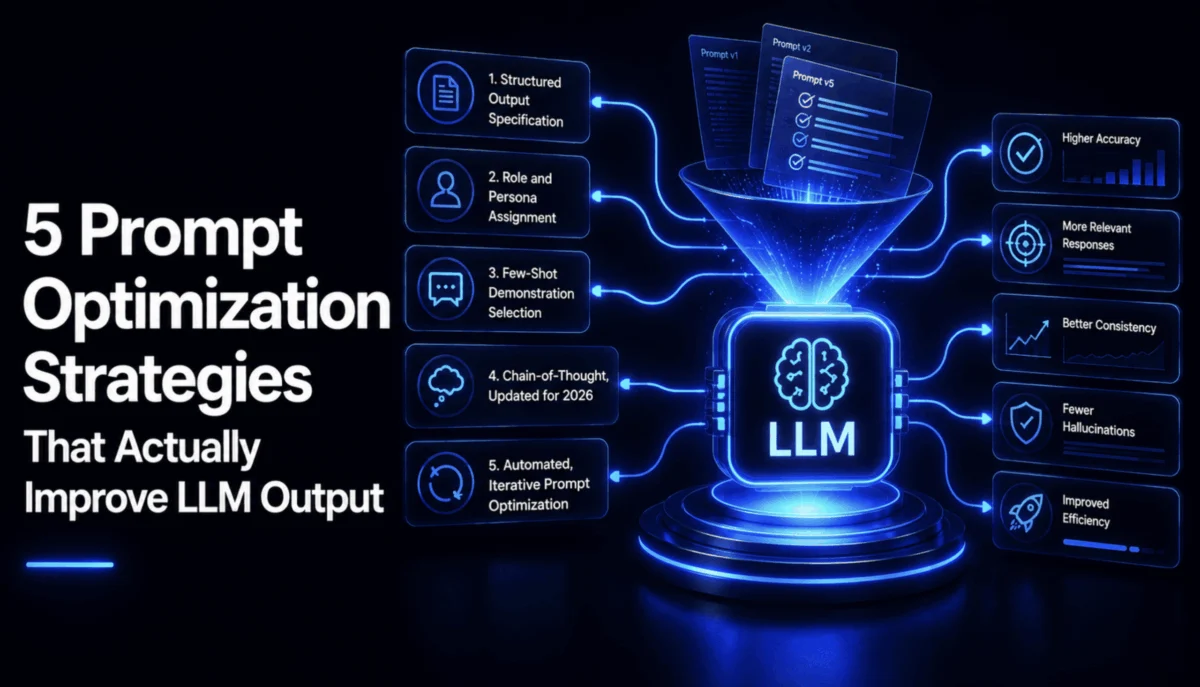
1. Specifying Structured Output for Downstream Reliability
The single most measurable lever in prompt optimization is the transition from unstructured prose to explicit, schema-backed output formats. While asking an LLM to list action items in natural language yields a fluent, human-readable response, it fails to produce data that downstream enterprise systems can reliably parse. In production environments, unparseable output represents a critical failure point rather than a minor inconvenience.
To mitigate this risk, developers integrate data validation frameworks such as Pydantic to enforce strict JSON schemas. When raw model outputs are validated against predefined classes containing specific attributes—such as owner, task description, and due date—applications can programmatically catch validation errors. Empirical testing reveals that vague prompts result in complete parsing failures when evaluated by automated validation functions. Conversely, requesting output framed within an explicit schema guarantees that returned data aligns seamlessly with database ingestion pipelines, eliminating the need for manual human transcription.
2. Assigning Targeted Roles and Domain Personas
Assigning a specific operational persona activates targeted sectors of a model’s latent training data, yielding more context-aware outputs than generic instructions. A generic instruction such as "Extract the action items from this transcript" provides the model with no contextual awareness regarding conversational ambiguity.
By contrast, framing the model as a meticulous executive assistant primes the system to anticipate common conversational patterns, including mid-sentence corrections, revoked assignments, and unconfirmed owners. This role-based priming ensures that the model actively monitors the entire dialogue for recalibrations rather than blindly pattern-matching the earliest plausible statements. Because role assignment introduces zero computational overhead, it serves as an essential baseline optimization for complex natural language processing tasks.
3. Implementing Diversity-Aware Few-Shot Demonstration Selection
Research into prompt optimization consistently demonstrates that the selection of few-shot examples often exerts a greater impact on output quality than instruction phrasing alone. However, the prevailing industry error involves selecting examples arbitrarily or relying on near-duplicate variations of the same underlying pattern.
To maximize the pedagogical value of few-shot demonstrations, advanced pipelines utilize algorithms such as Term Frequency-Inverse Document Frequency (TF-IDF) vectorization combined with cosine similarity metrics. This approach identifies candidate examples and greedily selects a subset that maximizes dissimilarity. For instance, in an action-item extraction task, an optimized few-shot set comprises distinct structural patterns: one case featuring a cleanly confirmed owner, one involving an explicitly unresolved ownership status, and one demonstrating the merger of a secondary task into an existing deliverable. This diversity ensures the model learns robust logical boundaries rather than memorizing a single repetitive scenario.
4. Harnessing Chain-of-Thought Reasoning for Complex Ambiguities
Chain-of-thought (CoT) prompting—instructing a model to articulate its reasoning steps prior to generating a final answer—has evolved alongside frontier model architectures. While modern LLMs possess native internal reasoning capabilities that diminish the necessity for explicit CoT in straightforward tasks, reasoning prompts remain indispensable when handling severe conversational ambiguity.
Without explicit reasoning instructions, models frequently latch onto initial statements while ignoring subsequent corrections—a critical vulnerability in transcripts featuring reassigned tasks. By explicitly commanding the model to trace ownership across the entire dialogue before formulating the extraction, developers force the system to maintain contextual continuity. Furthermore, cost-conscious engineering teams have begun adopting derivative methodologies such as "Chain of Draft," which restricts reasoning steps to concise, minimal-token statements, achieving comparable accuracy while drastically reducing computational latency and token expenditure.
5. Automated Iterative Prompt Optimization and Hill-Climbing Algorithms
The most advanced frontier in prompt optimization involves replacing manual guesswork with automated, metric-driven search processes. Rather than intuitively adjusting prompt phrasing, developers deploy optimization algorithms that evaluate candidate instruction fragments against comprehensive test suites.
Using automated hill-climbing algorithms, systems iteratively test the addition of specific instruction fragments—such as rules governing final-owner tracking or the prohibition of fabricated data—against a ground-truth dataset. A composite scoring function calculates recall, owner accuracy, and penalties for hallucinations. Empirical evaluations demonstrate that automated optimization can elevate baseline prompt performance from moderate success rates to near-perfect accuracy within a handful of iterations. Crucially, this algorithmic approach identifies the minimum effective set of instructions, preventing the prompt bloat that often accompanies manual, intuition-driven revisions.
Broader Industry Implications and Future Outlook
The maturation of prompt optimization as a distinct discipline signifies a broader shift toward engineering rigor in artificial intelligence applications. As enterprises scale their generative AI deployments, the reliance on ad-hoc prompt crafting is rapidly giving way to systematic, automated testing pipelines.
The economic implications of these optimization strategies are substantial. By reducing parsing errors, minimizing token consumption through efficient reasoning structures, and eliminating hallucinated data, organizations can significantly lower the operational costs associated with LLM inference. Furthermore, establishing deterministic, verifiable prompt performance builds the necessary compliance and auditability required for deploying AI systems within highly regulated industries such as finance, healthcare, and legal services.
Ultimately, the transition from prompt engineering to prompt optimization represents the formalization of human-AI interaction. By treating prompts as structured code and subjecting them to rigorous, empirical validation, software engineers can bridge the gap between experimental AI prototypes and resilient, enterprise-grade production systems.