The modern landscape of data science and artificial intelligence is frequently defined by an intense race toward high-level frameworks, sophisticated deep learning architectures, and automated machine learning pipelines. For many newcomers entering the technology sector, foundational programming concepts are viewed merely as a preliminary hurdle—a brief waiting room to be traversed as quickly as possible before reaching the "prime time" libraries where advanced modeling occurs. This rush toward complexity often leads to the cultivation of a specific archetype of practitioner: one who can effortlessly replicate a tutorial when conditions are ideal, yet becomes entirely stranded the moment real-world data deviates from the structured examples provided in documentation.
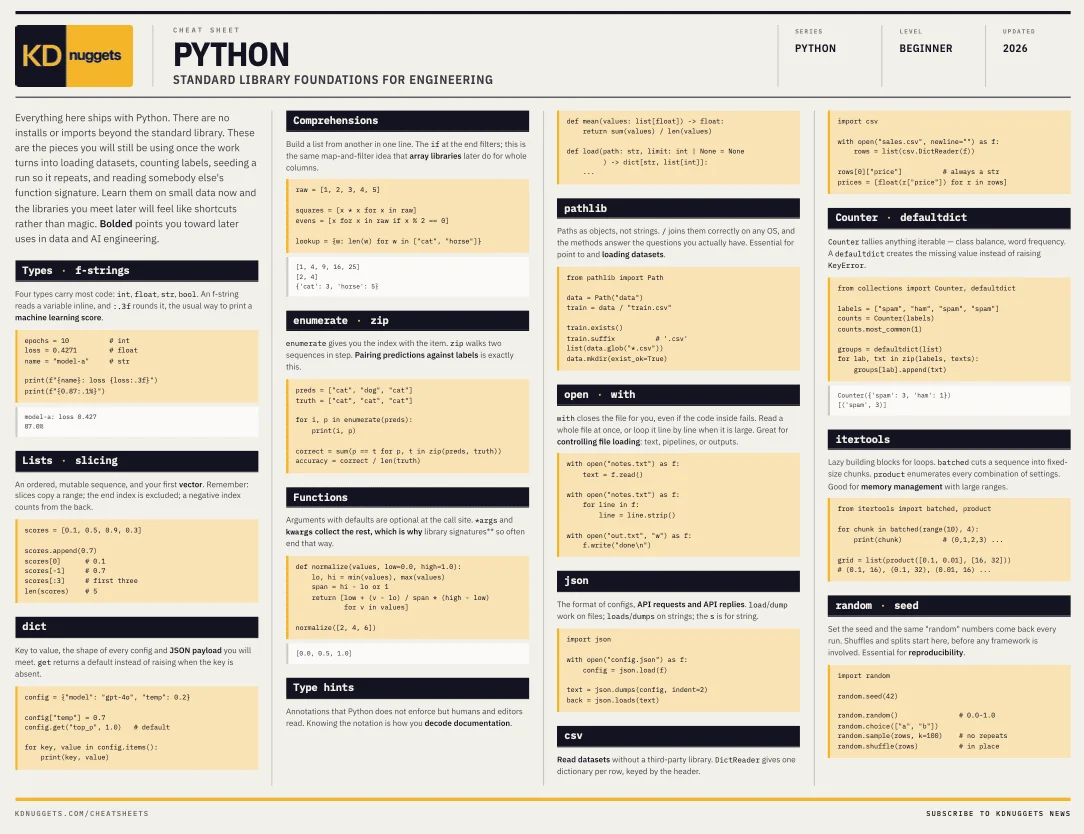
Addressing this persistent industry vulnerability, KDnuggets has released a comprehensive new technical resource titled Python Foundations for Engineering: A Cheat Sheet. Designed to bridge the gap between superficial syntax memorization and deep computational comprehension, the resource focuses on the fundamental programming concepts that do not get left behind as technology stacks evolve. While high-level frameworks undergo constant revision, rapid deprecation, and replacement, the underlying programming paradigms remain remarkably consistent throughout an engineer’s career. Understanding these core mechanics is no longer optional for professionals seeking long-term viability in software engineering, data analytics, and machine learning infrastructure.
The Pitfalls of Tutorial-Driven Development in AI and Data Science
The traditional educational trajectory for aspiring data scientists and machine learning engineers heavily emphasizes application programming interfaces (APIs) and third-party libraries such as Pandas, NumPy, Scikit-Learn, TensorFlow, and PyTorch. While these tools are undeniably powerful, premature reliance on them frequently fosters a superficial understanding of computational logic. When a practitioner learns to manipulate data exclusively through high-level abstractions without grasping the underlying native Python data structures, they handicap their ability to troubleshoot anomalous behavior.
Industry surveys and technical hiring managers have long noted a recurring skills gap among entry-level candidates. While applicants often display impressive portfolios featuring complex neural networks built from online templates, many struggle significantly when asked to perform basic data ingestion, memory optimization, or custom exception handling in native Python. This phenomenon stems from tutorial-driven development, where students copy and paste code snippets while crossing their fingers that the output matches expectations.
When discrepancies arise—such as memory leaks, unexpected type conversions, or performance bottlenecks—engineers lacking foundational knowledge are frequently paralyzed. They must rely entirely on external assistance, whether through searching online forums or prompting generative artificial intelligence tools. However, utilizing generative AI effectively still requires a precise understanding of the underlying domain to evaluate whether a generated solution is correct, secure, and efficient. Without foundational literacy, debugging transforms from a systematic engineering process into an exercise in trial and error.
The Longevity of Native Python Versus Ephemeral Frameworks
A central thesis of the new KDnuggets engineering resource is the permanence of native Python constructs compared to the transient nature of specialized frameworks. Throughout the history of data science, popular libraries have risen and fallen. Software packages that dominated computational workflows a decade ago have frequently been superseded by faster, more modern alternatives. Yet, the foundational mechanics of the Python programming language—such as iterator protocols, generator expressions, memory management, functional programming paradigms, and object-oriented principles—remain entirely intact.
The cheat sheet compiles essential material that survives technological iteration. For instance, a manual data transformation written across a handful of native Python operations mirrors the logical structure of vectorized operations executed by large-scale array libraries across columns containing tens of millions of records. When a data scientist first encounters a logical concept through native iteration, transitioning to a heavily optimized vectorized equivalent is seamless. The syntax may be more concise, but the underlying mental model remains identical.
Furthermore, mastering these fundamentals eliminates the dependency on external package installations, version pinning conflicts, and environment configuration headaches. Everything featured in the foundational cheat sheet ships natively with Python. There are no external dependencies to manage, ensuring that code remains lightweight, portable, and resistant to the dreaded version drift that frequently breaks legacy enterprise pipelines.
Decoding Reference Documentation and Function Signatures
Beyond algorithmic logic, native Python literacy dictates an engineer’s ability to consume technical documentation independently. Modern libraries and internal enterprise codebases are heavily documented using advanced Python features, including complex function signatures, optional arguments, variable-length argument lists (*args and **kwargs), and type annotations.
Although the CPython interpreter does not strictly enforce type annotations at runtime, modern Integrated Development Environments (IDEs) and static analysis tools rely heavily on them to catch errors before execution. Furthermore, official reference manuals, docstrings, and developer specifications utilize this precise notation to describe library behavior. Practitioners who view Python basics as a mere waiting room often find themselves functionally illiterate when reading library source code or advanced documentation.
Without fluency in this programming prose, reference materials remain perpetually opaque. Every minor technical question transforms into an external quest, reducing overall productivity and stifling professional growth. Conversely, an engineer fluent in Python’s native type system and signature conventions can open any library’s source code, understand its internal mechanisms, and adapt it to custom enterprise requirements without hesitation.
Core Engineering Tasks That Define Real-World Projects
When the superficial excitement of training a deep learning model subsides, the day-to-day reality of data engineering and machine learning operations (MLOps) reveals a different set of priorities. Industry analyses of data science workflows consistently indicate that upwards of 80% of an engineer’s time is spent on data preparation, ingestion, cleaning, validation, and pipeline maintenance.
The KDnuggets cheat sheet explicitly targets these unglamorous yet mission-critical tasks. Among the foundational concepts highlighted in the resource are:
- Safely locating, opening, and closing files across diverse operating systems without triggering resource leaks.
- Seamlessly navigating and parsing the myriad data formats in which configuration files and API traffic actually arrive, including JSON, CSV, XML, and unstructured text logs.
- Rigorously validating and counting dataset contents before blindly trusting statistical summaries or model assumptions.
- Implementing reproducible workflows by properly managing random number generation seeds and environment states.
These tasks are not merely preliminary steps to real engineering work; they constitute the vast majority of what professional software and data engineering entails. Neglecting these fundamentals guarantees project delays, data corruption, and irreproducible research findings.
Broader Implications for the Technology Sector and Enterprise Hiring
The release of Python Foundations for Engineering: A Cheat Sheet arrives at a critical juncture for the technology employment market. As the market experiences a maturation phase following years of rapid, speculative expansion, enterprise organizations are increasingly prioritizing engineering rigor over buzzword-heavy resumes. Hiring managers are moving away from candidates who only know how to invoke high-level API endpoints, placing a premium on engineers who deeply understand system architecture, data flow, and code efficiency.
Data from recent technical recruitment benchmarks indicate that companies are shifting their interview processes to focus heavily on foundational coding competency, debugging capabilities, and systems design using native language features. Candidates who rely entirely on black-box frameworks are finding it increasingly difficult to pass rigorous technical screenings.
By shifting educational focus back toward core engineering principles, resources like the KDnuggets cheat sheet aim to elevate the baseline competency of the global developer community. As artificial intelligence tools generate an unprecedented volume of boilerplate code, the human engineer’s primary value shifts from syntax generation to architectural oversight, code review, and robust system validation. Achieving this level of expertise requires an intimate familiarity with the language’s foundational mechanics.
Ultimately, treating Python’s basics as a permanent home rather than a temporary waiting room empowers practitioners to build resilient, scalable, and maintainable systems. Whether scaling a data pipeline to handle billions of records or debugging a mission-critical machine learning model in production, the engineers who succeed are those whose foundations are built on solid, enduring principles rather than fleeting frameworks.