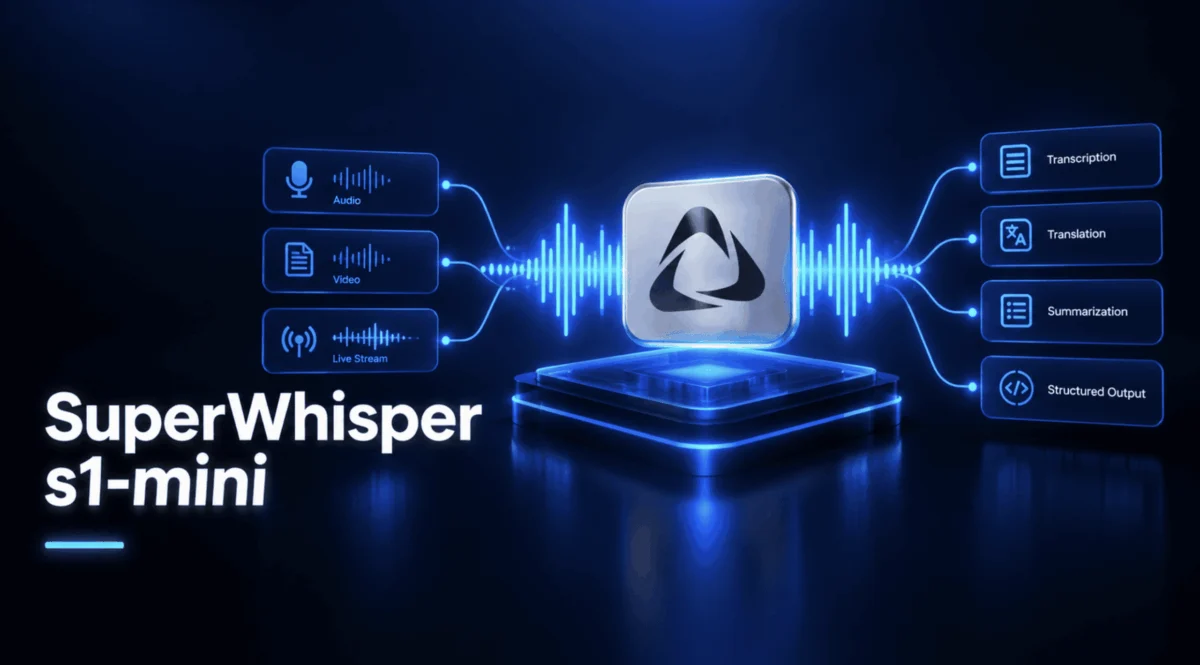
The landscape of automated speech recognition (ASR) and natural language processing underwent a notable shift on August 19, 2026, with the official debut of the S1 product family from SuperWhisper. The launch introduces three proprietary models—S1-Voice, S1-Language, and the open-weight S1-mini—designed to challenge the prevailing industry norm that high-accuracy voice transcription and cleanup require massive computational resources or necessitate the transfer of sensitive user data to third-party cloud servers. While two of these models operate via cloud infrastructure, the release of the S1-mini model has drawn immediate attention from developers and enterprise engineers seeking efficient, local, and privacy-centric audio processing solutions.
Background Context and Technological Evolution
For years, speech-to-text applications have relied on a two-step paradigm: converting audio waveforms into raw text via an ASR engine, followed by post-processing using general-purpose large language models (LLMs). While general models like GPT-4 or standard 7-billion and 8-billion parameter open-weights models are capable of cleaning punctuation, removing filler words, and structuring transcripts, they are rarely optimized specifically for the linguistic quirks of spoken conversation. Consequently, these models often introduce unintended alterations, such as correcting perceived factual errors, softening profanity, or modifying a speaker’s natural dialect. Furthermore, running general-purpose LLMs locally for simple transcription cleanup places an unnecessary burden on consumer hardware, leading to high latency and intensive RAM and CPU utilization.
SuperWhisper developed the S1 product suite to address these systemic inefficiencies. Rather than relying on a monolithic model to handle everything from acoustic decoding to stylistic formatting, the company partitioned the transcription pipeline into distinct, specialized tiers. This modular approach allows users and organizations to select deployment architectures tailored precisely to their operational security requirements, whether operating entirely offline on standard edge hardware or utilizing scalable cloud environments for heavy administrative workflows.
Anatomy of the S1 Family: Voice, Language, and Mini
The S1 lineup comprises three distinct models, each engineered for a specific stage of the audio-to-text pipeline.
S1-Voice serves as the core speech-to-text engine, designed to replace traditional acoustic and language transcription models. According to SuperWhisper’s initial benchmark evaluations across eight standard datasets—including complex meeting audio and corporate earnings calls—S1-Voice achieved an average word error rate (WER) of 6.8%, outperforming 15 comparable commercial and open-source models tested by the company. On the LibriSpeech benchmark specifically, the model recorded a 2.2% WER, highlighting its robustness in handling diverse acoustic environments and varied speaker accents.
S1-Language operates downstream as a cloud-hosted instruction-following model. It is tailored for complex administrative tasks that require advanced custom formatting, automated meeting-minute generation, and stylistic normalization tailored to individual corporate identities. Organizations handling high volumes of sensitive or structured documentation typically deploy S1-Language in tandem with S1-Voice to ensure seamless pipeline processing from audio ingestion to final output.
The S1-mini, however, represents the most radical departure from traditional industry practices. Built as a 0.596-billion-parameter model (often rounded to 0.6 billion) fine-tuned directly from the Qwen3-0.6B architecture, S1-mini is published with open weights on Hugging Face under a modified Apache 2.0 license. Crucially, it is engineered to run entirely offline on standard laptop CPUs without requiring dedicated graphics processing units (GPUs).
Engineering Constraints and Performance Metrics of S1-mini
The defining characteristic of S1-mini is its deliberate design philosophy, which developers have described as "ruthlessly obedient." Unlike general-purpose conversational agents trained to be helpful, creative, or expansive, S1-mini is optimized exclusively for text normalization. Its singular function is to transform raw, unpunctuated, lowercase ASR transcripts into clean, readable text without editorializing. The model is specifically constrained never to introduce external facts, modify dialects, suppress profanity, or inject commentary into the source material.
Performance evaluations conducted on a held-out test set comprising 7,519 English utterances across 104 previously unseen transcripts demonstrate the efficacy of this narrow optimization. S1-mini achieved a 94.8% token accuracy rate and a text-edit error rate of just 11.6%. When tasked with formatting email outputs, the model correctly identified greeting lines in 99.3% of test cases and sign-offs in 97.9% of instances.
Reliability metrics further underscore the model’s stability in production environments. Fewer than 1% of generations exhibited degenerate behaviors such as infinite text looping or premature truncation. Moreover, when presented with input consisting entirely of background noise or verbal fillers, the model correctly returned an empty string in 98.6% of test cases, successfully avoiding the hallucination tendencies common in larger, unconstrained LLMs.
Granular Control via the Control-Line Architecture
To achieve precise output customization without retraining the underlying weights, SuperWhisper implemented a structured input paradigm known as a control line. Prepended to every raw transcript, the control line consists of three independent, orthogonal settings: Styling, Structure, and Context.
The Styling axis governs formalization levels, ranging from casual to formal, and dictates capitalization rules and contraction handling. The Structure axis manages prose versus list layouts; to prevent erratic formatting, the model is conservatively programmed to reject list formatting unless an input contains at least three distinct items. The Context axis switches between general prose and email modes, which automatically triggers specialized parsing for salutations and closures. Because these three axes were trained independently, developers can combine them flexibly to suit various application requirements.
Technical Integration and Implementation Considerations
For developers integrating S1-mini into local software pipelines via the Hugging Face transformers library, adherence to specific configuration protocols is mandatory to prevent execution failures. Because the model inherits the chat template of its Qwen3 parent architecture, it retains a native "thinking mode" by default. S1-mini was trained explicitly without reasoning traces; consequently, failing to explicitly set enable_thinking=False during tokenization causes the model to output an empty internal thought block and terminate generation silently, producing no usable text output.
Additionally, standard deployment practices dictate the use of greedy decoding (do_sample=False). Because text normalization is fundamentally a deterministic transformation rather than a creative generative task, disabling sampling prevents unwanted stochastic variance in the final output. For production environments utilizing resource-constrained edge devices, developers frequently leverage GGUF quantized builds optimized for execution platforms such as llama.cpp, Ollama, or LM Studio, achieving significant reductions in memory footprint with a negligible impact on transcription accuracy.
Licensing and Commercial Adoption Implications
While the S1-mini model is distributed openly under an Apache 2.0 license, prospective commercial adopters must review the specific repository terms closely. The license includes a mandatory attribution clause requiring applications utilizing the model to retain the exact designation "S1-mini" and reference "Superwhisper" in documentation and user interfaces.
The introduction of the S1 family addresses a critical market gap between resource-heavy cloud processing and unreliable local alternatives. By providing an open-weight, highly specialized CPU-compatible model for text normalization, SuperWhisper has lowered the barrier to entry for developers building privacy-compliant dictation software, automated note-takers, and offline transcription utilities. As edge AI hardware continues to evolve, models like S1-mini signal a broader industry movement toward task-specific, highly optimized micro-models that prioritize predictability and efficiency over generalized scale.