The intersection of biotechnology and high fashion has yielded an unprecedented material innovation that could permanently alter how the global apparel industry approaches manufacturing, sustainability, and garment lifecycle management. Researchers at the Chinese Academy of Sciences in Beijing have successfully engineered what they classify as "living textiles" derived from the parasitic fungus Cordyceps militaris. Published in a recent study in Science Advances, this breakthrough demonstrates that macroscale fabrics can be grown rather than woven, opening the door to eco-friendly garments that are not only fully biodegradable but possess active biological traits such as self-repair mechanisms, environmental responsiveness, and customizable programmable functions.
While the concept of wearing a parasitic fungus—best known in popular culture for fictionalized apocalyptic narratives rather than haute couture—may initially challenge conventional aesthetic standards, the scientific reality is grounded in rigorous biochemical engineering. The material successfully bridges a long-standing chasm in materials science: the difficulty of unifying structural integrity with sustained biological activity at macroscopic scales. As the global textile industry faces mounting pressure to reduce its massive carbon footprint, water consumption, and accumulation of non-biodegradable synthetic waste, fungal-derived biomaterials present a compelling, scientifically viable alternative to both traditional agriculture-based fibers and petroleum-based synthetics.
The Chronology and Development of Fungal Fashion
The journey toward viable fungal textiles began as researchers sought to address the limitations of next-generation sustainable materials, which are increasingly expected to display capabilities traditionally reserved for living organisms, such as adaptation, environmental response, and regeneration. Engineered living materials harness metabolically active cells to achieve these traits, yet keeping those cells alive and functional within a stable, usable sheet of fabric has historically proven exceptionally difficult.
The research team at the Chinese Academy of Sciences initiated their methodology by cultivating Cordyceps militaris in a controlled liquid culture environment. During this initial growth phase, the fungi formed spherical mycelial pellets. These pellets were subsequently subjected to a low-energy fusion process, which allowed them to merge into free-standing, macroscopic sheets without destroying the underlying cellular structure.
To overcome the inherent rigidity of raw fungal biomass, the team introduced glycerol as a plasticizing treatment. This crucial step significantly increased the flexibility of the material, enabling it to be folded, twisted, and manipulated into complex geometric configurations—such as intricate origami cranes—without inducing structural cracking or fiber fatigue. Further proving the material’s mechanical viability, researchers braided four separate strips of the fungal fabric into a unified rope, which successfully demonstrated a load-bearing capacity of one kilogram without failing.

Mechanical Resilience and Self-Repair Mechanisms
One of the most remarkable attributes of the newly developed living textile is its autonomous regenerative capability. In practical applications, clothing is frequently subjected to tears, rips, and localized wear. To test the material’s resilience under such conditions, researchers introduced a series of deliberate mechanical cuts into the fungal fabric.
The repair process relies on the preservation of viable mycelia within the macroscale film. Upon the application of just a few microliters of water to the damaged area, followed by simple ambient drying, the severed edges visibly rejoined. Subsequent mechanical stress testing revealed an astonishing retention of structural integrity; the restored fabric samples maintained impressive load-bearing capacities even after undergoing multiple cycles of damage and water-activated repair.
This self-healing property stems directly from the metabolic activity of the living cells embedded within the matrix. When rehydrated, the dormant mycelial network resumes local growth activities, bridging the micro-gaps across the laceration site and effectively knitting the structure back together at a cellular level. This drastically contrasts with traditional textiles, which require external stitching, patching, or chemical adhesives to mend, or synthetic technical fabrics that rely on microencapsulated chemical healing agents with finite lifespans.
Environmental Responsiveness and Customization
Beyond structural repair, the Cordyceps militaris textiles demonstrated a unique capacity to interact dynamically with their surrounding environment. The researchers successfully stimulated the formation of aerial hyphae—the reproductive precursor structures that typically emerge from subterranean fungi to reach the surface—by depositing precise nutrient solutions onto the fabric in predefined patterns.
Because the embedded mycelium remained actively viable throughout the manufacturing and treatment process, the nutrient stimuli triggered the fungal hyphae to germinate and extend outward in targeted configurations. The team successfully grew these living patterns into distinct shapes, including a snowflake, a maple leaf, and the official logo of the Shenzhen Institute of Advanced Technology. This capability suggests that future garments could dynamically alter their surface topography or visual motifs in response to external environmental cues or applied biochemical triggers.
Furthermore, the researchers expanded the functional repertoire of the textiles by integrating engineered microbial partners through coculture techniques. By introducing Saccharomyces cerevisiae (common baker’s yeast), they successfully imparted vibrant surface colorations to the fabric, producing hues of blue, red, orange, and purple without the toxic chemical dyes traditionally associated with the textile industry. Additionally, the incorporation of melanin-rich Aspergillus niger provided the material with natural ultraviolet (UV) radiation protection, all while preserving the fundamental structural integrity of the base textile.

Environmental Impact and Biodegradability
The ecological credentials of the Cordyceps militaris fabric were formally evaluated through comprehensive life cycle assessments and standardized biodegradation studies. Synthetic textiles, such as polyester and nylon, can persist in landfills or oceans for hundreds of years, shedding microplastics continuously throughout their existence. Natural fibers like cotton, while biodegradable, often require intensive land, pesticide, and water resources during agricultural production.
The fungal textiles developed by the Chinese Academy of Sciences offer a balanced environmental profile. Biodegradation trials confirmed that the material almost completely broke down within a span of 41 days under standard environmental conditions. Because the fabric is composed entirely of organic biomass and biocompatible additives, its eventual disposal does not contribute to long-term environmental contamination. The production process itself is characterized by low-energy fusion steps and liquid-phase cultivation, which avoids the heavy chemical processing and high carbon emissions typical of synthetic fiber synthesis.
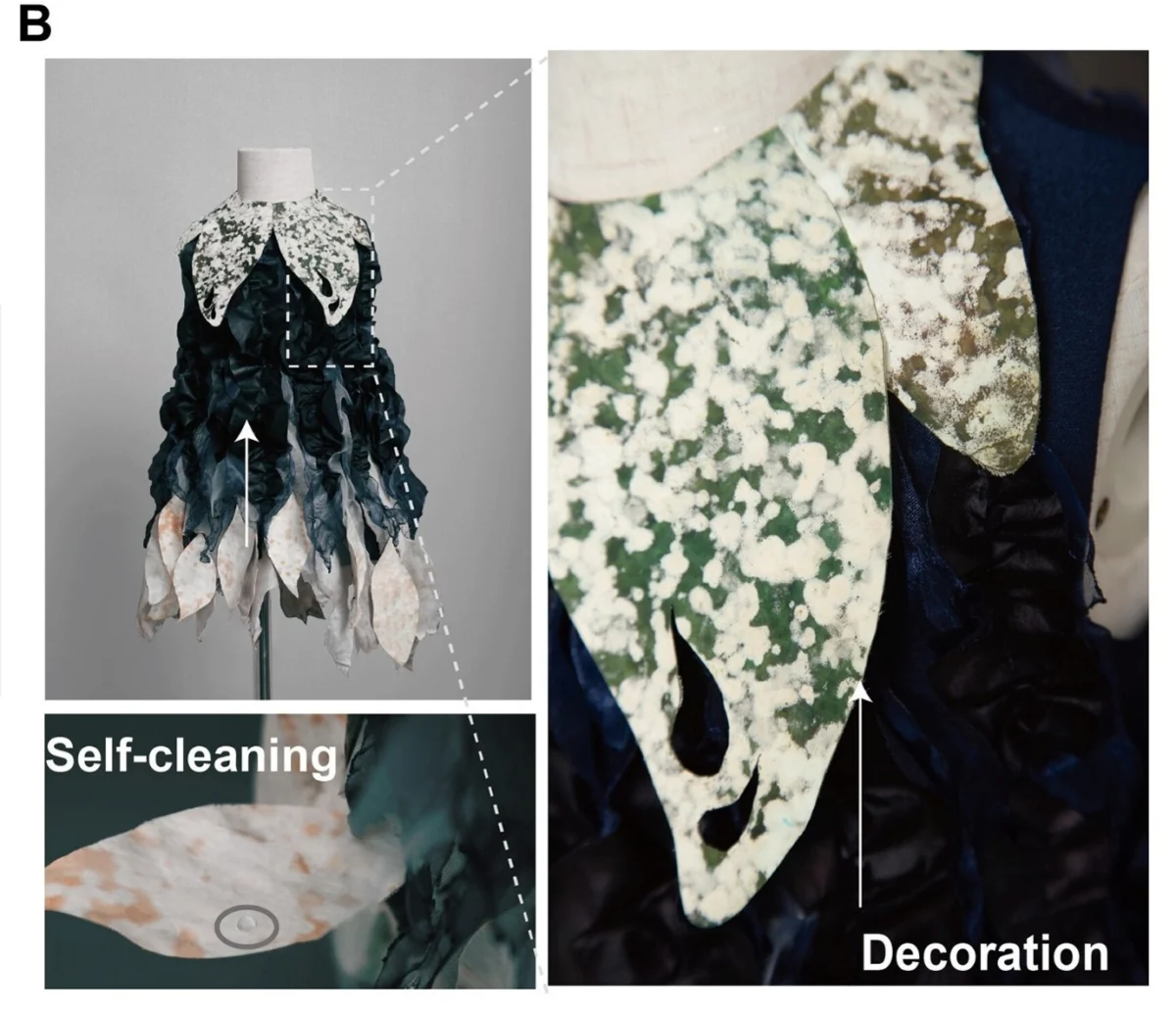
To cement these findings in a tangible format, the research team successfully fabricated a fully realized prototype dress from the material. This garment incorporated pigment-producing yeast for aesthetic coloration and localized aerial hyphae for surface texturing, serving as a concrete proof-of-concept for the viability of living textiles in commercial fashion applications.
Broader Implications Across Industries
While the prospect of wearing Cordyceps-based couture on commercial runways remains a distant horizon, the underlying technology holds profound implications that extend far beyond the apparel sector. As noted by the study authors in their concluding remarks, this biological fabrication paradigm provides a robust foundation for the broader development of adaptive, living material platforms across multiple disciplines.
In the biomedical field, similar living membranes could be utilized for advanced wound dressings that actively respond to bodily fluids, deliver therapeutics, and regenerate their own structural matrix over healing skin. In environmental engineering, responsive fungal films could be engineered to detect and neutralize specific pollutants or heavy metals upon contact. Meanwhile, architectural designers are increasingly looking toward mycelium-based composites for sustainable, self-healing building insulation and structural panels that sequester carbon and reduce the construction industry’s heavy reliance on carbon-intensive concrete and steel.
As interdisciplinary research continues to bridge the gap between biology and materials engineering, living textiles represent a paradigm shift from extractive, dead-matter manufacturing to regenerative, biologically integrated production systems. Although commercialization will require navigating regulatory frameworks, scaling production methodologies, and shifting consumer perceptions, the foundational science established by the Chinese Academy of Sciences demonstrates that the future of materials design may literally be alive.