For decades, the origin of life has been anchored by a vexing, circular dilemma known as the "chicken or egg" problem: How could RNA—the molecule theorized to have jump-started life—have functioned and evolved without the protective enclosure of a cellular membrane? On the primordial Earth, a planet characterized by volatile temperatures, acidic pools, and a lack of organized biological structures, naked RNA would have been far too fragile to survive, let alone orchestrate the complex chemical reactions necessary to build the first cells.
A landmark study published in Nature Communications by researchers at the University at Buffalo, in collaboration with Princeton University, has provided a compelling piece of this evolutionary puzzle. The research suggests that RNA possesses an intrinsic, temperature-dependent ability to self-organize into "condensates"—liquid-like, membrane-less droplets. These structures, the study argues, could have served as the original biological compartments, shielding RNA from harsh environments while concentrating the molecules enough to catalyze the emergence of life.
The RNA World Hypothesis: Context and Challenges
The "RNA World" hypothesis posits that before the rise of DNA and proteins, RNA acted as both a genetic repository and a functional catalyst. Unlike DNA, which is primarily a storage medium, RNA can fold into complex shapes to perform enzymatic tasks, much like proteins. This dual utility makes it the prime candidate for the first self-replicating molecule.
However, the hypothesis has long been plagued by the "enclosure problem." Without a lipid bilayer to sequester them, early RNA molecules would have diluted into the vast, chaotic primordial soup. Without a controlled micro-environment, the probability of two specific RNA molecules colliding and interacting in a meaningful way would be statistically negligible. Furthermore, the high-energy, ionizing environment of the early Earth would have rapidly degraded exposed nucleotides.
For years, scientists have looked for a mechanism that could explain how RNA could "self-contain" without the need for sophisticated biological machinery. The discovery that RNA molecules naturally phase-separate into droplets provides a physical mechanism for this containment, effectively acting as a "protocell" that forms spontaneously based on the laws of chemistry rather than biological evolution.
The Physics of Phase Separation
The study, led by Priya R. Banerjee, PhD, Twentieth Century Club Professor in the University at Buffalo Department of Physics, marks a significant shift in how biochemists view the stability of early life. Building on previous research from 2023 that established RNA’s tendency to form droplets at high temperatures, the team sought to understand the molecular "why" behind this behavior.
By comparing RNA with single-stranded DNA of identical sequences, the researchers uncovered a striking disparity. In laboratory trials, RNA consistently began forming these condensates at temperatures approximately 10 degrees Celsius lower than DNA. This suggests that RNA is inherently "stickier" and more prone to aggregation than its genetic successor.
This aggregation is not merely a clustering effect; it is a complex phase transition. Inside these droplets, RNA molecules frequently form interconnected networks, transitioning from a fluid state to a more viscous, gel-like structure. This gel state is significant: it provides a physical buffer, potentially insulating the interior molecules from external chemical degradation while allowing for the necessary diffusion of smaller substrates.
The Role of the 2′-Hydroxyl Group
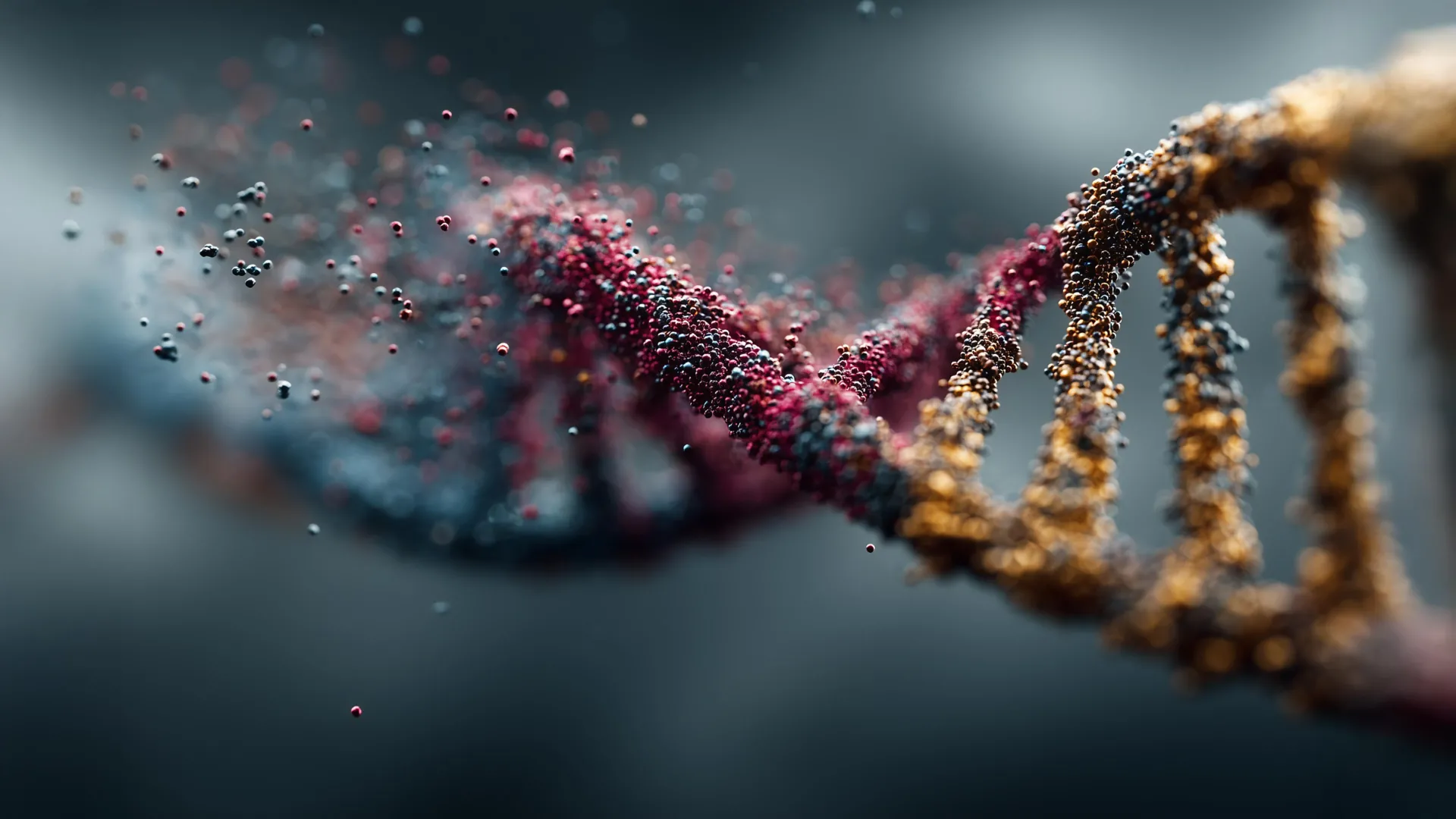
The fundamental driver of this behavior, according to the study, is a subtle chemical difference that distinguishes RNA from DNA: a single oxygen atom. Every RNA sugar unit contains a 2′-hydroxyl (2′-OH) group, a feature absent in the sugar backbone of DNA.
Through a combination of temperature-controlled microscopy, small-angle X-ray scattering, and molecular dynamics simulations, the team found that this 2′-OH group exerts a disproportionate influence on the molecule’s behavior. The presence of the 2′-OH group facilitates stronger interactions with magnesium ions—which were likely abundant in early Earth’s mineral-rich environment—and influences the hydration shell of the molecule.
When the researchers chemically replaced the 2′-OH group with a 2′-Ome (methoxy) group, the RNA’s ability to form condensates was severely hindered. This finding indicates that the evolutionary transition from RNA to DNA—which involved the loss of this oxygen atom—was not just a change in stability, but a fundamental shift in how the genetic material organizes itself. The "deoxygenation" that led to DNA likely prioritized long-term stability and fidelity over the self-organizing, fluidic nature of RNA.
Implications for Synthetic Biology and Evolutionary Science
The implications of this research extend far beyond the history of Earth; they provide a blueprint for synthetic biology. The ability to program RNA to form droplets that behave like living compartments could enable the development of "synthetic cells." If researchers can successfully engineer these droplets to perform specific biochemical reactions—such as template-directed synthesis or information storage—they could effectively recreate the transition from chemistry to biology in a laboratory setting.
"These findings reveal, for the first time, how remarkably small changes in molecular chemistry can control the emergence of much larger, self-organized biomolecular structures," says Dr. Banerjee. "They could allow us to eventually address even deeper questions, like whether these condensates helped bridge the gap between simple molecules and the earliest forms of life."
For the broader scientific community, the study serves as a validation of the bottom-up approach to the origin of life. Instead of searching for complex, pre-existing cell membranes, researchers are now looking at the inherent physical properties of prebiotic building blocks. If RNA’s structural chemistry naturally favors self-organization, then the emergence of the first "living" structures may have been an inevitable result of thermodynamic laws rather than a "lucky" accident.
Chronology of the Research
The investigation, supported by the National Institutes of Health, the National Science Foundation, and the Hypothesis Fund, reflects a multi-year effort to reconcile physical chemistry with evolutionary biology.
- Pre-2023: General consensus in the field holds that RNA is the primary candidate for early life, yet the mechanism for its concentration remains elusive.
- 2023: Dr. Banerjee’s laboratory publishes initial findings showing that RNA naturally organizes into liquid droplets at high temperatures, offering a potential solution to the dilution problem.
- 2024 (Early Access): The current study is published in Nature Communications, providing the mechanistic explanation for why RNA condenses more efficiently than DNA, specifically highlighting the 2′-OH group as the critical molecular switch.
- Future Trajectory: The Banerjee lab is currently working to engineer these droplets into "active" compartments that can perform basic biochemical functions, moving toward the goal of a fully synthetic, RNA-based cell.
Looking Ahead: The Quest for the First Cell
While this research provides a vital clue, many questions remain. Scientists must still determine how these droplets could have evolved into stable, lipid-bound cells and how RNA-based catalysts (ribozymes) could have achieved the precision required for high-fidelity replication.
However, the discovery that the fundamental structure of RNA was "pre-programmed" to facilitate the formation of protocells offers a robust, evidence-based path forward. By demonstrating that life’s most essential molecule could essentially create its own home, the University at Buffalo team has moved the field closer to answering one of humanity’s most profound questions: how, from the inert dust of the early Earth, the first spark of life was sustained long enough to ignite the evolutionary process.