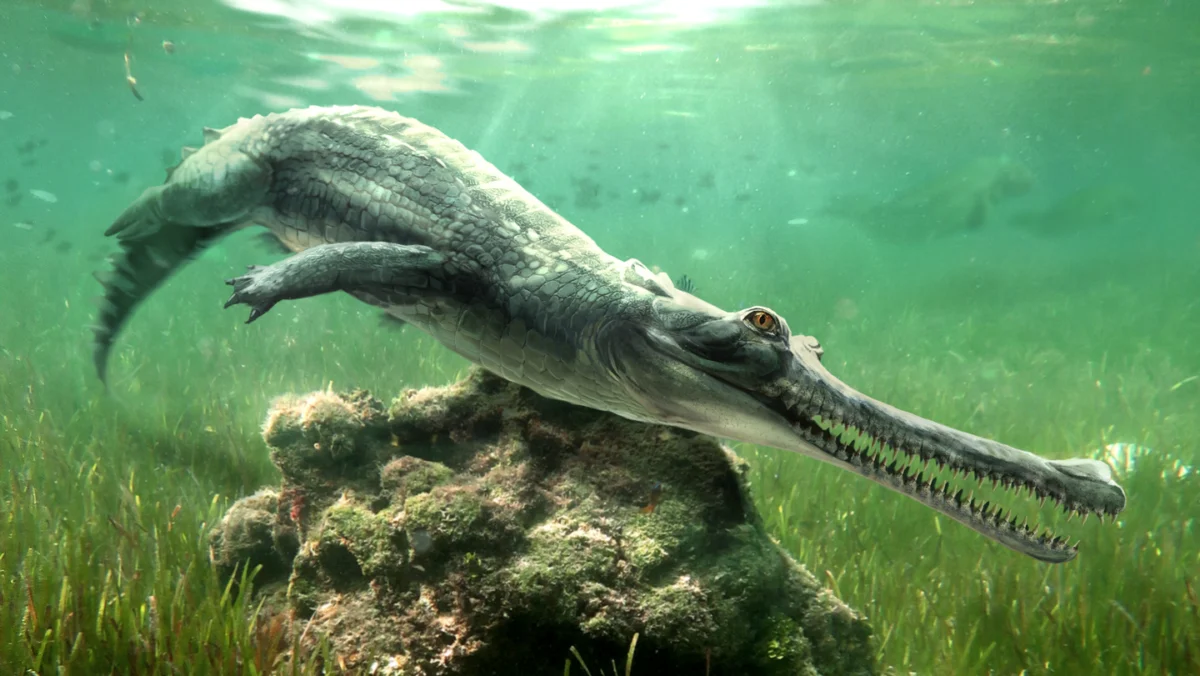
The Great Sphinx of Giza, a monumental icon of antiquity, is famously missing its nose, a feature lost to the ravages of time and history. Recent paleontological research has revealed that it is not the only ancient resident of the Giza plateau to share this distinctive, albeit unintentional, aesthetic. A 45-million-year-old fossilized crocodilian skull, unearthed from the very same Eocene-era limestone that provided the stone for the Sphinx, has been identified as a previously unknown genus. This discovery, detailed in the October 7 issue of Royal Society Open Science, provides a significant missing link in the evolutionary history of the gavial, a specialized group of crocodilians that has long puzzled biologists and paleontologists alike.
A Century of Misclassification Corrected
The journey to identifying Herugavialis cairensis began nearly a century ago. In 1927, German paleontologists working in the hills near Cairo recovered a fossilized skull that was initially categorized as a species of Tomistoma. Tomistoma is a genus of crocodilian that, in modern times, is represented by a single species—the Malayan gharial—restricted to the freshwater habitats of Southeast Asia. For decades, the Egyptian fossil sat in archives, accepted as an ancient relative of this modern Asian genus.
However, modern evolutionary biology, bolstered by advanced imaging and analytical techniques, began to suggest that the 1927 classification was flawed. In 2023, Paul Burke, a paleontologist then completing his doctoral studies at University College London, undertook a comprehensive re-evaluation of the specimen. By utilizing 3-D X-ray computed tomography (CT scanning), Burke and his team were able to peer into the fossil’s internal architecture, meticulously mapping the structure of its braincase and nasal cavities.
"As we have advanced in the last 100 years, we have acquired so many new methodologies that we can now implement to determine exactly what kind of species this fossil is," says Burke, who is currently affiliated with the Swedish Museum of Natural History in Stockholm. The high-resolution scans allowed the researchers to compare the internal morphology of the Egyptian fossil against a vast dataset of both extant and extinct gavial specimens. The results were conclusive: the specimen did not belong to Tomistoma. Instead, it represented an entirely new, undescribed genus, which the team formally named Herugavialis cairensis. The name pays homage to the Egyptian deity Heru, or Horus—a figure historically linked to the Great Sphinx—while honoring the geographic origin of the discovery.
The Ecological Context of the Eocene
The discovery of Herugavialis provides a window into the environmental landscape of Northern Egypt during the Middle Eocene, approximately 45 million years ago. At that time, the region was not the arid landscape known to modern tourists. Instead, the area was submerged under the warm, shallow waters of the Tethys Ocean.
Herugavialis was a specialized marine predator. Unlike modern gavials, which are strictly confined to freshwater ecosystems, this ancient reptile thrived in nearshore saltwater environments. Its anatomy—characterized by a long, slender snout armed with needle-like, interlocking teeth—was perfectly adapted for snatching fast-moving fish from the Tethys currents.
The limestone formations of the Giza plateau are rich in fossilized marine life, including sharks, rays, and early cetaceans. These deposits serve as a massive, naturally occurring archive of Eocene biodiversity. The fact that Herugavialis was interred in the same geological strata used to construct the Sphinx is a striking historical convergence. While the Sphinx was carved by human hands to mimic the likeness of a pharaoh, Herugavialis was sculpted by millions of years of sedimentation, both eventually emerging as "noseless" figures from the same primordial stone.
Implications for Gavial Evolution
The identification of this genus has broader implications for our understanding of how crocodilians radiated across the globe. Khalafallah Salih, a paleontologist at Al Neelain University in Khartoum, Sudan, suggests that the discovery challenges traditional models of crocodilian dispersal.

"The finding supports the hypothesis that the evolution of gavials and their relatives in Africa was significantly more complex than previously assumed," Salih notes. His analysis suggests that Herugavialis does not share close genetic or structural affinities with other known African or Mediterranean gavial fossils. Rather, it appears to represent an early, isolated branch of the gavial family tree that diverged and adapted to the coastal niches of the Tethys long before the ancestors of modern species became established in Asian river systems.
This discovery underscores a recurring theme in paleontology: that the fossil record is frequently underestimated in terms of taxonomic diversity. By re-examining "forgotten" fossils using modern technology, scientists are uncovering a more nuanced map of life’s history, identifying "ghost lineages" that have long gone unrecognized.
The Endangered Legacy of the Gavial
While Herugavialis represents a long-extinct branch of the crocodilian family, its modern counterparts face an uncertain future. Gavials today are among the most critically endangered crocodilians on the planet. Their specialized biology—which includes a high sensitivity to water quality and a reliance on specific riverine habitats—makes them highly vulnerable to human-driven environmental degradation, such as dam construction, sand mining, and pollution.
Burke emphasizes that the public often focuses heavily on the more aggressive or "charismatic" members of the crocodilian order, such as the American alligator or the Nile crocodile, while the unique evolutionary history of the gavial remains obscure.
"They are still alive today and they are critically endangered," Burke states. "We should know about them and their long history." By bringing attention to the deep evolutionary roots of the gavial through discoveries like Herugavialis, researchers hope to stimulate greater public interest and conservation efforts. The gavial is not merely a curiosity of the past; it is a distinct, specialized lineage that has navigated the challenges of Earth’s changing oceans for tens of millions of years.
Future Directions for Research
The methodology employed by Burke and his colleagues—integrating 3-D digital reconstruction with traditional comparative anatomy—is expected to become the gold standard for future re-evaluations of historical fossil collections. Museums across Europe and North America house thousands of specimens collected in the late 19th and early 20th centuries that have not been studied with modern imaging equipment.
The case of Herugavialis cairensis demonstrates that these archives are not stagnant repositories of history but are instead active sites of ongoing discovery. As researchers continue to apply these advanced techniques to other specimens from the Eocene, it is highly probable that more "hidden" species will emerge from the shadows of misclassification.
In the immediate future, the team plans to conduct isotopic analysis on the fossilized teeth of Herugavialis. This will provide further insight into the animal’s diet and migration patterns, potentially confirming whether it moved between freshwater and marine environments or remained strictly within the coastal zones of the Tethys. For now, the noseless skull of Herugavialis serves as a silent, stony witness to a world that existed long before the pyramids were conceived, reminding us that the history of life is written as much in the rocks beneath our feet as it is in the monuments we build upon them.