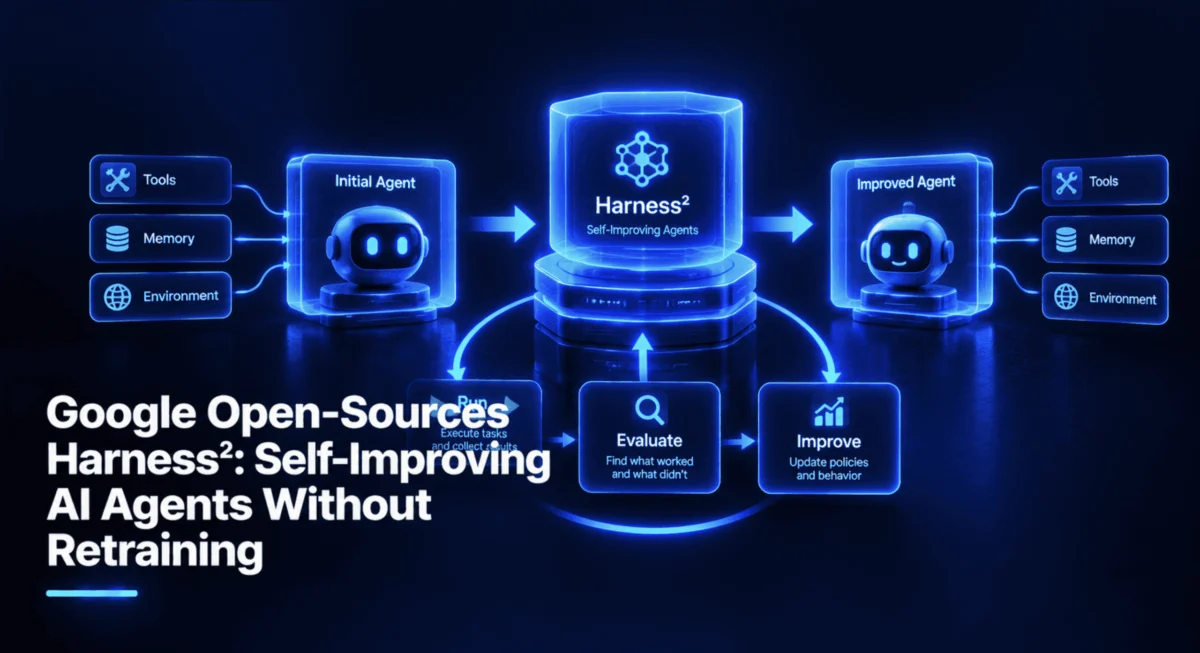
Google Research has officially open-sourced Harness² (also referred to as Harness2), a groundbreaking framework designed to empower artificial intelligence agents with the capability to autonomously improve their performance over time without requiring any retraining of the underlying foundation models. Released under the permissive Apache 2.0 license, this innovative approach bypasses the traditional, resource-intensive paradigm of model fine-tuning and weight modification. Instead, Harness² dynamically rewrites and optimizes the peripheral architecture surrounding an AI model—collectively known as the "harness"—which includes prompts, tools, memory structures, operational skills, and helper scripts.
The launch of Harness² is accompanied by a comprehensive research paper titled Harness²: Recursive Agent Harnessing for an Open World, published on arXiv, alongside a dedicated project site and active community discussions across developer platforms. As deployment demands for reliable, autonomous AI agents surge across professional and enterprise landscapes, this framework offers a scalable alternative that modifies only an agent’s operational environment, effectively carrying learned improvements seamlessly into subsequent tasks.
Background Context and Industry Challenges
For years, the standard methodology for enhancing the capability and accuracy of large language models (LLMs) and task-specific AI agents involved either prompt engineering by hand or direct model fine-tuning. While manual prompt engineering works well for predictable, highly scoped tasks, it breaks down rapidly when agents encounter what researchers define as an "open world"—unforeseen real-world scenarios, novel data structures, and ambiguous professional workflows that developers could not possibly anticipate during the initial design phase.
Conversely, fine-tuning underlying model weights requires access to massive computational resources, substantial training datasets, and, in many cases, proprietary weights that are restricted behind third-party APIs. For the vast majority of enterprise teams and developers relying on API-driven foundation models, direct weight modification is practically impossible. Harness² addresses this fundamental industry bottleneck by shifting the locus of improvement from the internal neural weights to external, modular components stored as plain-text files.
Architectural Anatomy: The Eight Components of a Harness
In the architecture of Harness², a harness represents the entire supportive ecosystem that enables a model to function effectively as an autonomous agent. Rather than treating the LLM as a static black box that requires internal updates, Harness² targets eight distinct architectural components for continuous optimization:
- System Prompt: The foundational, persistent instructions that establish the model’s baseline persona and operational parameters.
- Guardrails: Explicit operational boundaries and safety rules dictating permissible and prohibited actions.
- Memory: Long-term contextual data storage carried across multi-step task executions.
- Skills: Reusable, modular instructions tailored for specific types of professional work or problem-solving routines.
- Tool Guidance: Detailed directives outlining precisely how and when the agent should invoke external software tools.
- Scripts: Executable helper code that the agent can write, modify, and run to automate data processing or logic checks.
- Subagents: Delegated secondary helpers utilized to break down and manage isolated sub-tasks.
- Plugins: Middleware layers that dynamically shape behavioral interactions inside the core tool execution loop.
By systematically refining these eight components, the framework can radically alter an agent’s problem-solving efficacy without touching a single parameter of the underlying neural network.
The Two Levels of Recursion: How Harness² Operates
The superscript "2" in Harness² denotes a sophisticated dual-loop recursive architecture that governs how the agent adapts locally and globally over time.
Task-Level Recursion (Propose–Probe–Compose)
Operating on every individual task, the first loop relies on behavioral contrasts between executions rather than explicit ground-truth feedback. In open-world environments, agents rarely receive a clean answer key; instead, Harness² analyzes the behavioral differences between two separate runs of the same task. Through an iterative cycle of proposing edits to the harness, probing the results against operational constraints, and composing a refined version, the agent optimizes its approach to the immediate problem.
Harnessing-Level Recursion
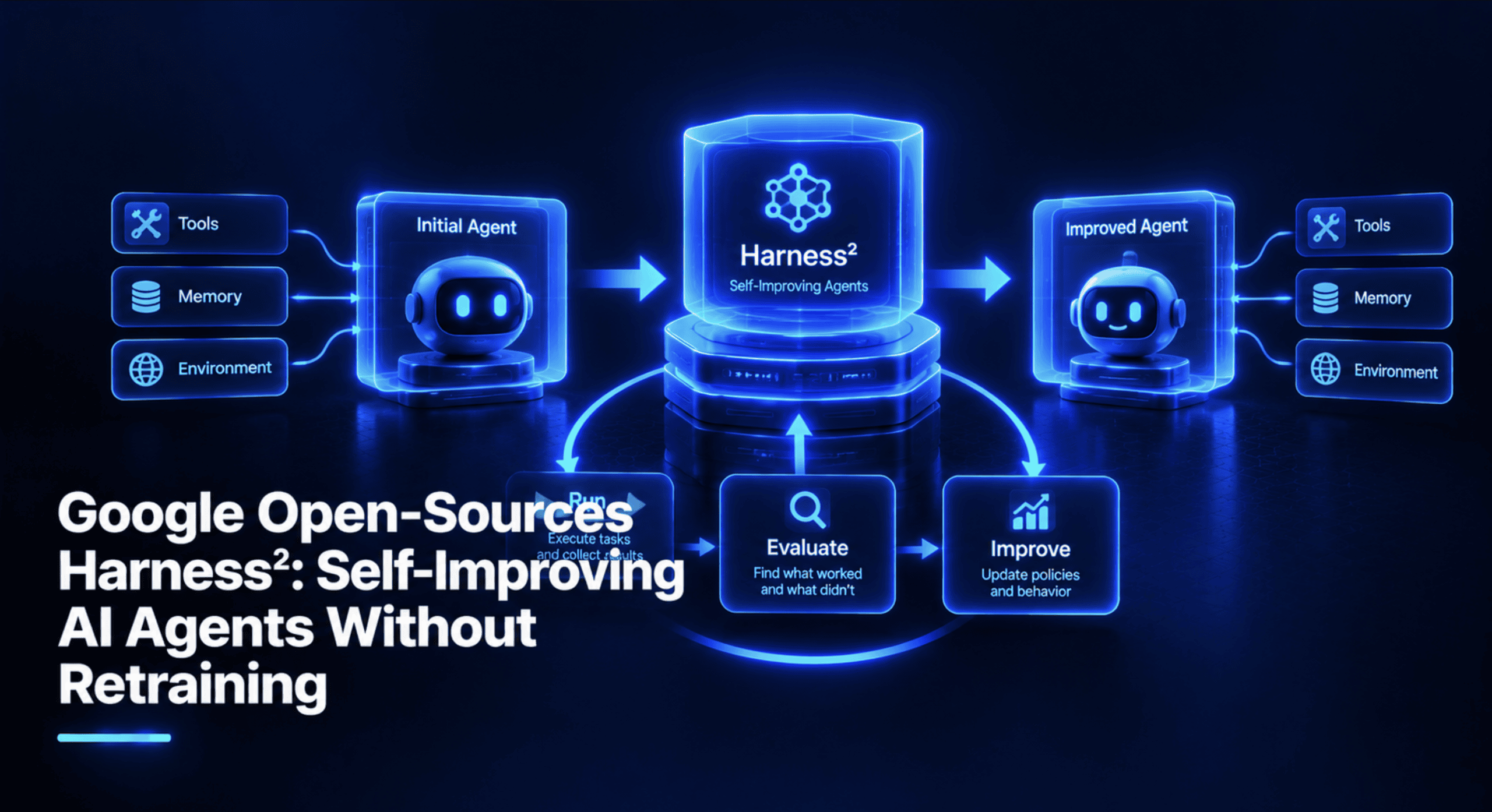
Upon the completion of a task, an experience reflector stores the successfully adopted harness along with evidence-supported lessons into a persistent improvement harness. This repository directly informs and guides the refinement process for subsequent tasks. Consequently, while the first loop enhances the agent’s performance on a specific assignment, the second loop continuously improves the framework’s overarching capability to refine agents across entirely new domains.
Parallel Versus Sequential Recursion Modes
To balance computational efficiency and performance optimization, Harness² supports different execution modes governed by a designated budget parameter, denoted as $k$. Developers can allocate computational resources through parallel or sequential recursion modes.
Because rigorous optimization sweeps—such as those evaluated on the Legal Agentic Benchmark (LAB), which features 1,143 distinct tasks—can demand thousands of individual executor rollouts and improver sessions, understanding these modes is crucial for cost management. Sequential execution processes improvements step-by-step, while parallel execution evaluates multiple candidate harnesses simultaneously before selecting the optimal path forward.
Benchmark Performance and Empirical Results
Google Research tested Harness² across multiple foundation models, including GLM-5 and Gemini 3.5 Flash, utilizing three distinct and rigorous industry benchmarks:
- WorkBuddy-Bench: Focusing on comprehensive office, web, and software coding tasks, models configured with Harness² achieved performance gains of up to 11.5 points using a single optimization step ($k = 1$).
- Legal Agentic Benchmark (LAB): Derived from Harvey’s legal-tech ecosystem, LAB tests complex legal reasoning and document generation. Harness² demonstrated partial pass-rate improvements of up to 11.8 percentage points.
- JobBench: Evaluated across broad professional workflows, the framework yielded performance increases of up to 4.5 points.
While these figures represent peak performance gains under specific configurations rather than generalized averages, empirical data from the accompanying research paper indicates that scaling the recursion budget $k$ yields further performance enhancements. Independent reproduction and community evaluation are currently underway as researchers deploy the open-source codebase in diverse operational environments.
Practical Implications and Enterprise Impact
The introduction of Harness² carries significant implications for the broader enterprise software and artificial intelligence development sectors. By decoupling agent improvement from model retraining, the framework delivers three core practical advantages:
- Cost Efficiency: Eliminating the requirement for GPU clusters and extensive training datasets drastically reduces the financial barrier to building high-performing, domain-specific AI agents.
- Interpretability and Control: Because every modification made by the framework is stored in plain-text files—such as rewritten Python scripts, updated system prompts, and explicit Markdown-based experience logs—human engineers can easily inspect, audit, and approve changes before deployment. This transparency is vital for highly regulated industries such as legal, finance, and healthcare.
- API Agnosticism: Organizations restricted to using closed-source foundation models via standard APIs can fully leverage self-improving agent architectures without needing direct access to model weights.
Getting Started: Free Local Demonstrations and Vertex AI Integration
For developers seeking to explore the framework without incurring cloud costs, Google has included a local demonstration mode that operates entirely offline using deterministic editors and real Python execution environments, requiring zero API credentials. Utilizing modern Python packaging tools such as Astral’s uv, developers can clone the repository, establish an isolated virtual environment, and execute the demonstration suite within minutes.
For enterprise environments scaling up to fully model-backed evaluations, Harness² integrates natively with cloud infrastructures such as Google Cloud Vertex AI. By configuring environment variables to assign roles for executors, improvers, and judges, teams can run comprehensive benchmark suites—such as the LAB legal evaluation framework—using production-grade LLMs. The framework provides specialized command-line utilities (harness2, harness2-demo, harness2-judge, and harness2-report) to manage setup, execution, grading, and performance reporting seamlessly.
Conclusion
Google Research’s release of Harness² marks a notable philosophical shift in how the artificial intelligence community approaches agent optimization. By treating the agent’s environment as a dynamic, self-rewriting library of experiences rather than relying exclusively on deep neural network retraining, the framework provides a transparent, scalable, and highly adaptable mechanism for open-world problem solving. As developers, researchers, and enterprises begin to fork the repository and test its capabilities across diverse professional workflows, Harness² may well establish a new standard for autonomous, continuously improving AI systems.