An international consortium of leading plant scientists has unveiled a groundbreaking molecular mechanism employed by a rare lineage of land plants, offering a tantalizing glimpse into strategies that could revolutionize crop yields. This discovery, emerging from collaborative research at the Boyce Thompson Institute (BTI), Cornell University, and the University of Edinburgh, holds significant promise for engineering staple crops like wheat and rice to convert sunlight into sustenance with unprecedented efficiency.
The Central Challenge: Rubisco’s Inherent Limitations
At the heart of this scientific breakthrough lies Rubisco, an enzyme universally recognized as pivotal for life on Earth. Rubisco’s fundamental role is to capture atmospheric carbon dioxide (CO2) – the essential building block for plant growth – and initiate the process of photosynthesis. However, this vital enzyme is notoriously inefficient. It operates at a relatively slow pace and possesses a significant drawback: it frequently mistakes oxygen (O2) for CO2. This "mistake" triggers a wasteful process known as photorespiration, which diverts energy away from carbon fixation and consequently limits a plant’s overall growth potential.
"Rubisco is arguably the most important enzyme on the planet because it’s the entry point for nearly all carbon in the food we eat," explained Dr. Fay-Wei Li, an Associate Professor at the Boyce Thompson Institute and a co-leader of the research. "But its inherent slowness and susceptibility to oxygen interference represent a major bottleneck, fundamentally limiting how efficiently plants can convert solar energy into biomass."
The global agricultural sector has long grappled with this limitation. Despite millennia of crop domestication and selective breeding, the intrinsic inefficiency of Rubisco has remained a persistent challenge. While various organisms have evolved ingenious solutions over evolutionary timescales, translating these adaptations into the crops that feed billions has proven an arduous task.
Algae’s Carbon Concentrating Mechanism: A Precedent and a Puzzle
A notable evolutionary adaptation observed in many types of algae involves the spatial organization of Rubisco. These single-celled organisms have developed specialized micro-compartments within their cells called pyrenoids. Within these pyrenoids, Rubisco is densely packed, and CO2 is actively concentrated around it. This high concentration of CO2 effectively "outcompetes" oxygen, significantly enhancing Rubisco’s efficiency and minimizing photorespiration.
For decades, researchers have harbored the ambition of replicating this algal carbon-concentrating mechanism in terrestrial food crops. The rationale is compelling: by creating similar high-CO2 micro-environments within crop cells, it might be possible to dramatically boost photosynthetic output. However, the sheer complexity of the molecular machinery involved in pyrenoid formation and function has presented a formidable barrier. Transferring these intricate systems from algae, which are evolutionarily distant from land plants, into crops has been fraught with difficulty, yielding limited success.
Hornworts: An Unexpected Evolutionary Bridge
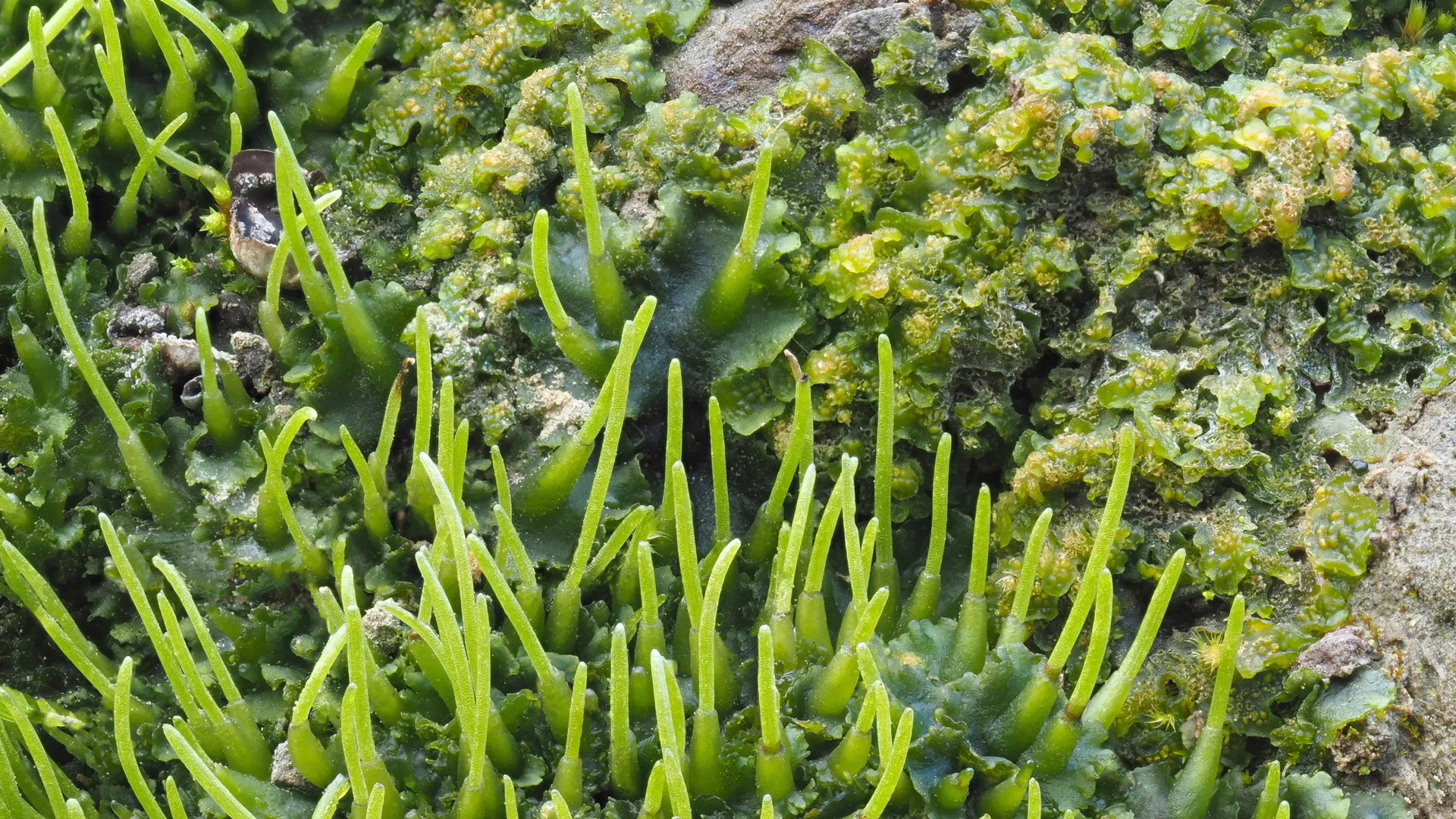
The recent breakthrough emerged from the scientific investigation of hornworts, a small and ancient group of bryophytes. What makes hornworts particularly significant is their unique position in plant evolution: they are the only known land plants to possess cellular structures that bear a striking resemblance to algal pyrenoids, effectively acting as natural carbon-concentrating compartments. Crucially, hornworts share a much closer evolutionary lineage with crop plants than algae do. This proximity suggested that their molecular toolkit for carbon concentration might be more readily adaptable and transferable to agricultural species.
The research team, comprising scientists from BTI, Cornell University, and the University of Edinburgh, embarked on this investigation with a prevailing hypothesis: they expected hornworts to employ a mechanism analogous to that found in algae, likely involving specific proteins that aggregate Rubisco. However, their findings took a decidedly unexpected turn, revealing a fundamentally different and elegantly simple strategy.
"We assumed hornworts would use something similar to what algae use — a separate protein that gathers Rubisco together," stated Tanner Robison, a graduate student working under Dr. Li and a co-first author of the study. "Instead, we discovered they’ve modified Rubisco itself to do the job."
The RbcS-STAR Protein: A Molecular Velcro for Rubisco
The key to this novel mechanism lies in an unusual protein component that the researchers have termed RbcS-STAR. Rubisco, in its functional form, is a complex enzyme assembled from two types of protein subunits: large subunits (RbcL) and small subunits (RbcS). In hornworts, a specific variant of the RbcS subunit possesses an extended region, an additional segment known as the STAR domain.
This STAR domain acts as a remarkably effective molecular anchor, functioning akin to a microscopic Velcro. When present, this tail causes the Rubisco proteins to self-associate, leading to the formation of tightly packed clusters within the plant cell. This clustering effectively concentrates Rubisco in specific locations, creating the high-density environment conducive to efficient carbon fixation.
Demonstrating Universal Functionality Across Plant Species
To ascertain whether the STAR domain’s clustering capability could be harnessed in other plant systems, the research team conducted a series of rigorous experiments. Their initial investigation involved introducing the RbcS-STAR component into a closely related hornwort species that, unlike its pyrenoid-forming relatives, does not naturally develop these carbon-concentrating compartments. Following the introduction of RbcS-STAR, the researchers observed a dramatic shift in Rubisco localization. Instead of being diffusely spread throughout the cell, Rubisco began to aggregate into distinct, organized structures that mimicked the appearance of pyrenoids.
Emboldened by this success in hornworts, the scientists then moved to test the STAR domain’s potential in a more widely studied model organism: Arabidopsis thaliana. This small flowering plant is a workhorse in plant biology research due to its well-understood genetics and rapid life cycle. Upon introducing the RbcS-STAR component into Arabidopsis, the results mirrored those observed in hornworts. Rubisco readily gathered into dense clusters within the chloroplasts, the cellular organelles where photosynthesis takes place.
Professor Alistair McCormick, from the University of Edinburgh and another co-leader of the research, highlighted the significance of these findings: "We even tried attaching just the STAR tail to Arabidopsis‘s native Rubisco, and it triggered the same clustering effect. That tells us STAR is truly the driving force. It’s a modular tool that can work across different plant systems." This demonstrates that the STAR domain’s ability to induce Rubisco clustering is not limited to its native context but possesses a remarkable degree of cross-species compatibility.
Implications for Agricultural Biotechnology: A Pathway to Enhanced Crops
The universal nature of the STAR domain’s function across such diverse plant species is precisely what makes this discovery so profoundly important for the future of agriculture. It strongly suggests that by strategically introducing this simple "velcro component" into key food crops, scientists may be able to induce the desired Rubisco clustering, thereby enhancing their photosynthetic efficiency.
However, the researchers are careful to temper expectations with a pragmatic outlook. While clustering Rubisco is a critical step, it is not the sole determinant of photosynthetic efficiency. The efficient delivery of CO2 to these clustered Rubisco sites remains a crucial, albeit separate, challenge.
Dr. Laura Gunn, an Assistant Professor at Cornell University and a third co-leader of the study, articulated this point with a clear analogy: "We have built a Rubisco house, but it won’t be an efficient house unless we update the HVAC." The team is actively engaged in research to address this vital aspect, aiming to ensure that the carbon-concentrating machinery is coupled with an effective CO2 supply system. This dual approach is essential for realizing the full potential of enhanced photosynthesis.
A Leap Forward in Sustainable Food Production
Despite the remaining challenges, this discovery represents a significant stride in the ongoing quest to optimize photosynthesis, the fundamental process that sustains life on Earth. Even marginal improvements in photosynthetic efficiency can translate into substantial increases in crop yields. Such enhancements are vital for meeting the escalating global demand for food, particularly in the face of a growing population and the increasing pressures of climate change on agricultural systems.
The ability to boost crop productivity through genetic engineering that mimics natural evolutionary solutions offers a pathway towards more sustainable food production. This approach has the potential to reduce the need for extensive land use, minimize the application of fertilizers and pesticides, and decrease the overall environmental footprint of agriculture.
"This research shows that nature has already tested solutions we can learn from," Dr. Li concluded. "Our job is to understand those solutions well enough to apply them where they’re needed most — in the crops that feed the world."
The foundational research for this study was published in the prestigious journal Science. The publication highlights the significant contributions of four early-career scientists: Tanner A. Robison, Yuwei Mao, Zhen Guo Oh, and Warren S.L. Ang, who shared equal authorship. The corresponding authors leading this international collaboration were Laura H. Gunn, Alistair J. McCormick, and Fay-Wei Li, underscoring the interdisciplinary and multi-institutional nature of this scientific endeavor. The work represents a critical step in understanding and harnessing the power of plant biology to address global food security and sustainability challenges.