An international research collaboration, featuring scientists from the Southwest Research Institute (SwRI), has unveiled a groundbreaking understanding of how complex organic molecules (COMs), deemed fundamental chemical building blocks for life, may have been incorporated into Jupiter’s four largest moons during their formative stages. These pivotal findings, detailed in a series of companion papers published in The Planetary Science Journal and Monthly Notices of the Royal Astronomical Society, offer profound insights into the potential delivery mechanisms of life’s essential ingredients to the Jovian system billions of years ago.
Unraveling the Origins of Life’s Building Blocks
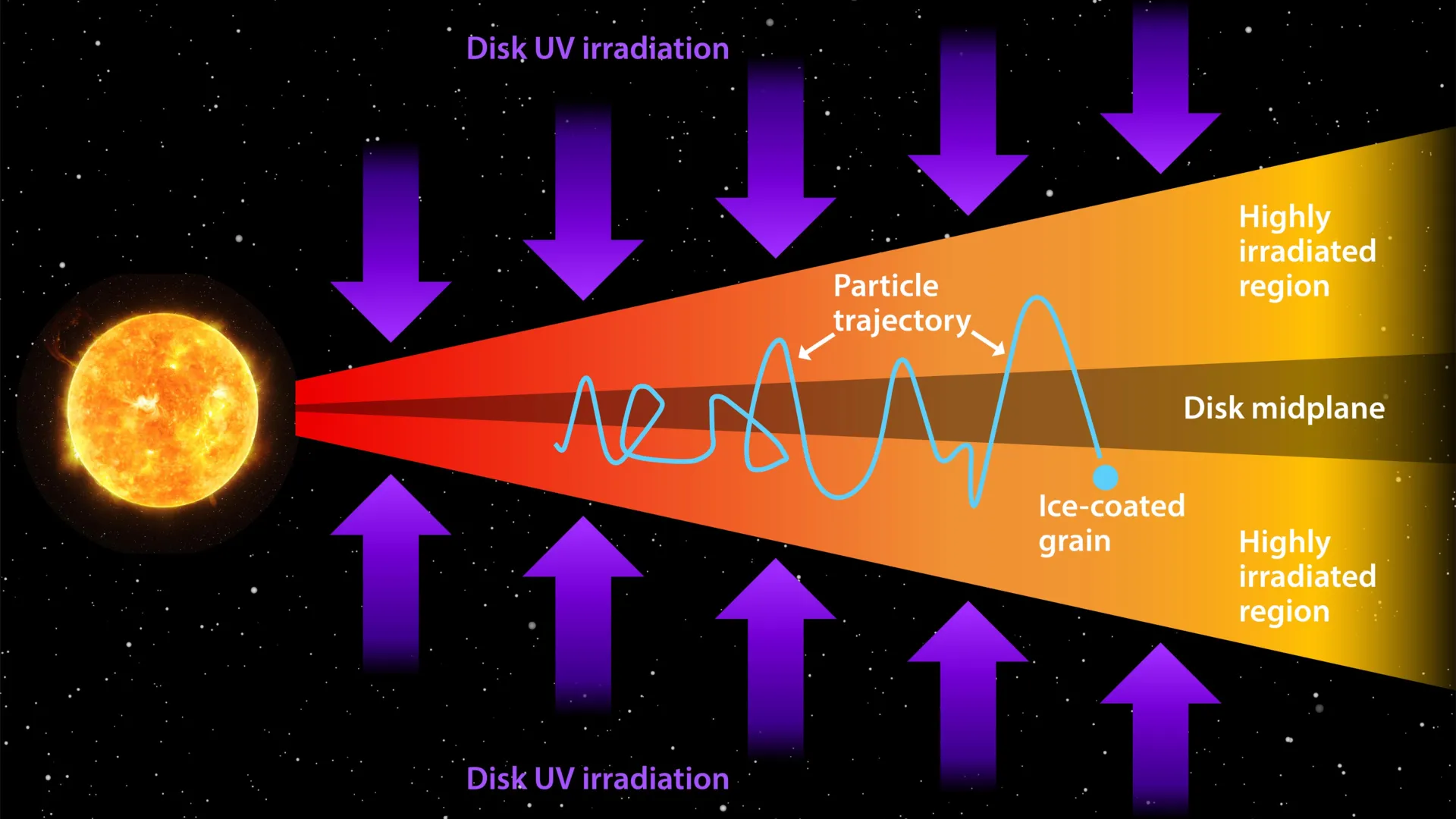
Complex organic molecules are carbon-based compounds that also contain elements crucial for biological systems, such as oxygen and nitrogen. Laboratory experiments have established that these intricate molecules can be synthesized when icy dust grains, rich in methanol or blends of carbon dioxide and ammonia, are subjected to ultraviolet radiation or gentle thermal energy. Such conditions are not only prevalent but are considered standard within protoplanetary disks – the vast, rotating clouds of gas and dust that encircle young stars and serve as the nurseries for planetary formation.
The research team meticulously modeled the chemical processes occurring within these nascent solar systems. By integrating sophisticated models of disk evolution with simulations that tracked the trajectory and behavior of icy particles, they were able to precisely quantify the radiation levels and temperatures these dust grains would have encountered during their journey.
"Our integrated approach, combining disk evolution with particle transport models, allowed us to accurately determine the specific radiation and thermal conditions experienced by the icy grains," explained Dr. Olivier Mousis, a senior researcher in SwRI’s Solar System Science and Exploration Division and lead author of one of the pivotal studies. "Following this, we directly compared our simulated outcomes with existing laboratory experiments designed to replicate COM formation under realistic astrophysical conditions. The convergence of these results strongly suggests that COM formation is indeed feasible within both the broader protosolar nebula and Jupiter’s own circumplanetary disk."
The collaborative effort brought together expertise from SwRI, Aix-Marseille University in France, and the Institute for Advanced Studies in Ireland. Their simulations constructed detailed representations of two key environments: the protosolar nebula, the immense cloud from which our Sun and planets eventually coalesced, and Jupiter’s circumplanetary disk. This latter structure, a swirling disc of gas and dust that enveloped the young gas giant, was the crucible from which its moons eventually formed. By incorporating a critical grain transport component into their models, the researchers could meticulously trace the migratory paths of icy particles. This enabled them to reconstruct a comprehensive physical and chemical history of the primordial material that ultimately coalesced to form the Galilean moons: Io, Europa, Ganymede, and Callisto.
A Dual Pathway for Organic Delivery
The simulations painted a compelling picture, indicating that a significant proportion of icy grains within Jupiter’s nascent environment likely underwent COM formation. These organic-rich grains were then transported into the region where Jupiter’s moons were actively assembling. In certain simulated scenarios, a remarkable finding emerged: nearly half of the modeled particles successfully carried newly synthesized organic molecules from the wider protosolar nebula into Jupiter’s circumplanetary disk. Crucially, these molecules appear to have been incorporated into the growing moons with minimal subsequent chemical alteration.
Adding another layer of complexity, the results also propose that some COM formation might have occurred much closer to Jupiter itself. Evidence from the simulations suggests that specific regions within Jupiter’s circumplanetary disk experienced temperatures sufficiently elevated to drive the chemical reactions necessary for the creation of these complex organic compounds. This implies a dual origin for the organic material found on the Galilean moons: a significant contribution from the vast, primordial solar nebula, coupled with localized chemical synthesis within Jupiter’s immediate orbital environment billions of years ago.
Implications for Ocean Worlds and the Search for Life
The implications of these findings are particularly profound when considering the potential habitability of Jupiter’s icy moons. Europa, Ganymede, and Callisto are all strongly suspected to harbor vast subsurface oceans of liquid water beneath their frozen exteriors. The presence of liquid water, combined with inferred internal energy sources, makes these worlds prime candidates in the ongoing search for extraterrestrial life.
If COMs were an integral part of the material from which these moons accreted, then these ocean worlds may not only possess the essential solvent (water) and energy but also the fundamental molecular ingredients required for prebiotic chemistry. This includes the very molecules that, on Earth, formed the basis for amino acids and nucleotides – the building blocks of proteins and nucleic acids, respectively.
"Our findings strongly suggest that Jupiter’s moons did not originate as chemically barren worlds," Dr. Mousis elaborated. "Instead, it is highly probable that they accreted, or accumulated, a substantial inventory of complex organic molecules at their very formation. This endowment would have provided a foundational chemical environment that could later interact with the liquid water present within their interiors."
The scientific community is eagerly anticipating further data from ongoing and upcoming missions to the Jovian system. NASA’s Europa Clipper mission and the European Space Agency’s JUICE (Jupiter Icy Moons Explorer) spacecraft are currently en route, tasked with extensively investigating the structure, composition, and potential habitability of these enigmatic moons.
"Establishing credible pathways for the formation and delivery of complex organic molecules provides scientists with a critical interpretive framework for the upcoming measurements we expect from Jupiter’s surface and subsurface chemistry," Dr. Mousis concluded. "By bridging the disciplines of laboratory chemistry, disk physics, and particle transport modeling, our work offers a compelling glimpse into how the conditions necessary for life may be deeply rooted in the earliest epochs of planetary formation."
A Chronological Perspective on Early Solar System Chemistry
The formation of our solar system is understood to have begun approximately 4.6 billion years ago with the gravitational collapse of a giant molecular cloud. This collapse led to the formation of the protosolar nebula, a swirling disk of gas and dust. Within this nebula, the Sun ignited, and the remaining material began to clump together.
~4.6 Billion Years Ago: The protosolar nebula forms. Within this disk, icy dust grains are abundant, particularly in the colder, outer regions.
Early Stages of Protoplanetary Disk Evolution: As young stars form, their protoplanetary disks are bathed in ultraviolet radiation from the star and neighboring stars, and can experience mild heating. These conditions are ideal for the chemical synthesis of complex organic molecules on the surfaces of icy dust grains. Methanol (CH₃OH), carbon dioxide (CO₂), and ammonia (NH₃) are common components of these ices.
Formation of Jupiter and its Circumplanetary Disk: Jupiter, as one of the first planets to form, accreted a massive amount of gas and dust. This created a circumplanetary disk around the young giant planet, mirroring the conditions of the larger protosolar nebula but on a smaller scale.
Migration and Accretion of Icy Grains: Icy grains, some carrying pre-formed COMs from the protosolar nebula, and others capable of forming COMs within the circumplanetary disk, are transported by gas drag and gravitational interactions.
~4.5 Billion Years Ago (approximate): The Galilean moons begin to form through accretion within Jupiter’s circumplanetary disk. The simulations suggest that a significant fraction of the material that built these moons was already enriched with COMs, either delivered from the outer solar system or synthesized locally within Jupiter’s disk.
Present Day: The Galilean moons, particularly Europa, Ganymede, and Callisto, are now understood to be potential abodes for life, thanks to the presence of liquid water and now, potentially, the essential organic precursors delivered billions of years ago.
Supporting Data and Scientific Context
The concept of organic molecules being delivered to planetary bodies is not new. Comets and asteroids, often referred to as "dirty snowballs" and "rubble piles" respectively, have long been recognized as potential carriers of organic compounds to Earth and other planets. The Murchison meteorite, which fell in Australia in 1969, is a prime example, containing over 100 amino acids, including some not found in terrestrial life.
However, this new research specifically targets the delivery mechanism to the gas giant’s moons, a region previously less understood in terms of organic import. The modeling work relies on established astrophysical models of disk dynamics, such as the viscous accretion disk model, which describes how gas and dust move and evolve in these structures. Particle transport models, often based on equations of motion that account for gas drag, gravitational forces, and radiation pressure, are used to track the movement of individual dust grains.
The laboratory experiments referenced are crucial for validating the chemical pathways. These often involve cryogenic ice deposition onto substrates, followed by irradiation with UV light or exposure to thermal cycles, mimicking the conditions in space. The detection of COMs is typically performed using techniques like mass spectrometry and infrared spectroscopy.
Broader Impact and Implications for Astrobiology
The implications of this research extend far beyond our solar system. The processes modeled for Jupiter’s moons are likely to be common across the galaxy. Many exoplanetary systems feature gas giants, and the formation of their moons would occur within similar circumplanetary disks. Therefore, the potential for delivering life’s essential chemical precursors to moons orbiting gas giants is a widespread phenomenon.
This discovery significantly bolsters the scientific rationale for exploring ocean worlds like Europa and Enceladus (a moon of Saturn). The presence of both liquid water and organic molecules creates a compelling "recipe for life" scenario. Future missions will now have more specific targets and a clearer understanding of what chemical signatures to search for in the subsurface oceans. The identification of specific types of COMs, their abundance, and their distribution could provide crucial clues about the history of these worlds and their potential to harbor life, past or present.
This research underscores a paradigm shift in our understanding of planetary formation and habitability. It suggests that the ingredients for life are not necessarily rare occurrences but may be widely distributed throughout planetary systems from their very inception. The intricate interplay of cosmic chemistry, physics, and celestial mechanics, as revealed by this international team, paints a more optimistic picture for the prevalence of potentially habitable environments in the universe.