Stanford University researchers have achieved a significant breakthrough in materials science by creating a soft, flexible material capable of mimicking the rapid skin-shifting abilities of cephalopods, such as octopuses and cuttlefish. In a study published in the journal Nature, the team describes a polymer-based system that can dynamically alter its surface topography and visual properties at the micron scale—dimensions smaller than the width of a human hair. This innovation marks a pivotal step toward the development of advanced camouflage, next-generation wearable displays, and responsive soft robotics.
The research, led by doctoral student Siddharth Doshi and senior authors Nicholas Melosh and Mark Brongersma, addresses a long-standing challenge in engineering: how to create a material that is simultaneously soft, durable, and capable of high-resolution structural changes. By combining traditional semiconductor manufacturing techniques with innovative polymer chemistry, the Stanford team has developed a "smart" skin that can transition from a flat, transparent state to a complex, three-dimensional textured surface in seconds.
The Biological Inspiration: Nature’s Master of Disguise
For decades, biologists and engineers have been fascinated by the camouflage capabilities of the class Cephalopoda. Unlike most animals, which rely on fixed patterns or slow hormonal changes to alter their appearance, octopuses and cuttlefish utilize a sophisticated network of muscles and specialized cells to change their look in milliseconds.
The biological process involves three primary layers: chromatophores (pigment-filled sacs), iridophores (reflective cells), and leucophores (white-reflecting cells). Crucially, these animals also possess papillae—small bundles of muscle that can change the texture of the skin from smooth to rugose, allowing them to mimic the grain of sand or the jagged edges of coral. This dual-action control of color and texture is what the Stanford researchers sought to replicate.
"Textures are crucial to the way we experience objects, both in how they look and how they feel," explained Siddharth Doshi. "These animals can physically change their bodies at close to the micron scale, and now we can dynamically control the topography of a material—and the visual properties linked to it—at this same scale."
A Serendipitous Breakthrough in Materials Engineering
The path to this discovery was not linear. The project began when Doshi was using a scanning electron microscope (SEM) to examine nanostructures on a water-responsive polymer film. In a moment of scientific serendipity, Doshi decided to reuse a polymer sample that had already been exposed to the electron beam during a previous experiment.
Upon exposing the reused film to water, Doshi observed that the areas previously hit by the electron beam behaved differently than the unexposed regions. The electron beam had subtly altered the chemical cross-linking of the polymer, changing its ability to absorb water and swell.
"We realized that we could use these electron beams to control topography at very fine scales," Doshi said. This accidental observation provided the "key" to the entire project: using electron-beam lithography—a standard tool in the microchip industry—to "program" the swelling behavior of soft materials.
The Mechanism: Electron Beams and Water-Responsive Polymers
The technical core of the innovation lies in the use of electron-beam lithography (EBL) on a specific type of water-responsive polymer. In traditional manufacturing, EBL is used to etch patterns into hard silicon. In this application, the researchers used the focused beam of electrons to create a "map" of varying density within the polymer film.
When the film is dry, it remains flat and featureless. However, when moisture is introduced, the polymer begins to swell. Because the electron beam has changed the absorption capacity of specific regions, different parts of the material swell at different rates and to different heights. This allows for the creation of intricate, predetermined 3D patterns that emerge only when the material is "activated" by a solvent like water.
The precision of this method is unprecedented for soft materials. The researchers demonstrated that they could control the height of surface features with nanometric accuracy, creating textures that are invisible to the naked eye until they are triggered to expand.
Topographic Realism: From Flat Surfaces to 3D Landscapes
To demonstrate the material’s potential for high-fidelity topographic control, the Stanford team created a microscopic replica of El Capitan, the iconic rock formation in Yosemite National Park.
In its dry state, the polymer film carrying the El Capitan "map" is a perfectly flat, transparent sheet. Once water is applied, the "mountain" rises from the surface, with the varying density of the polymer dictating the peaks and valleys of the formation. This transition is entirely reversible; by applying an alcohol-based solvent, the water is drawn out, and the material returns to its original flat state.
Beyond simple 3D shapes, the team can manipulate the material’s finish. By adjusting the micro-scale roughness, the researchers can switch the material’s appearance from a glossy, reflective surface to a matte, diffused finish. This level of control over light scattering is essential for creating realistic camouflage that can match the "sheen" of natural environments.
Optical Precision: Achieving Dynamic Color Through Nanophotonics
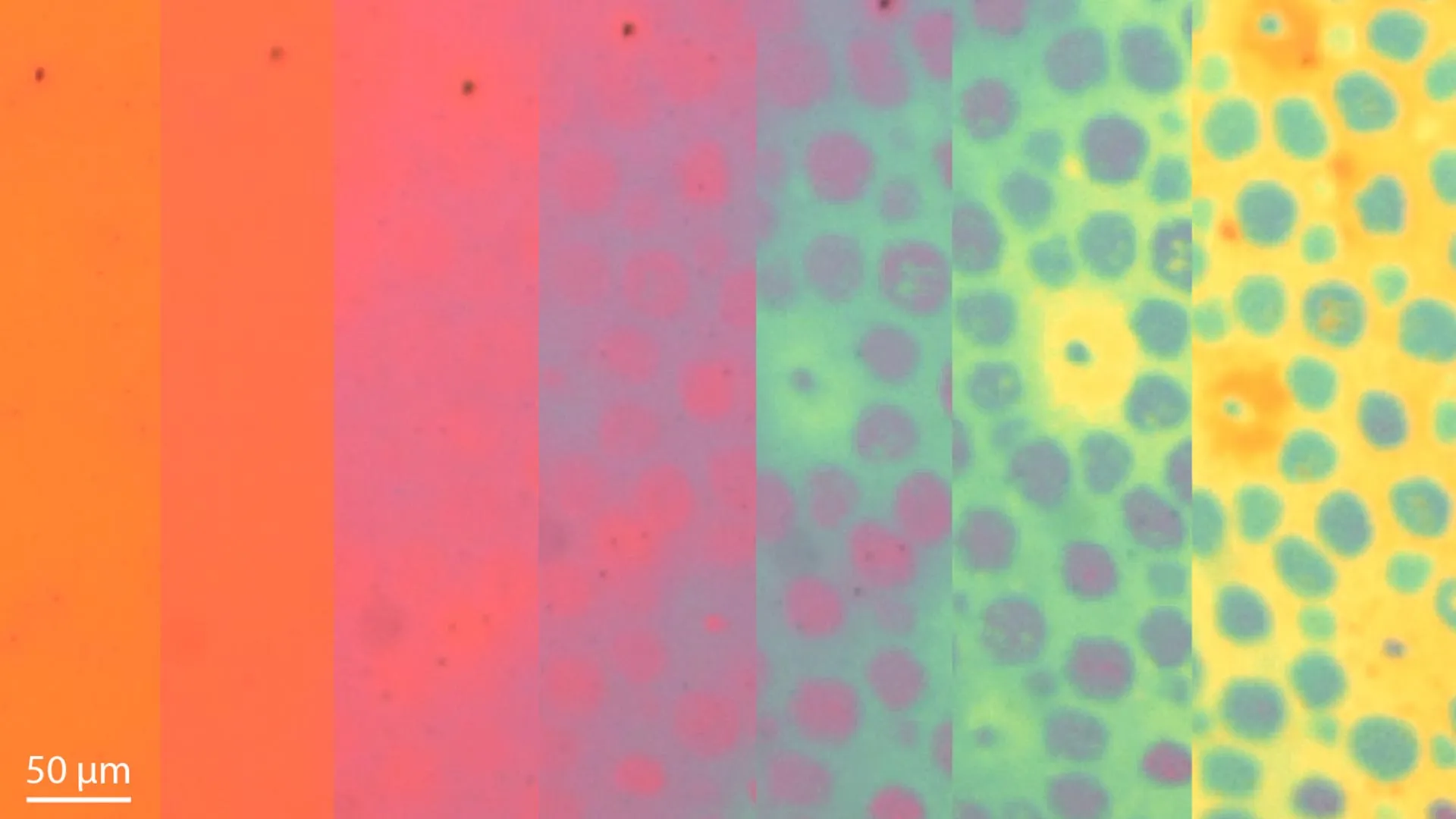
While texture is one half of the cephalopod’s toolkit, color is the other. The Stanford researchers achieved dynamic color shifting by integrating their polymer into structures known as Fabry-Pérot resonators.
These resonators consist of the polymer film sandwiched between two thin layers of metal (such as gold or silver). The color perceived by the human eye is determined by the distance between these two reflective layers, which causes certain wavelengths of light to interfere constructively while others are canceled out.
As the polymer film absorbs water and expands, the distance between the metal layers increases, causing the reflected color to shift across the visible spectrum—from blue to green to red. This "structural color" is the same phenomenon that gives peacock feathers and butterfly wings their vibrant hues. Unlike traditional dyes, these colors do not fade and can be precisely tuned by controlling the amount of hydration in the polymer.
"By dynamically controlling the thickness and topography of a polymer film, you can realize a very large variety of beautiful colors and textures," said Mark Brongersma, a professor of materials science and engineering. "The introduction of soft materials that can expand, contract, and alter their shape opens up an entirely new toolbox in the world of optics to manipulate how things look."
The Role of Artificial Intelligence in Autonomous Camouflage
One of the most ambitious goals of the research is to move away from manual control and toward autonomous, real-time adaptation. Currently, the transition of the material requires the manual application of water or solvents to trigger the swelling.
The researchers are now looking toward a future where the material is integrated with computer vision and artificial intelligence. By using a camera to "see" the background environment, an AI system could calculate the exact amount of hydration or electronic stimulation needed to match that background’s color and texture.
"We want to be able to control this with neural networks—basically an AI-based system—that could compare the skin and its background, then automatically modulate it to match in real time, without human intervention," Doshi said.
This would involve the development of a closed-loop system where the material’s "skin" is embedded with sensors and micro-actuators that can deliver moisture or electrical heat to specific "pixels" of the polymer, allowing for seamless blending into any environment.
Interdisciplinary Applications: From Soft Robotics to Bioengineering
The implications of this research extend far beyond the realm of camouflage. The ability to control surface topography at the micron scale has significant value in several other fields:
- Soft Robotics: Friction is a major factor in how robots move. By changing the surface texture of a robot’s "feet," engineers could allow a robot to transition from a low-friction state (to slide across a floor) to a high-friction state (to grip and climb a wall).
- Bioengineering: Cells are highly sensitive to the physical environment they grow on. By creating surfaces that can change their texture dynamically, researchers could study how cells respond to mechanical stimuli in real-time, potentially leading to new methods for tissue engineering and regenerative medicine.
- Wearable Technology: The thin, flexible nature of the material makes it ideal for "smart" clothing or wearable displays that don’t rely on traditional LED screens. This could lead to health-monitoring patches that change color based on sweat composition or clothing that changes its thermal properties by altering its surface area.
- Information Encryption: Because the patterns on the polymer are only visible when wet or under specific light conditions, the material could be used to create high-security labels or "hidden" watermarks for anti-counterfeiting measures.
Academic Context and Collaborative Effort
The success of this project is a testament to the interdisciplinary environment at Stanford University. The research involved faculty and students from multiple institutes, including Stanford Bio-X, the Wu Tsai Human Performance Alliance, and the Precourt Institute for Energy.
Nicholas Melosh, a senior author on the paper, emphasized the uniqueness of the material. "There’s just no other system that can be this soft and swellable, and that you can pattern at the nanoscale," he said. "Small changes in the properties of soft materials over micron distances are finally possible, which will open up all sorts of possibilities."
The study received support from a wide array of prestigious organizations, including the National Science Foundation, the Department of Energy, and the Air Force Office of Sponsored Research, highlighting the strategic importance of soft-matter physics in national defense and industrial innovation.
Conclusion: A New Frontier in Soft Matter Science
The development of this bio-inspired polymer represents a fundamental shift in how we think about "surfaces." No longer are surfaces static boundaries; with the integration of nanophotonics and responsive chemistry, they become dynamic interfaces capable of communicating information, altering physical interactions, and concealing objects in plain sight.
While the technology is still in the laboratory stage, the proof-of-concept provided by the Stanford team offers a clear roadmap for the future. As the team works to automate the system and integrate it with electronic triggers, the day when human-made objects can disappear into their surroundings as effectively as an octopus may be closer than ever before. For now, the "El Capitan" demonstration stands as a vivid reminder of the power of serendipity and the endless potential of looking to nature for engineering solutions.