The discovery of remarkably preserved fossils in Yunnan, China, is rewriting our understanding of early animal evolution, pushing back the known origins of several animal lineages by millions of years. Unearthed from rocks dating to the Ediacaran Period, specifically the precisely dated Ediacaran Doushantuo Formation, these fossils provide compelling evidence that complex animal life, including potential ancestors of modern vertebrates and marine invertebrates, emerged and diversified much earlier than previously theorized. The findings, detailed in recent paleontological research, shed light on the enigmatic Ediacaran biota, a group of soft-bodied organisms that flourished before the Cambrian Explosion, a period of rapid diversification of animal life.
Unveiling the Jiangchuan Biota: A Window into Early Animal Life
The newly discovered fossil assemblage, informally dubbed the "Jiangchuan biota" after the discovery site, offers an unprecedented glimpse into a vibrant marine ecosystem that existed over 539 million years ago. The exceptional preservation quality of these fossils allows scientists to discern fine details of morphology, providing crucial clues about the life habits and evolutionary relationships of these ancient creatures. Among the most significant finds are organisms that exhibit characteristics suggestive of early bilaterians, the group that includes most animals with a symmetrical body plan, a distinct head and tail, and internal organs.
Prior to these discoveries, the prevailing scientific consensus placed the origin of many bilaterian groups closer to the beginning of the Cambrian Period, approximately 541 million years ago. However, the Jiangchuan biota contains organisms that appear to predate this critical evolutionary transition. This suggests that the evolutionary roots of many major animal phyla extend deeper into the Ediacaran, a period characterized by unique and often bizarre life forms that are only partially understood.
A Rich Tapestry of Ediacaran Life
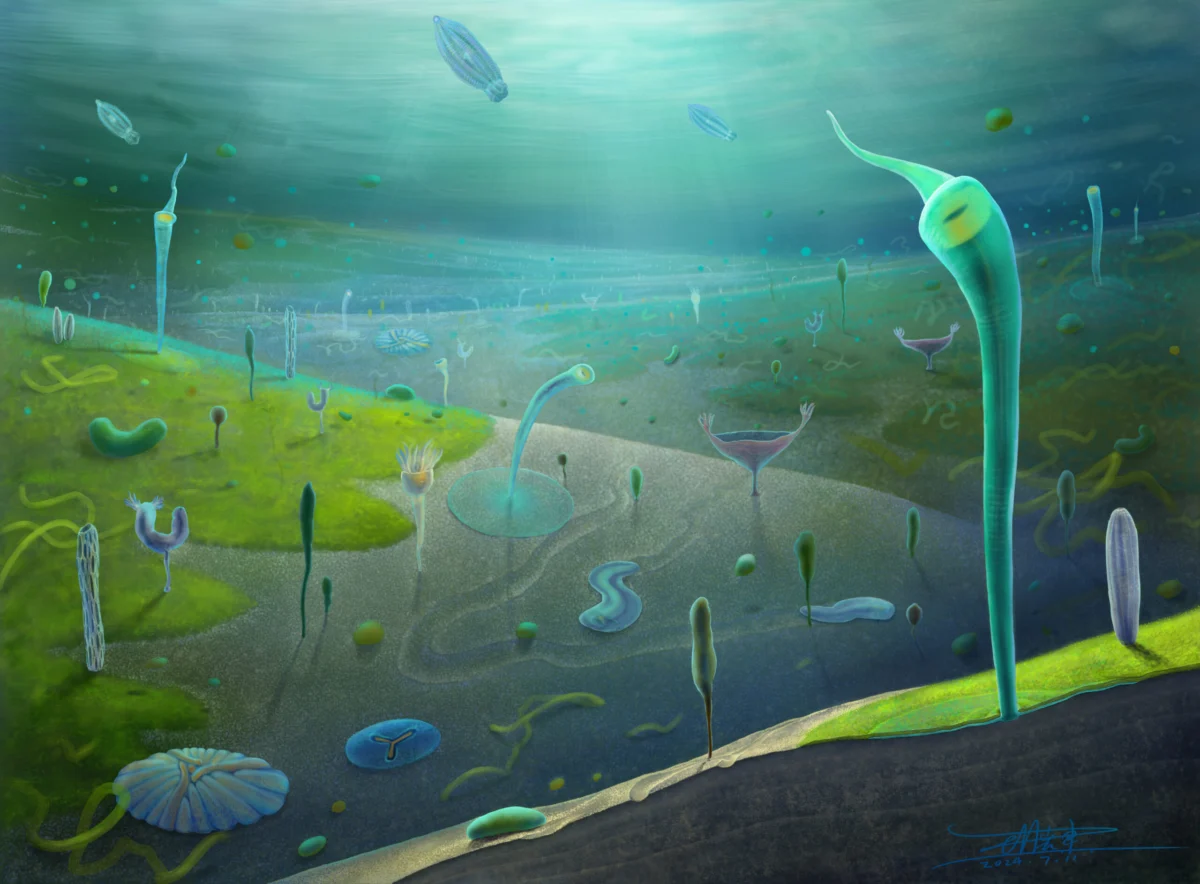
The illustration accompanying the research depicts a diverse seafloor community. Among the key organisms identified are:
- "Bugle worms": These are described as tall, cylindrical, blue-green animals with a disc-shaped anchor. Their morphology suggests a sessile lifestyle, firmly attached to the substrate. Researchers are exploring potential links to annelids (segmented worms) or other tube-dwelling invertebrates.
- Potential early relatives of corals: These organisms are depicted as purple and shaped like cocktail glasses. Their structure hints at colonial or polyp-like forms, possibly representing an early branching within cnidarians, the phylum that includes modern corals, jellyfish, and sea anemones.
- Relatives of modern vertebrates and sea stars: A particularly intriguing find is a purple, sausage-shaped creature on a stalk. This organism exhibits features that have led some paleontologists to hypothesize it could be an early relative of echinoderms (like sea stars and sea urchins) or even an early chordate, the group that ultimately gave rise to vertebrates. The presence of such potentially complex bilaterians in the Ediacaran pushes back their evolutionary timeline considerably.
The exceptional preservation conditions, likely involving rapid burial in fine-grained sediments and possibly mineralization processes, have allowed for the preservation of soft tissues, which are rarely fossilized. This level of detail is critical for identifying homologous structures and inferring evolutionary relationships.
Reconstructing the Ediacaran Timeline: A Shifting Paradigm
The Ediacaran Period, spanning from about 635 to 541 million years ago, is a crucial chapter in Earth’s history. It represents the time when multicellular life began to dominate the planet’s oceans. Before the Ediacaran, life was largely microbial. The emergence of macroscopic, multicellular organisms during this period laid the groundwork for the explosive diversification seen in the subsequent Cambrian Period.
The Ediacaran biota itself is a subject of intense scientific debate. These organisms, which include forms like Dickinsonia, Charnia, and Spriggina, possess unusual body plans that don’t always fit neatly into modern taxonomic categories. Some appear to be simple fronds, others have quilted or segmented bodies, and their mode of life – whether they were motile, sessile, filter feeders, or osmotrophs (absorbing nutrients from their environment) – is often inferred from limited evidence.
The new fossils from Yunnan are significant because they appear to bridge the gap between the more enigmatic Ediacaran forms and the more recognizable bilaterian body plans that define the Cambrian. This suggests that the evolutionary innovations leading to animal diversity were already underway, or even well-established, long before the Cambrian "explosion."
Key Chronological Milestones:
- ~635-541 million years ago: Ediacaran Period. The emergence and diversification of the Ediacaran biota, characterized by early complex multicellular life.
- ~541 million years ago: The beginning of the Cambrian Period, marked by a dramatic increase in the diversity and abundance of animal fossils, particularly those with hard skeletons.
- ~539 million years ago: The age of the Jiangchuan biota fossils discovered in Yunnan, China, suggesting the presence of advanced bilaterian forms during the late Ediacaran.
Supporting Data and Scientific Context
The dating of the Ediacaran Doushantuo Formation is crucial to understanding the significance of these fossils. Radiometric dating techniques, such as those applied to volcanic ash layers or sedimentary rock formations, have provided a robust chronological framework for the Ediacaran. The Doushantuo Formation has been reliably dated to the late Ediacaran, making the findings from the Jiangchuan biota particularly impactful.
Previous fossil discoveries have hinted at an earlier origin for some animal groups. For instance, trace fossils suggesting burrowing activity, a hallmark of mobile bilaterians, have been found in Ediacaran rocks. However, these trace fossils can be ambiguous and do not offer the detailed morphological evidence provided by body fossils. Molecular clock analyses, which estimate divergence times of species based on genetic mutation rates, have also often suggested deeper evolutionary roots for animal phyla than traditional fossil evidence alone might indicate. The Jiangchuan fossils provide crucial empirical support for these molecular estimates, helping to reconcile the fossil record with genetic data.
The geological setting of the discovery is also important. The sedimentary rocks of the Doushantuo Formation are known for their exceptional preservation capabilities, often trapping delicate organic remains. This environment, characterized by marine deposition in relatively quiet waters, is ideal for fossilizing soft-bodied organisms. The specific lithology (rock type) and mineralogy of the sediments play a critical role in preventing decomposition and preserving fine structures.
Implications for Understanding Animal Evolution
The implications of these findings are profound:
- Earlier Origin of Bilaterian Diversity: The presence of complex bilaterian forms in the late Ediacaran suggests that the evolutionary "experimentation" leading to the major animal phyla began much earlier than previously thought. This means the Cambrian Explosion may not have been an instantaneous event but rather the culmination of a long period of evolutionary development.
- Rethinking the Ediacaran Biota: These fossils challenge existing interpretations of the Ediacaran biota. If advanced bilaterians were already present, then some of the enigmatic Ediacaran forms might represent early experiments in multicellularity that were eventually outcompeted or went extinct, while others might be stem groups to modern phyla.
- Understanding Environmental Drivers: The Ediacaran was a period of significant environmental change, including increasing oxygen levels in the atmosphere and oceans. These changes are widely believed to have been critical for the evolution of complex animal life. The earlier appearance of animal groups could suggest that these environmental triggers occurred earlier or had a more gradual but sustained impact than previously understood.
- Revisiting Evolutionary Arms Races: The emergence of new animal forms, especially predators and mobile organisms, would have initiated ecological interactions like predation and competition. The earlier presence of these complex life forms suggests that these "evolutionary arms races" began in the Ediacaran, shaping the trajectory of life’s diversification.
Future Research and Unanswered Questions
While these discoveries are monumental, they also open new avenues for research and raise further questions. Scientists will undoubtedly focus on:
- Detailed Phylogenetic Analysis: Further detailed examination of the fossil morphology, potentially using advanced imaging techniques like micro-CT scanning, will be crucial for precisely placing these organisms within the tree of life.
- Broader Sampling: Continued exploration of similar geological formations worldwide may reveal more evidence of early animal life, helping to build a more complete picture of global biodiversity during the Ediacaran.
- Paleoenvironmental Reconstruction: A deeper understanding of the environmental conditions in which these organisms lived could shed light on the factors that facilitated their evolution and survival.
The Jiangchuan biota represents a significant leap forward in our understanding of life’s early history. By pushing back the known timeline for the diversification of animal groups, these fossils underscore the long and complex evolutionary journey that led to the incredible biodiversity we see on Earth today. The Ediacaran, once considered a prelude to animal life, is increasingly revealing itself as a period of profound innovation and the very cradle of the animal kingdom.