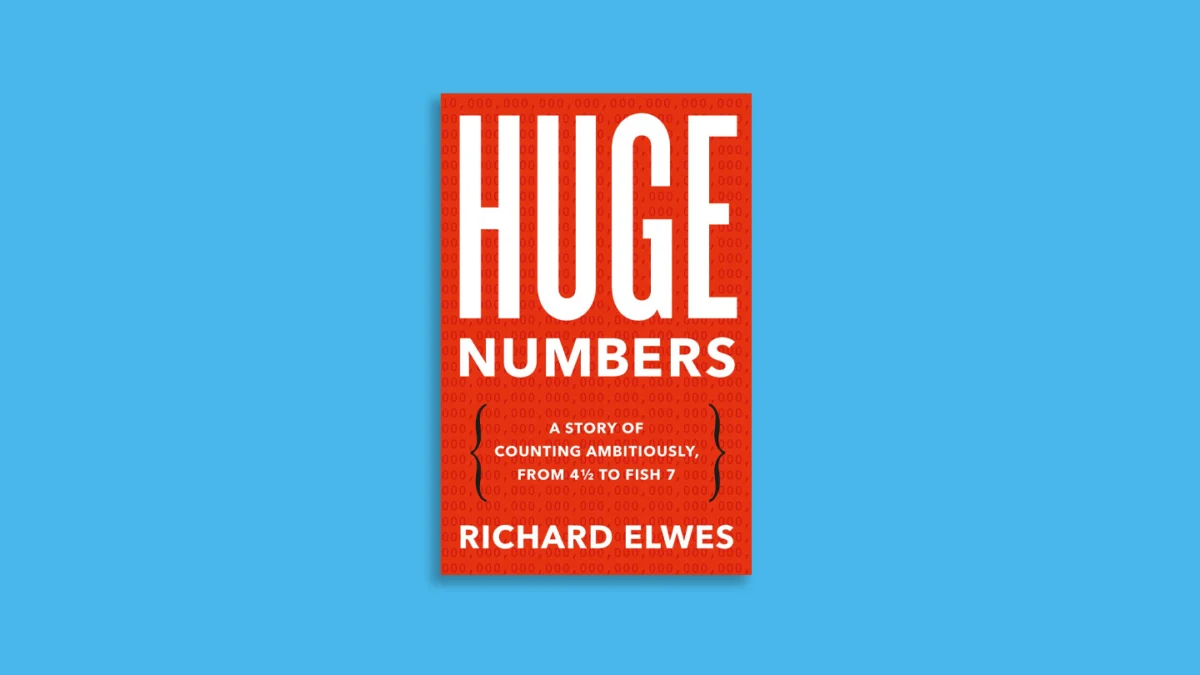
In the vast expanse of mathematics, where numbers stretch into infinity, a specialized field known as googology explores the concept of unimaginably large quantities. This intriguing domain, once confined to the theoretical musings of mathematicians, is now brought to a wider audience through Richard Elwes’s new book, "Huge Numbers." The work offers a captivating journey into the history, methodology, and sheer conceptual audacity behind the human quest to grasp and define numbers that dwarf conventional understanding. Elwes, a mathematician by profession, meticulously navigates the evolution of numerical notation and conceptualization, demonstrating how human ingenuity has continuously pushed the boundaries of what is computable and conceivable.
The very notion of a "huge number" can be a subjective and evolving concept. While many might initially envision figures like a trillion or a quintillion, Elwes swiftly recalibrates this perception. He introduces the familiar googol (10100) and its even more prodigious counterpart, the googolplex, only to reveal them as mere starting points in the grander landscape of googology. The book’s central thesis is that what we consider "big" is perpetually relative, constantly being redefined by mathematical innovation. Elwes posits that "small numbers are the exceptions; big numbers are the rule," a statement that underscores the infinite nature of the number line and the inherent tendency for magnitudes to grow exponentially.
From Innate Sense to Abstract Constructs: The Genesis of Large Number Understanding
Elwes’s exploration begins not with astronomical figures, but with the fundamental human capacity for number. He delves into our innate number sense, an intuitive ability to distinguish small quantities, typically fewer than five, without explicit counting. This basic cognitive tool, Elwes explains, forms the bedrock upon which more complex numerical systems are built. As quantities exceed this innate threshold, the technique of counting becomes indispensable, allowing humans to transcend biological limitations and engage with larger sets.
The book then traces the historical development of "numerical technologies"—the linguistic, notational, and computational tools that have enabled humanity to conceptualize and manipulate increasingly vast quantities. This historical arc highlights a persistent human drive to extend our understanding and control over magnitude, moving from simple tally marks and early numeral systems to the sophisticated symbolic languages of modern mathematics.
The Exponential Explosion: When Numbers Outgrow Standard Notation
A significant portion of "Huge Numbers" is dedicated to explaining the mechanisms by which mathematical quantities can escalate at breathtaking speeds, often necessitating entirely new systems of representation. Elwes illustrates this through examples like the astronomical fine levied against Google by a Russian court in 2024, amounting to $2 times 10^34$. This figure, while immense, still falls within the realm of standard scientific notation. However, the book quickly moves beyond such figures to explore sequences of numbers that "explode even faster," challenging the very foundations of traditional arithmetic and demanding novel conceptual frameworks.
Elwes meticulously details the progression of mathematical notation designed to handle these escalating magnitudes. He begins with scientific notation, where numbers are expressed as a base-10 numeral multiplied by a power of 10. For instance, 3 × 10⁶ represents three million. This system proves efficient for many scientific applications, such as describing the vast distances in the cosmos or the immense timescales of cosmic evolution.
However, as exponents themselves become enormous, scientific notation reaches its limitations. A number like 1010,000,000,000, a 1 followed by ten billion zeroes, becomes unwieldy. Elwes then introduces the concept of "towers of powers," where exponents are themselves exponents. This notation allows for more compact representation, transforming the aforementioned example into a tower of three tens. Yet, even these towers eventually become too tall to practically write down or comprehend.
Beyond Towers: Knuth Arrows, Mountains, and the Frontiers of Googology
The narrative progresses to more advanced notational systems, such as Knuth’s up-arrow notation. This system, developed by Donald Knuth, allows for the concise representation of iterated exponentiation. For example, $5 uparrowuparrow 4$ signifies a tower of four fives, representing $5^5^5^5$. Even this powerful notation, Elwes explains, eventually encounters its own limits, leading to the development of even more complex constructs like "Knuth mountains."
As the numbers become truly unfathomable, they transcend even these advanced notations. Elwes guides readers into the realm of numbers defined by mathematical functions and attributed to mathematicians or characterized by unique, often whimsical, names. This includes figures like Goodstein numbers, Rayo’s number, busy beaver numbers, and Fish’s number 7. These numbers are so abstract and vast that their definitions often relate to the theoretical capabilities of hypothetical computing machines, such as Turing machines endowed with extraordinary powers. These are numbers so large they exist primarily as conceptual constructs, pushing the boundaries of logic and imagination rather than representing tangible quantities in the physical universe.
Implications and the Future of Numerical Exploration
The implications of studying googology extend beyond abstract mathematical curiosity. Understanding how to define and work with immense numbers has practical applications in fields like theoretical computer science, cryptography, and cosmology. For instance, the analysis of busy beaver numbers, which relate to the maximum output of simple computer programs, has implications for understanding the limits of computation and the nature of undecidability.
Furthermore, the pursuit of googology reflects a fundamental aspect of human intellectual endeavor: the drive to explore and comprehend the unknown, even when that unknown stretches into the seemingly infinite. Elwes’s work implicitly suggests that the creation of new mathematical notations and concepts to describe enormous numbers is not merely an exercise in abstract thought, but a testament to the boundless creativity of the human mind.
A Journey Through the Mind of a Mathematician
While "Huge Numbers" offers a comprehensive survey, Elwes acknowledges that the sheer scale of the subject matter can be challenging. He notes that at times, the narrative may seem to veer into tangents, and the intricate nature of the numbers discussed can make it difficult for readers to maintain a consistent grasp of the thread. However, he reassures the patient reader that perseverance will be rewarded.
The book promises a profound transformation in the reader’s perception of magnitude. By delving into the world of googology, individuals gain a vastly expanded frame of reference for what it means to be "truly, unfathomably, large." The journey is framed as an appreciation for the history of mathematical innovation, a celebration of the "creative, intrepid explorers of the biggest numbers known," and a testament to humanity’s ongoing quest to understand the universe, one immense number at a time. Elwes’s work serves as an invitation to marvel at the continuous breaking of mathematical boundaries, driven by an insatiable curiosity for the scale of existence, both real and imagined.
This article is based on the book "Huge Numbers" by Richard Elwes, published by Basic Books.