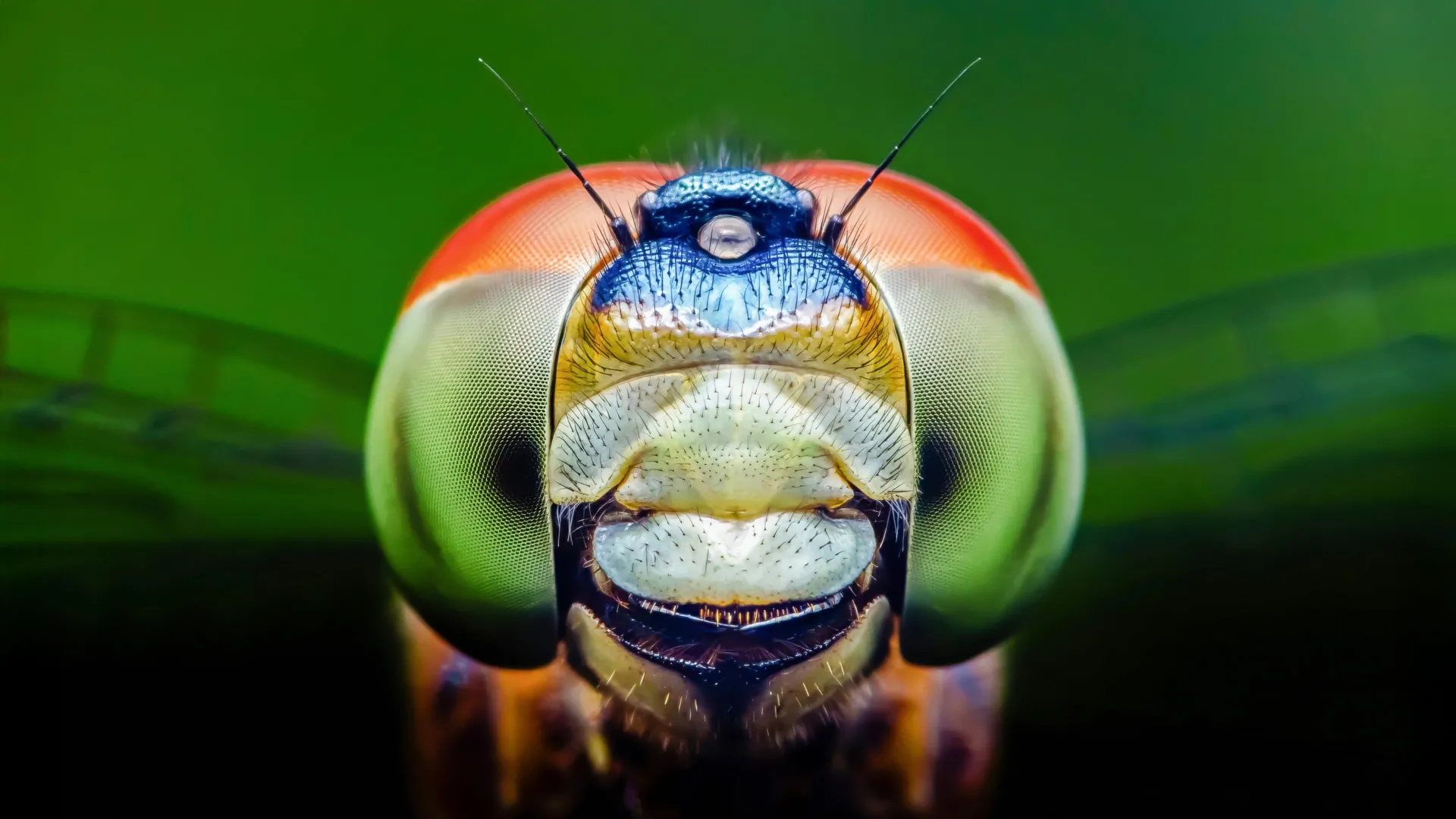
A groundbreaking discovery by researchers at Osaka Metropolitan University (OMU) has unveiled a remarkable instance of parallel evolution, demonstrating that distantly related species can independently arrive at the same biological solutions. Scientists have identified that dragonflies perceive red light through a mechanism astonishingly similar to that employed by mammals, including humans. This finding, which centers on a specific opsin protein in dragonflies, not only deepens our understanding of insect vision but also carries significant implications for the development of cutting-edge medical technologies, particularly in the burgeoning field of optogenetics.
The Intricacies of Color Perception: Mammals and the Quest for Red
Human color vision, a marvel of biological engineering, is fundamentally dependent on specialized proteins found within the retina known as opsins. These light-sensitive molecules are the gatekeepers of our visual world, translating photons into electrochemical signals that the brain interprets as color. Humans possess three primary types of cone opsins, each exquisitely tuned to specific wavelengths of light: blue, green, and red. This tripartite system allows for the perception of a broad spectrum of colors, forming the rich tapestry of our visual experience.
The ability to detect red light, specifically, has long been a subject of fascination for evolutionary biologists and vision scientists. While many animals possess color vision, the nuances of red perception can vary significantly. For humans, the red-sensitive opsin plays a crucial role in distinguishing shades of crimson, scarlet, and everything in between, contributing to our ability to navigate complex environments, identify ripe fruits, and even perceive subtle social cues. The molecular architecture of these opsins, and how they evolved to capture specific wavelengths, has been a significant area of research for decades, with advancements in genetic sequencing and protein analysis gradually illuminating the evolutionary pathways.
Dragonflies: An Unforeseen Red Light Specialist
Among the insect kingdom, dragonflies have long been recognized for their sophisticated visual capabilities. However, their ability to perceive red light has remained a subject of particular interest. A dedicated research team at OMU, spearheaded by Professors Mitsumasa Koyanagi and Akihisa Terakita of the Graduate School of Science, has now pinpointed a specific opsin within dragonflies that exhibits an extraordinary sensitivity to light at approximately 720 nanometers (nm). This wavelength extends beyond the upper limit of the red spectrum visible to the average human, suggesting that dragonflies possess a visual acuity for red light that surpasses our own.
Professor Terakita elaborated on the significance of their findings, stating, "This is one of the most red-sensitive visual pigments ever found. Dragonflies can likely see deeper into red light than most insects." This heightened sensitivity opens up a new dimension in understanding insect behavior and ecology, prompting further investigation into the functional advantages conferred by such a specialized visual system. The discovery challenges previous assumptions about the visual limitations of insects and underscores the diverse evolutionary strategies that have emerged to optimize sensory perception.
The Evolutionary Advantage: Red Vision for Mating and Survival
The OMU research team postulates that this exceptional sensitivity to deep red light plays a critical role in the mating rituals of dragonflies. To test this hypothesis, the scientists delved into the study of reflectance – the measure of how much light a surface bounces back. In the intricate aerial dances and displays of dragonflies, reflected light is a paramount factor in how individuals perceive and identify each other.
Through meticulous measurements, the researchers observed distinct differences in the way male and female dragonflies reflect red to near-infrared light. These subtle variations in coloration, invisible to many other species, are likely crucial for rapid mate recognition during flight. This suggests that male dragonflies may leverage these nuanced visual signals to efficiently locate and identify potential mates amidst the dynamic backdrop of their environment. Such a specialized visual system would provide a significant evolutionary advantage, ensuring successful reproduction in a competitive ecosystem. The ability to discern these subtle spectral differences could be the key to distinguishing between conspecifics and other flying insects, preventing wasted energy and potential misidentification.
A Striking Case of Convergent Evolution: The Molecular Parallel
The most astounding revelation from the OMU study lies in the striking similarity between the dragonfly’s red light detection mechanism and that of mammals. "Surprisingly, the mechanism by which dragonfly red opsin detects red light is identical to that of red opsin in mammals, including humans," remarked first author Ryu Sato, a graduate student. "This is an unexpected result, suggesting that the same evolutionary process occurred independently in distantly related lineages."
This finding represents a profound example of convergent evolution, where unrelated organisms independently evolve similar traits or mechanisms to adapt to similar environmental pressures or functional needs. The evolutionary divergence between insects and mammals is vast, spanning hundreds of millions of years. Yet, both lineages have independently converged on a shared molecular strategy for sensing red light. This parallel development points to the inherent efficiency and robustness of this particular biological solution, suggesting it is a highly effective way to capture and process these specific light wavelengths. The identification of this shared molecular blueprint opens up exciting avenues for comparative genomics and evolutionary biology, allowing scientists to explore the underlying genetic and biochemical factors that drive such independent evolutionary innovations.
Engineering Dragonfly Vision: A Leap Forward for Medical Technology
Beyond its implications for evolutionary biology, the OMU team has uncovered a key detail within the dragonfly opsin that holds immense promise for technological and medical applications. They identified a single amino acid position within the opsin protein that acts as a crucial determinant of its light sensitivity. By strategically modifying this specific position, the researchers were able to fine-tune the protein’s responsiveness, shifting its sensitivity towards longer wavelengths and bringing it closer to the infrared spectrum.
This precise manipulation allowed them to engineer a modified version of the opsin protein that reacts to even longer wavelengths of light. Demonstrating the practical utility of their engineered protein, they successfully showed that cells engineered to contain this modified opsin could be activated by near-infrared light. This breakthrough represents a significant advancement in the ability to control biological processes with light, paving the way for more precise and less invasive therapeutic interventions. The ability to engineer light sensitivity with such fine-tuned control is a testament to the power of understanding fundamental biological mechanisms.
The Promise of Optogenetics: Illuminating the Depths of Biology
The potential applications of this discovery are particularly profound in the field of optogenetics, a revolutionary discipline that employs light-sensitive proteins to precisely control and study the activity of cells within living organisms. Optogenetics has already transformed neuroscience, allowing researchers to activate or inhibit specific neurons with light, thereby unraveling complex neural circuits and understanding brain function.
The ability to engineer proteins that respond to near-infrared light is especially valuable because longer wavelengths of light possess superior penetration capabilities into biological tissues. This means that researchers could use near-infrared light to activate engineered cells located deep within the body, areas that are currently difficult or impossible to access with conventional optogenetic tools.
Professor Koyanagi emphasized the significance of their achievement: "In this study, we succeeded in shifting the sensitivity of a modified near-infrared opsin from Gomphidae dragonflies even further toward longer wavelengths and confirmed that the modified near-infrared opsin can induce cellular responses in response to near-infrared light. These findings demonstrate this opsin as a promising optogenetic tool capable of detecting light even deep within living organisms."
This advancement could revolutionize treatments for a range of conditions, from neurological disorders and chronic pain to blindness and genetic diseases. For instance, it could enable the targeted activation of specific gene therapies or the precise modulation of neural activity in deep brain regions without the need for invasive surgical procedures. The implications extend to regenerative medicine, where precise light-based stimulation could guide tissue growth and repair. The development of such sophisticated optogenetic tools, inspired by the evolutionary innovations of dragonflies, marks a significant stride towards more targeted, effective, and less invasive medical interventions in the future.
The research, published in the esteemed journal Cellular and Molecular Life Sciences, represents a culmination of years of dedicated scientific inquiry and underscores the profound interconnectedness between seemingly disparate areas of biology and technology. It serves as a powerful reminder that nature’s own evolutionary solutions often hold the keys to unlocking unprecedented scientific and medical advancements. The dragonfly, a creature of flight and keen eyesight, has now offered humanity a glimpse into a future where light-based therapies can reach the deepest recesses of our bodies, promising a new era of precision medicine. The journey from understanding the visual world of an insect to engineering tools that can heal the human body is a testament to the relentless curiosity and ingenuity of scientific exploration.