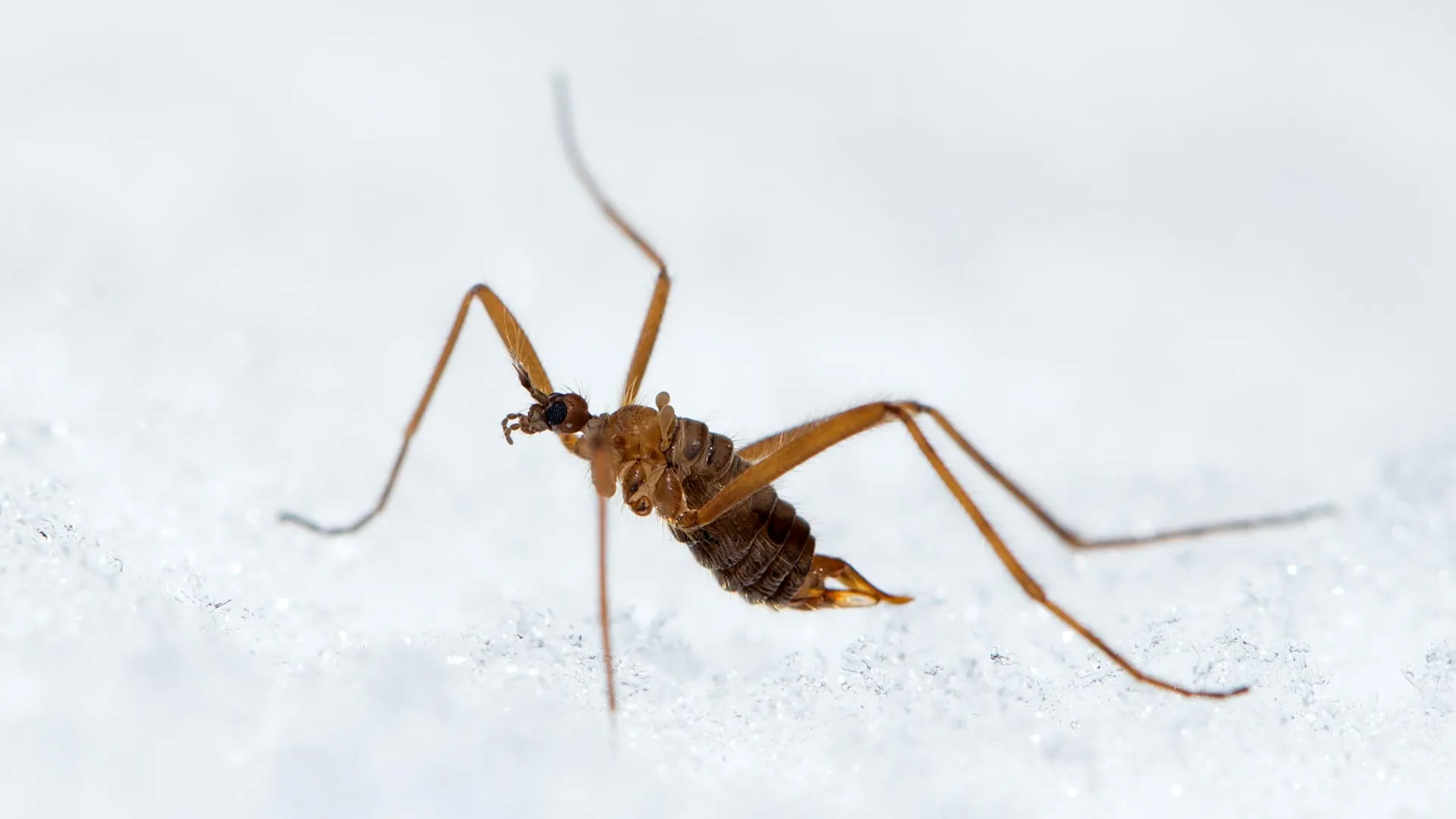
Snow flies, often overlooked as common insects, possess a survival strategy that defies typical entomological norms. Their ability to thrive in freezing environments, while most of their kin seek refuge in dormancy, has captivated researchers, revealing a remarkable suite of biological adaptations. A groundbreaking study by scientists at Northwestern University has elucidated the intricate mechanisms that allow these wingless insects to navigate snowy landscapes, find mates, and reproduce in conditions lethal to the vast majority of arthropods. The findings, published on March 24 in the prestigious journal Current Biology, not only expand our understanding of life’s resilience in extreme climates but also hold potential for revolutionary advancements in cryopreservation and materials science.
The research, led by Marco Gallio, the Soretta and Henry Shapiro Research Professor in Molecular Biology and professor of neurobiology at Northwestern’s Weinberg College of Arts and Sciences, alongside Marcus Stensmyr, a biology professor at Lund University in Sweden, delved into the genetic and physiological underpinnings of snow fly survival. Their investigation challenges the conventional understanding of cold-blooded creatures being entirely at the mercy of external temperatures. Instead, they found that snow flies actively counteract the freezing conditions, demonstrating a "mind-boggling ability to adapt to extremes."
A Biological Arsenal for the Frost
Unlike most insects, which enter a state of diapause or seek out sheltered microhabitats to survive sub-zero temperatures, snow flies remain remarkably active in the frost. They have been observed to thrive at temperatures as low as -6 degrees Celsius (21.2 degrees Fahrenheit), a feat that necessitates a sophisticated internal defense system against ice crystal formation and cellular damage.
The study’s most striking revelations center on two key adaptations: the production of specialized antifreeze proteins and the generation of internal body heat. These mechanisms, previously thought to be largely exclusive to a few highly specialized organisms, suggest that evolution has converged on similar solutions for the universal problem of freezing.
The Ingenuity of Antifreeze Proteins
A significant portion of the research focused on the snow fly’s genetic makeup. The Northwestern team, in collaboration with Richard Suhendra, a Ph.D. student working under William Kath of the McCormick School of Engineering, embarked on the ambitious task of sequencing the snow fly genome. This was a critical step, as it allowed for comparisons with the genomes of related insect species that lack cold tolerance. RNA analysis further pinpointed which genes were actively transcribed and translated into proteins under freezing conditions.
The initial genetic sequencing yielded perplexing results. "We couldn’t find many of the genes within any database," Gallio recounted. "Initially, I thought we must have sequenced some alien species. It’s very rare for an active gene, which makes a protein, to not have a match." This anomaly pointed towards a unique evolutionary trajectory for the snow fly.
Further investigation revealed that these unclassifiable genes were responsible for producing antifreeze proteins (AFPs). These proteins function by binding to nascent ice crystals, inhibiting their growth and preventing them from damaging cell membranes and intracellular components. This mechanism is remarkably similar to that employed by Arctic fish, which navigate frigid waters by producing their own AFPs.
"Remarkably, some of the antifreeze proteins we found are actually structurally related to those of Arctic fish," Gallio stated, highlighting the convergent evolution at play. This suggests that the evolutionary pressures of surviving in icy environments have led to similar molecular solutions across vastly different taxa. The precise structural similarities and functional efficiencies of these snow fly AFPs are a subject of ongoing research, but their presence unequivocally explains a critical aspect of the insect’s cold hardiness.
To empirically validate the role of these proteins, Matthew Capek, a Ph.D. student in the Gallio Lab, undertook a series of ingenious experiments. He genetically engineered fruit flies (Drosophila melanogaster) to express a specific snow fly AFP. When these modified fruit flies were subjected to laboratory freezing conditions, they exhibited significantly higher survival rates compared to their unmodified counterparts. This provided direct evidence that the snow fly AFP acts as a potent cryoprotectant, effectively acting as a molecular shield against freezing damage.
Internal Thermogenesis: A Mammalian Echo
Beyond their ability to prevent ice formation, snow flies possess another astonishing adaptation: the capacity to generate their own body heat. While insects are ectothermic, relying on external sources for warmth, snow flies appear to have evolved a mechanism for endogenous thermogenesis.
The genetic analysis revealed the presence of genes associated with energy metabolism and cellular processes known to produce heat. Specifically, the researchers identified genes linked to mitochondrial thermogenesis in brown adipose tissue, a specialized tissue found in mammals like polar bears and marmots, which is crucial for heat production, particularly during hibernation or in cold environments.
"We found genes that in larger animals are associated with mitochondrial thermogenesis in brown adipose tissue," Gallio explained. "Many animals like marmots and polar bears have brown fat, which is there to produce heat. When they go into hibernation, they burn this stored fat to produce heat rather than to produce chemical energy. So, in some ways snow flies use a combination of the strategies used by polar bears and by Arctic fish."
This implies that snow flies are not merely passively tolerating the cold but are actively regulating their internal temperature to maintain metabolic activity. Experimental measurements confirmed this hypothesis. When placed in progressively colder environments, snow flies consistently maintained an internal temperature a few degrees Celsius higher than other insect species, such as bees and moths, which rely on shivering to generate heat. The absence of shivering in snow flies suggests a more fundamental, cellular-level heat production mechanism, akin to that found in mammals.
This internal warmth, even if modest, could be critically important. It may provide the insects with enough metabolic energy to move, find mates, and lay eggs during brief periods of relative warmth within their frigid habitat, or to quickly seek shelter before succumbing to prolonged exposure.
Beyond Physical Resilience: A Diminished Sense of Cold Pain
The adaptations of snow flies extend beyond their physical defenses against freezing. The research also uncovered evidence that these insects possess a reduced sensitivity to the noxious stimuli associated with extreme cold. For most organisms, the sharp, painful sensation of touching ice or frigid surfaces serves as a crucial warning signal, prompting avoidance behavior to prevent tissue damage.
The Northwestern University study identified a key sensory protein responsible for detecting harmful stimuli in insects. In snow flies, this protein exhibits significantly diminished responsiveness compared to its counterparts in species like mosquitoes and fruit flies. This desensitization allows snow flies to tolerate higher levels of cold-induced stress without triggering a debilitating pain response, enabling them to continue their activities even when exposed to conditions that would incapacitate other insects.
"It turns out that a specific irritant receptor is 30 times less sensitive in snow flies than in mosquitoes and fruit flies," Gallio noted. This reduced sensitivity is a sophisticated adaptation, allowing the insects to operate in their preferred sub-zero environment without being constantly deterred by the perceived threat of cold.
Broader Implications and Future Frontiers
The implications of this research extend far beyond the realm of entomology. The discovery of highly effective antifreeze proteins and endogenous thermogenesis in snow flies opens new avenues for technological innovation.
Advancements in Cryopreservation
The ability of snow flies to prevent ice crystal formation within their cells has direct relevance to cryopreservation techniques. Current methods for preserving biological materials, such as cells, tissues, and organs, often face challenges related to ice damage. Understanding the molecular mechanisms of snow fly AFPs could lead to the development of novel cryoprotectants that are more effective and less toxic than current agents, potentially revolutionizing organ transplantation, fertility treatments, and the long-term storage of valuable biological samples.
Biomimicry in Materials Science
The principles of endogenous thermogenesis observed in snow flies could also inspire new approaches in materials science. Imagine self-heating materials or coatings that can maintain optimal operating temperatures in extreme cold, without relying on external power sources. This could have applications in everything from aerospace engineering to the development of durable outdoor equipment and advanced insulation technologies.
Understanding Life’s Limits
More broadly, the study of snow flies contributes to our fundamental understanding of life’s adaptability and the limits of biological resilience. It underscores that even in the most challenging environments, life finds a way, often through elegant and unexpected evolutionary solutions. The research provides a compelling case study for how evolutionary pressures can drive the development of complex, multi-faceted survival strategies.
The collaborative nature of the research, involving institutions like Northwestern University and Lund University, as well as contributions from the McCormick School of Engineering and the NSF-Simons National Institute for Theory and Mathematics in Biology (NITMB), highlights the interdisciplinary approach required to tackle such complex biological questions. External collaborators, including the DNAzoo project, Olga Dudchenko, and Erez Lieberman Aiden from Rice University and Baylor College of Medicine, further demonstrate the broad scientific network engaged in this groundbreaking work.
The study, titled "Coordinated molecular and physiological adaptations enable activity at subfreezing temperature in the snow fly Chionea alexandriana," is set to be featured on the cover of the April 6 volume of Current Biology, underscoring its significance. The research was supported by a consortium of prestigious funding bodies, including the National Institutes of Health, the Pew Scholars Program, the McKnight Foundation, the Paula M. Trienens Institute for Sustainability and Energy, the Crafoord Foundation, the National Science Foundation, the Simons Foundation, and NITMB, reflecting the considerable scientific and societal interest in this field.
The Path Forward
The research team is not resting on its laurels. Future endeavors will focus on a deeper exploration of the cellular mechanisms behind snow fly thermogenesis and a comprehensive cataloging of the full spectrum of antifreeze proteins produced by these remarkable insects. By continuing to unravel the secrets of snow fly survival, scientists aim to uncover whether similar evolutionary strategies are employed by other organisms in extreme cold environments, further expanding our knowledge of life’s extraordinary capacity to adapt and thrive against all odds. The humble snow fly, it appears, holds keys to unlocking profound scientific advancements and inspiring innovative solutions to some of humanity’s most pressing technological challenges.