This research, led by Stephen Wilson and his team at the University of California, Santa Barbara (UCSB), represents a significant leap in the field of condensed matter physics. Published recently in the prestigious journal Nature Materials, the study explores the intricate interplay between two distinct forms of atomic-level "frustration" within a single material structure. By successfully interleaving magnetic frustration with bond frustration, the researchers have opened a new pathway toward controlling exotic quantum states, which may eventually serve as the foundation for next-generation quantum computing and information technologies.
The work, conducted within the materials department at UCSB, moves beyond traditional magnetism to investigate how the geometry of an atomic lattice can prevent a system from reaching a simple, ordered state. While the research is grounded in fundamental science, its implications for functionalizing quantum disordered magnetism are profound, offering a potential mechanism to manipulate long-range entanglement through external stimuli such as physical strain or magnetic fields.
The Physics of Frustration: Geometric Constraints
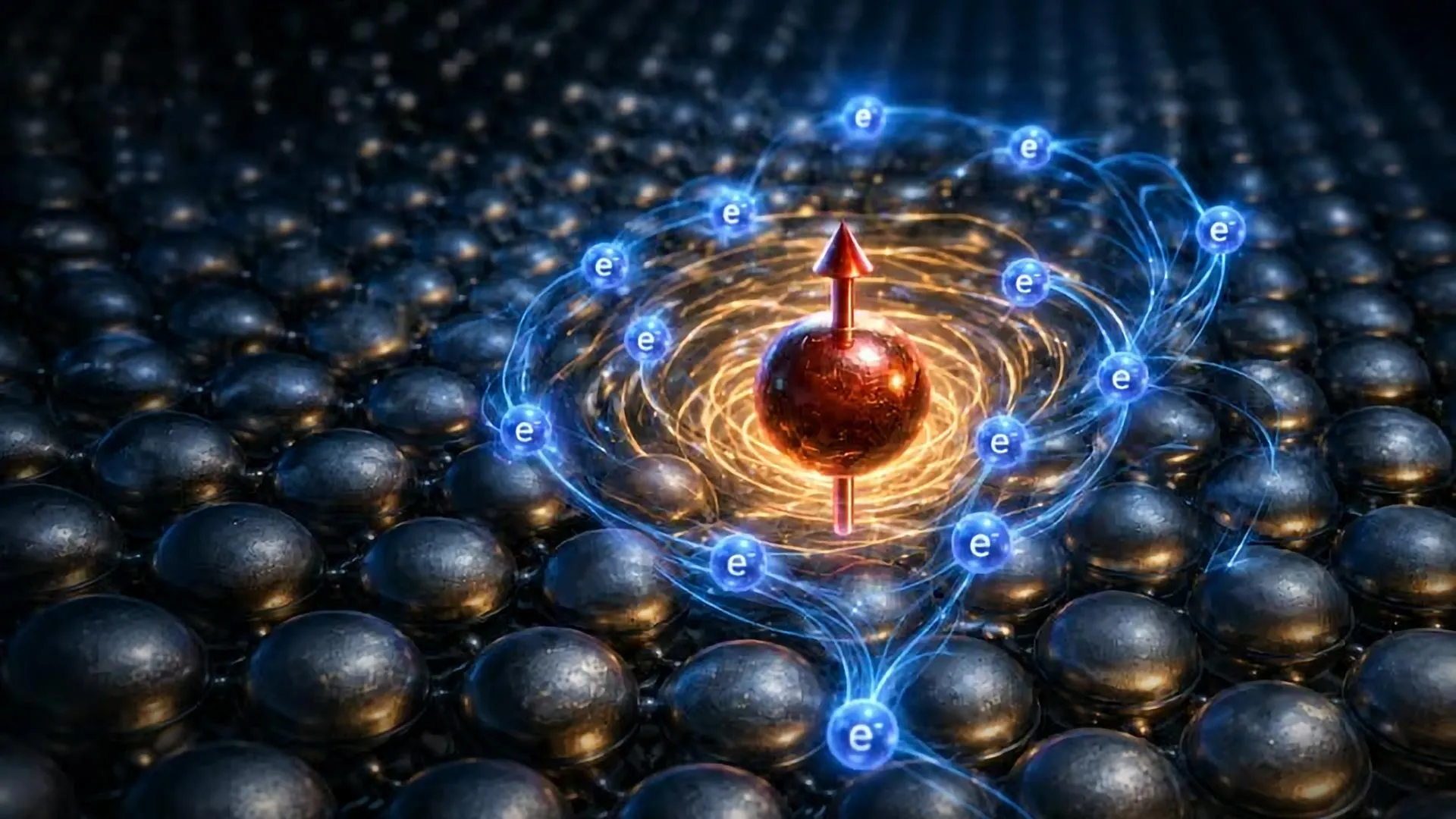
To understand the breakthrough, one must first grasp the concept of magnetic frustration. In a standard magnetic material, atoms possess a property called a magnetic dipole moment—essentially acting as tiny bar magnets. Under normal conditions, these moments interact with their neighbors to reach a "ground state," the configuration with the lowest possible energy. In an antiferromagnet, these moments prefer to point in opposite directions (antiparallel) to one another.
In a simple square lattice, this is easily achieved: if one atom points up, its four neighbors point down, creating a stable, alternating pattern. However, as Wilson’s team explains, this stability collapses when the atoms are arranged in a triangular lattice. In a triangle of three atoms, if two atoms point in opposite directions, the third atom is "frustrated." It cannot point opposite to both of its neighbors simultaneously. This geometric frustration prevents the material from settling into a conventional ordered state, forcing the magnetic moments to remain in a state of constant fluctuation or "quantum disorder," even as temperatures approach absolute zero.
The Introduction of Bond Frustration
The UCSB study introduces a second, more elusive layer of complexity: bond frustration. While magnetic frustration involves the orientation of spins, bond frustration involves the sharing of electrons between ions. In certain materials, two neighboring ions may attempt to share an electron to form a "dimer," a stable pair.
In a triangular or honeycomb lattice, these dimers face a similar dilemma to the magnetic moments. The geometry of the lattice restricts the ways in which these bonds can form, leading to a network of bonds that is inherently unstable and highly sensitive to external changes. Wilson’s team focused on a rare class of materials where both of these phenomena—magnetic frustration and bond frustration—coexist and are "interleaved" within the same crystalline structure.
Chronology of Research and Material Development
The discovery is the culmination of nearly a decade of intensive research into lanthanide-based materials. Lanthanides, the group of elements occupying the bottom rows of the periodic table, are prized in materials science for their large magnetic moments and complex electron shells.
- 2016–2018: Initial theoretical models suggested that triangular networks of lanthanides could host "quantum spin liquids"—states where magnetic moments never freeze into place but remain entangled across long distances.
- 2019–2021: Researchers began synthesizing specific lanthanide compounds to test these theories, focusing on the "frustration of long-range order."
- 2022–2023: The UCSB team identified a unique structural framework that allowed for the simultaneous presence of bond frustration. This led to the development of the "interleaved" model described in their latest paper.
- 2024: Publication in Nature Materials, detailing how the coupling of these two frustrated systems allows for unprecedented control over quantum states.
Supporting Data: The Power of Lanthanides
The choice of lanthanides was critical to the success of the study. Unlike transition metals, lanthanides possess "f-orbitals" that are shielded by outer electron shells. This results in highly localized magnetic moments that interact in complex ways. In the triangular lattice studied by Wilson, the interplay between these moments and the surrounding crystal field creates a landscape where multiple energy states are nearly degenerate (equal in energy).
Data from the study indicates that the interleaved system is exceptionally responsive to "strain"—the physical deformation of the crystal lattice. Because the bond network is frustrated, even a minor application of mechanical pressure can "tip the scales," forcing the bonds to reconfigure. Because these bonds are coupled to the magnetic moments, this structural change can trigger a transition in the magnetic state of the material. This "ferroic response" suggests that researchers could use mechanical strain to "switch" magnetic properties on and off at the quantum level.
Official Commentary and Scientific Reception
Stephen Wilson, a professor of materials at UCSB and the lead investigator, emphasized that while the work is "fundamental science," its purpose is to map out the possibilities for future hardware. "This is fundamental science aimed at addressing a basic question," Wilson stated. "It’s meant to probe what physics may be possible for future devices."
The scientific community has reacted with high interest, particularly those involved in the search for Quantum Spin Liquids (QSL). QSLs are a theoretical state of matter where spins are highly entangled but do not order. The UCSB study provides a "functionalized" version of this state. By embedding a potentially quantum disordered magnet within a frustrated bond network, the team has provided a handle—strain—to manipulate a state that is normally notoriously difficult to influence.
Experts in the field note that the ability to couple two different types of frustration is "exciting" because it allows for the engineering of materials that respond to stimuli they would otherwise ignore. For instance, a magnetic system that is usually indifferent to pressure could become highly sensitive to it if it is interleaved with a frustrated bond network.
Broader Impact: The Road to Quantum Entanglement
The ultimate goal of this line of research is the mastery of long-range entanglement. In quantum information science, entanglement is the phenomenon where the state of one particle is instantaneously connected to the state of another, regardless of distance. This is the "engine" behind quantum computing, where qubits (quantum bits) must remain entangled to perform complex calculations.
Wilson’s research suggests that by controlling the frustrated bond network, scientists might be able to "access" or "tune" the entanglement within the magnetic system. If a material can host a quantum disordered ground state with long-range entanglement, and if that entanglement can be nucleated or altered by applying strain or a magnetic field, it could lead to the development of "topological qubits." These qubits would be much more stable than those currently used in experimental quantum computers, as they would be protected by the material’s underlying geometry.
Implications for Future Technology
The implications of "Interleaved bond frustration in a triangular lattice antiferromagnet" extend beyond computing. The ability to engineer large ferroic responses—where a small input leads to a large change in output—has potential applications in:
- Quantum Sensors: Materials that are hyper-sensitive to magnetic fields or mechanical pressure could lead to sensors with unprecedented resolution.
- Energy-Efficient Electronics: Using strain to control magnetic states could reduce the energy requirements for data storage and processing, as mechanical strain can often be applied with less energy than high-frequency electromagnetic fields.
- New Phases of Matter: The study suggests that "proximity effects" between two frustrated lattices could lead to entirely new types of order that do not exist in nature, potentially uncovering "superconducting" or "superfluid" states within these complex crystals.
Conclusion: A New Paradigm in Materials Science
The UCSB study marks a shift from observing quantum phenomena to actively engineering them. By recognizing that different forms of frustration can be layered and coupled, Stephen Wilson and his team have provided a blueprint for creating materials with tailor-made responses.
As the global race for quantum supremacy intensifies, the ability to "functionalize" exotic states of matter becomes paramount. While commercial devices utilizing these interleaved frustrated systems may be years away, the fundamental physics established by this research provides the necessary map for the next generation of materials scientists. The study reinforces the idea that in the quantum realm, "frustration" is not a hindrance, but a powerful tool for innovation.