A groundbreaking study published in the scientific journal Zootaxa by researchers from the University of Georgia has officially identified and described two distinct, previously unrecognized species of black bass. These newly classified fish, now formally known as Bartram’s bass (Micropterus pucpuggy) and Altamaha bass (Micropterus calliurus), represent a significant addition to the understanding of North American freshwater ichthyofauna. The culmination of decades of fieldwork and advanced genetic analysis, this research sheds light on the intricate biodiversity within the Southeast’s river systems and underscores the urgent need for conservation efforts in the face of increasing environmental pressures.
A Discovery Forged Over Decades
The genesis of this discovery can be traced back to the 1980s, when Dr. Bud Freeman, a senior public service associate emeritus at the UGA Odum School of Ecology and lead author of the study, encountered what he suspected was an unknown species of bass. During a visit to the Broad River, Freeman was shown an unusual fish caught by a local couple. Recognizing its distinctiveness, he attempted to acquire the specimen for scientific study, but the couple intended to consume their catch. "That would have been an important specimen," Dr. Freeman recounted, emphasizing the lost opportunity and the early indication of a potentially undiscovered species.
This initial encounter spurred a sustained effort by Freeman and his research team to systematically collect and document bass populations across the region. Over the subsequent decades, meticulous fieldwork yielded crucial specimens that would ultimately form the basis for the formal species descriptions. Bartram’s bass were identified from 14 distinct sites within the Savannah and Saluda River basins, while Altamaha bass were sampled from 14 locations spanning the Altamaha and Ogeechee River systems. This extensive sampling strategy ensured a comprehensive understanding of the geographical distribution and morphological variation within these populations.
Distinct Morphological Characteristics and Genetic Validation
Prior to this research, both Bartram’s bass and Altamaha bass were often misidentified or grouped with the more widely recognized redeye bass (Micropterus coosae). However, closer examination of the collected specimens revealed undeniable physical differences that set them apart.
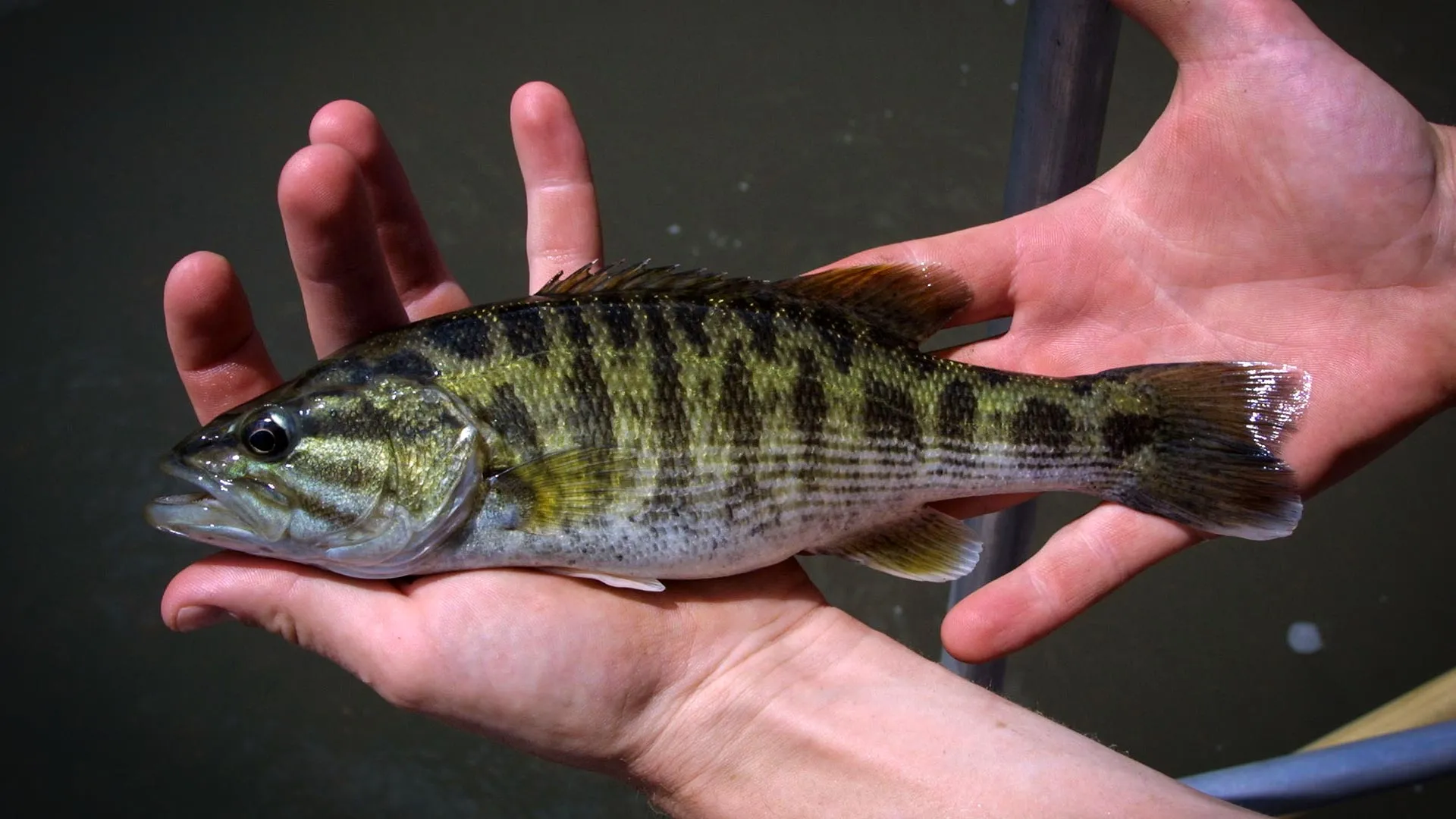
Bartram’s bass are characterized by a striking light golden hue, punctuated by dark brown blotches along their flanks. Their bellies possess a mottled appearance, and their fins exhibit a subtle rosy tint. A key distinguishing feature is their oval tooth patch, located on the tongue. Perhaps their most notable characteristic is their vibrant red eyes, each with a black pupil encircled by a thin, almost luminous gold ring. These fish can attain lengths of up to 15 inches, making them substantial inhabitants of their riverine environments.
The Altamaha bass, while also displaying golden scales, present a slightly different aesthetic. Their scales are edged with olive tones, and they bear darker markings along their sides. Their fins are accented with a distinct orange coloration, and they possess a smaller, oval tooth patch compared to Bartram’s bass. Consistent with Bartram’s bass, they share the characteristic red eyes with a gold ring around the pupil. Altamaha bass are comparable in size, typically reaching lengths of around 14 inches.
Beyond these observable physical traits, the research team employed cutting-edge genetic analyses to unequivocally confirm the distinct evolutionary lineages of these two bass species. This approach moved beyond traditional ichthyological methods, which relied heavily on scale counts, fin ray counts, and morphometric measurements.
"It used to be that you’d have to go out and catch the fish, bring it in, count the scales, measure the tail, measure this and that, write a description, and you’re done," explained Mary Freeman, a co-author of the study and adjunct faculty at the Odum School. "Now there is also genetic characterization. In this case, there’s genetic characterization of every single individual used to describe that fish to prevent including hybrid specimens." This integrated approach, combining morphology and genetics, provides a robust foundation for species identification and ensures the accuracy of the classifications.
The study utilized advanced bioinformatics tools to analyze mitochondrial DNA and small segments of nuclear DNA from over 100 specimens specifically designated for defining the two new species. The broader genetic dataset incorporated 570 fish, encompassing a diverse array of Micropterus species, including smallmouth, largemouth, northern spotted, shoal, Tallapoosa, redeye, and Alabama bass. This comprehensive genetic mapping allows for precise phylogenetic placement and helps to understand their evolutionary relationships.
"You’re laying the baseline for the future," Mary Freeman added. "Hybridization may result in Bartram’s bass not existing as it has existed, but we’ll know what it was." This statement highlights the critical importance of establishing definitive genetic profiles for these species, providing a benchmark against which future changes can be measured, particularly in the context of ongoing environmental pressures.
Habitat Alterations and the Growing Threat of Hybridization
Bartram’s bass and Altamaha bass are native to dynamic, flowing river systems. Their preferred habitats typically include calmer pools and the more vigorous, fast-moving sections adjacent to rocky shoals, areas where they can effectively forage and reproduce. However, these vital ecosystems have undergone significant transformation over time, primarily due to human activities. Sedimentation, a consequence of land use practices and deforestation, can degrade water quality and alter the physical structure of riverbeds. More profoundly, the construction of dams has fragmented waterways, creating barriers that disrupt natural fish migration patterns and alter flow regimes, often leading to the homogenization of habitats.
Compounding these challenges is the increasing risk of hybridization. The introduction of non-native Micropterus species into these river systems, often for recreational fishing purposes, has brought previously isolated populations into contact. This interbreeding between closely related but distinct species can lead to the loss of unique genetic material and the erosion of species integrity.
Dr. Bud Freeman articulated the gravity of this situation: "These evolutionarily distinct lineages are important to name. In recognizing these species, we recognize how quickly they are becoming lost as extrinsic barriers are breached by human activities." The formal recognition of Bartram’s bass and Altamaha bass serves not only as a scientific achievement but also as a stark warning about the vulnerability of these unique aquatic resources. The genetic mixing that results from introduced species can lead to hybrid swarms that dilute or entirely replace the native gene pools, ultimately threatening the long-term survival of these newly described species.
Naming Conventions and Scientific Legacy
The naming of these newly identified species carries historical and ecological significance. Dr. Freeman first proposed the name Bartram’s bass in the 1990s, a tribute to the renowned naturalist William Bartram. The scientific name, Micropterus pucpuggy, honors the Seminole-Creek people of Florida. Chief Micanopy, a prominent leader, had bestowed upon William Bartram the name "Puc Puggy," which translates to "Flower Hunter." Bartram’s extensive explorations in the southeastern United States between 1773 and 1776 provided invaluable early documentation of the region’s flora and fauna, including areas where Bartram’s bass are now known to reside.
The Altamaha bass, designated with the scientific name Micropterus calliurus, received its appellation from its descriptive characteristics. The term "calliurus" is derived from Greek words meaning "beautiful" and "tail," likely referencing the aesthetic qualities of its fins or overall appearance.
The collaborative effort behind this research involved a distinguished group of scientists. Contributions to the study published in Zootaxa were made by Kelly N. Petersen, Bryson G. Hilburn, and Mary C. Freeman from the UGA Odum School of Ecology; John P. Wares from the Odum School and the UGA Department of Genetics; Mark C. Scott of the South Carolina Department of Natural Resources; Natalia J. Bayona-Vásquez of Oxford College of Emory University; and Andrew T. Taylor of the University of North Georgia.
Financial support for this critical research was provided through a Competitive State Wildlife Grant. This grant, awarded to the South Carolina Department of Natural Resources and the Georgia Department of Natural Resources, underscores the cooperative spirit and the shared commitment to understanding and conserving the natural heritage of these states.
Broader Implications for Conservation and Scientific Understanding
The formal identification of Bartram’s bass and Altamaha bass has significant implications extending beyond academic circles. It serves as a powerful reminder that our understanding of biodiversity is constantly evolving and that many species may still await discovery, even in seemingly well-studied environments. This research highlights the critical role of ongoing taxonomic and genetic studies in documenting the planet’s biodiversity, providing essential baseline data for conservation planning.
The threats posed by habitat degradation and hybridization underscore the urgent need for proactive conservation strategies. Management plans for these river systems must now consider the specific needs and vulnerabilities of these newly recognized species. This may involve efforts to restore natural flow regimes, mitigate sedimentation, and carefully manage the introduction of non-native fish species.
Furthermore, the study’s success, built on a foundation of long-term observation and advanced scientific techniques, offers a model for future taxonomic research. The integration of traditional morphological analysis with modern genetic sequencing provides a more robust and accurate method for species identification, particularly in groups that have undergone complex evolutionary histories. The identification of these new species is not merely an academic exercise; it is a vital step in ensuring their future existence and the preservation of the ecological integrity of the southeastern United States’ vital freshwater ecosystems. The legacy of William Bartram and the wisdom of indigenous peoples are now intertwined with the scientific understanding of these remarkable fish, reminding us of the deep connections between human history, culture, and the natural world.