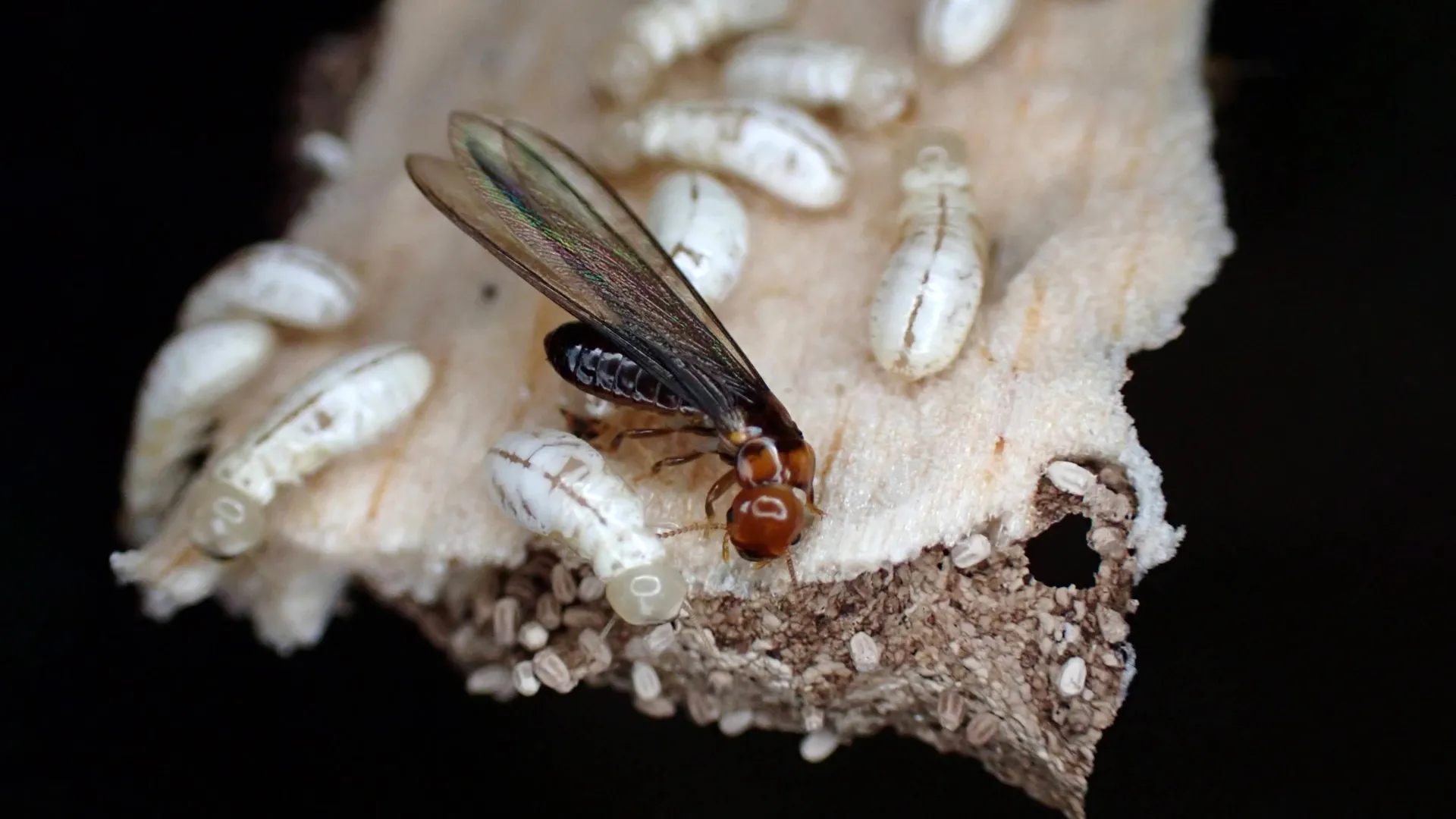
Researchers at the University of California, Riverside (UCR) have unveiled a groundbreaking discovery in the ongoing battle against drywood termites, identifying a chemical compound that effectively dismantles these destructive pests by disrupting their fundamental biological process of molting. The findings, published in the esteemed Journal of Economic Entomology, highlight bistrifluron as a highly selective and environmentally conscious alternative to traditional termite control methods, demonstrating remarkable efficacy in laboratory trials with a significant reduction in colony size and activity without posing risks to mammals. This development signals a potential paradigm shift in how homeowners and pest management professionals approach drywood termite infestations, which have long plagued wooden structures across the globe.
The insidious nature of drywood termites lies in their ability to remain hidden within the very structures they consume. Unlike subterranean termites, which require contact with soil, drywood termites establish their colonies entirely within wooden materials, such as attics, wall voids, and furniture. Their hidden lifestyle allows them to silently expand their colonies, often going unnoticed until substantial structural damage has already occurred, leading to costly repairs and potential safety hazards. Their reliance on wood for both sustenance and shelter, coupled with their secretive habits, makes them particularly challenging adversaries. The University of California, Riverside’s research directly targets a critical vulnerability in this hidden existence: the insect’s exoskeleton.
The Vulnerability of Molting: A Key to Termite Control
Termites, like all insects, possess an exoskeleton, a rigid outer covering that provides structural support, protection, and serves as an anchor for their muscles. This exoskeleton, however, is not permanent. As termites grow, they must periodically shed their old exoskeleton and develop a new, larger one – a process known as molting. Drywood termites undergo this crucial developmental stage approximately seven times throughout their life cycle. It is precisely this biological necessity that bistrifluron exploits.
Bistrifluron functions as a chitin synthesis inhibitor. Chitin is a tough, fibrous polysaccharide that is the primary structural component of insect exoskeletons, as well as fungal cell walls and other biological structures. By blocking the formation of new chitin, bistrifluron effectively prevents termites from developing a new exoskeleton after they shed their old one. "Once the termites reach a certain stage, they have to molt. They cannot avoid that," explained Nicholas Poulos, the corresponding author of the study and a doctoral student in UCR’s Department of Entomology. "With a lethal dose of this chemical, they’ll try to shed their old exoskeleton but won’t have a new one ready to protect them."
The consequences of this molting disruption are dire for the termite colony. While not an instantaneous poison, bistrifluron significantly impacts termite behavior. In laboratory settings, termites treated with the chemical exhibited reduced activity and a marked decrease in feeding. Over time, the inability to successfully molt leads to the insects’ demise, culminating in the collapse of the colony.
Rigorous Laboratory Testing and Remarkable Efficacy
The UCR research team conducted comprehensive laboratory tests using three different chitin synthesis inhibitors, including bistrifluron, against the western drywood termite, Incisitermes minor. This species is a significant pest, particularly in California and other regions with suitable climates. The results were compelling, with bistrifluron outperforming the other tested compounds at the rates used.
In one "no-choice" test, where termites were confined to treated wood, bistrifluron achieved an impressive 99 percent mortality rate within a 60-day period. In a more realistic "choice" test, where termites had the option of treated or untreated wood, a 0.1 percent concentration of bistrifluron still resulted in 96 percent mortality over the same timeframe. This demonstrates the chemical’s potent ability to incapacitate and eliminate termite populations.
A Self-Propagating Treatment: Termites as Vectors
Perhaps one of the most significant advantages of bistrifluron, as highlighted by the UCR study, is its capacity for self-propagation within a termite colony. The researchers observed that after termites consumed treated wood, they effectively transferred the chemical compound to other members of the colony through their feeding habits. In transfer tests, where only a small fraction of termites (5 percent) were initially exposed to the treated material, the entire groups eventually reached 100 percent mortality within 90 days.
This phenomenon is attributed to the social feeding behaviors of termites, specifically proctodeal trophallaxis, often referred to as "mouth-to-anus" feeding. Through this process, termites share regurgitated food and even essential gut microbes. This behavior, while difficult to observe due to their hidden lifestyle, becomes a critical factor in the dissemination of the treatment. Within 24 to 48 hours, food material moved from exposed "donor" termites to unexposed "recipient" termites, effectively spreading the lethal dose throughout the colony. This inherent trait of termites, which makes infestations difficult to detect, paradoxically enhances the effectiveness of bistrifluron-based treatments once introduced.
A Safer, More Targeted Approach to Pest Management
The implications of this research extend far beyond mere pest eradication. Bistrifluron offers a significant improvement in terms of safety and environmental impact compared to many conventional termite control methods. Traditional approaches often involve broad-spectrum insecticides that can pose risks to non-target organisms, including humans and pets. Fumigation, a common method for drywood termites, requires homeowners to vacate their properties for extended periods, involves extensive preparation, and can leave a residual chemical odor. Furthermore, fumigation often fails to prevent re-infestation.
"This chemical is more environmentally friendly than ones traditionally used for drywood termite infestations," stated Dong-Hwan Choe, a UCR entomology professor and senior author of the paper. "It’s specific to insects and can’t harm humans." The targeted nature of bistrifluron stems from its mechanism of action. Humans possess an internal skeletal system of bones, whereas insects rely on their external exoskeleton. By specifically disrupting chitin synthesis, bistrifluron targets a biological pathway unique to insects, leaving mammals unharmed.
The potential for localized treatment is another major advantage. Unlike whole-house fumigation, bistrifluron-based treatments could be applied directly to infested areas, reducing the need for disruptive and costly tenting procedures. This localized application, combined with the chemical’s ability to spread within the colony, offers the prospect of effectively eradicating infestations without the widespread application of chemicals.
Broader Implications and Future Directions
The success of bistrifluron in controlling western drywood termites (Incisitermes minor) is particularly relevant given the species’ significant economic impact, especially in California, where it is native. The study also notes that this chemical has been successfully used against subterranean termites, another major structural pest.
While the full collapse of a colony may take approximately two months, a longer timeframe than some rapid-acting insecticides, the trade-offs are considerable. The reduced toxicity, targeted action, and potential for localized application present a compelling case for its adoption. "We believe this method of spot treatment can kill a larger colony and spread more easily than current termite control methods," Professor Choe commented. "You don’t have to apply too much to get a very good result. The chitin synthesis inhibitors show promise as localized treatment for drywood termites."
Beyond the efficacy of bistrifluron itself, the UCR team is also exploring innovative methods to further enhance termite control strategies. Their previous research has investigated the use of scent lures, specifically pinene, a compound naturally released by forest trees. Western drywood termites perceive pinene as a signal for food. By incorporating pinene into localized insecticide injections, researchers have observed a significant increase in treatment effectiveness. A 2025 patent application from UCR details how adding pinene to insecticide treatments not only accelerated termite mortality but also increased the final kill rate, with mortality rates exceeding 95 percent when pinene was included, compared to approximately 70 percent with insecticide alone. This olfactory lure could allow for wider spacing of treatment application points, potentially reducing the time, labor, and amount of insecticide required for effective control.
Overcoming Practical Challenges and Addressing a Growing Threat
The researchers acknowledge that the current method of dissolving bistrifluron in acetone for laboratory application is not ideal for real-world scenarios due to acetone’s flammability and strong odor. "We are working to make it more feasible for practical application in real life scenarios," Poulos stated, indicating ongoing efforts to develop user-friendly and safe application methods for homeowners and pest control professionals.
The significance of this research is underscored by the expanding reach of drywood termites. Native to northern Mexico and California, the western drywood termite has been inadvertently transported to numerous other regions globally, including Hawaii, New York, Florida, Canada, China, Japan, Korea, and Australia, primarily through the movement of lumber and wood products. Their concealed existence within wood structures makes early detection and eradication exceedingly difficult.
Furthermore, the specter of climate change looms large, potentially exacerbating the problem. As global temperatures rise, previously unsuitable regions may become viable habitats for these termites, allowing them to expand their range. "As we move lumber around the world, the termites are constantly transported to new locations. If they find the climate there acceptable, the problem will spread," warned Professor Choe. "In areas where these termites are common, it’s just a matter of time before homes are infested, so this study is a good initial step toward alternative strategies for controlling them." The development of low-impact, highly targeted chemical treatments like those employing bistrifluron offers a promising path forward in mitigating the significant structural and economic damage caused by these persistent pests, potentially providing long-term protection against future infestations as the chemical may remain active in the wood.