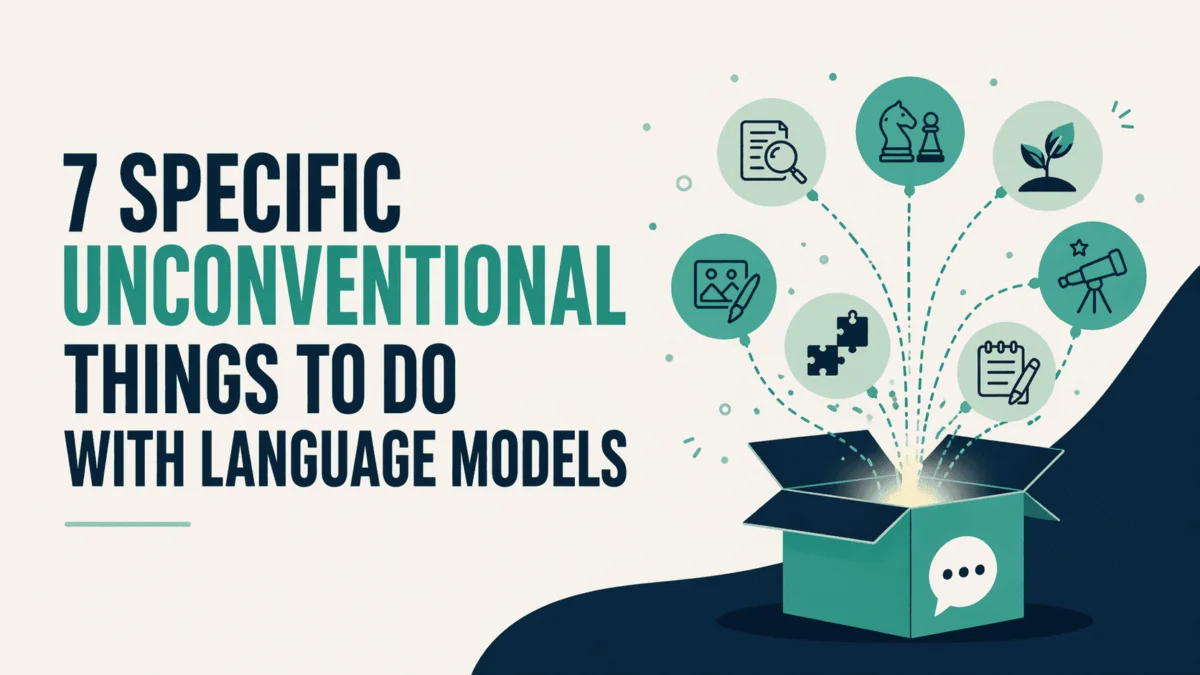
Large Language Models (LLMs), initially recognized for their proficiency in archetypal tasks such as drafting email messages or functioning as advanced search engines, are increasingly revealing a vast, untapped potential for creative problem-solving and strategic augmentation across diverse sectors. This deeper utility extends far beyond mere conversational interfaces, pointing towards a future where these AI systems serve as genuine cognitive partners rather than just sophisticated data processors. The following exploration delves into seven specific, unconventional applications of LLMs, highlighting their capacity to address complex challenges and foster innovation in ways previously unimaginable.
The Evolution of AI: From Algorithmic Curiosities to Strategic Imperatives
The journey of Large Language Models from nascent research projects to indispensable tools has been remarkably swift, underpinned by significant advancements in neural network architectures, particularly the Transformer model introduced in 2017. This breakthrough paved the way for models like OpenAI’s GPT series, Google’s LaMDA, and Meta’s LLaMA, which demonstrated unprecedented capabilities in understanding, generating, and manipulating human language. Early iterations were often confined to narrowly defined tasks, but with scaling laws revealing emergent properties as models grew in size and training data, their potential expanded exponentially. The market for AI software, estimated at over $100 billion in 2022, is projected to grow substantially, with LLMs forming a critical component of this expansion, driving efficiency and innovation across industries.
Initially, user interaction with LLMs primarily involved straightforward queries or simple content generation requests. However, as the models matured, a new discipline emerged: prompt engineering. This involves crafting precise and often elaborate instructions to elicit specific, nuanced responses from the AI. This shift in interaction paradigm is fundamental to unlocking the unconventional uses discussed, transforming LLMs from passive responders into active, configurable agents capable of performing highly specialized functions. The emphasis is no longer merely on what an LLM can do, but how it can be instructed to think, reason, and act in a manner that transcends its default programming. This evolution marks a significant chronology in AI adoption, moving from basic automation to advanced cognitive assistance.
Seven Pillars of Unconventional LLM Utility
The following applications illustrate the profound versatility of LLMs when guided by intentional and strategic prompting, moving beyond their conventional roles to tackle complex, nuanced problems.
1. The Algorithmic Devil’s Advocate: Stress-Testing Decisions
One of the most potent unconventional uses of LLMs lies in their capacity to act as an impartial, yet ruthless, critic for decision-making processes. Human decision-making is notoriously susceptible to cognitive biases such as confirmation bias, where individuals seek out information that confirms their existing beliefs, and groupthink, which stifles dissenting opinions. By explicitly instructing an LLM to adopt the persona of a devil’s advocate, users can subject their ideas, proposals, or strategies to rigorous scrutiny, forcing a confrontation with potential flaws, overlooked risks, or logical fallacies.
For instance, a prompt such as: "Act as a ruthless but logical critic. Review this project proposal and identify the top three hidden risks or logical fallacies I have overlooked," transforms the LLM into an analytical sparring partner. This application leverages the LLM’s vast training data to identify patterns of failure or weak reasoning that might escape human review. Industry analysts suggest that integrating AI-powered critical review processes could reduce project failure rates by up to 15-20% by preemptively identifying vulnerabilities. This function is particularly valuable in high-stakes environments like strategic business planning, engineering design, or public policy formulation, where the cost of oversight can be substantial. It fosters a culture of robust self-critique, enhancing the overall quality and resilience of decisions made by individuals and organizations.
2. Demystifying Technical Complexity: Error Decryption and Resolution
For professionals in software development, IT support, or engineering, encountering cryptic log files and indecipherable stack traces is a routine source of frustration. These "machine-generated balls of frustration" often require extensive specialized knowledge and time to interpret. LLMs offer a groundbreaking solution by translating this arcane technical jargon into clear, actionable natural language instructions.
A developer facing an obscure system error can paste a complex error log directly into an LLM with a prompt like: "I am getting this obscure system error: [paste error]. Explain exactly which line is failing in plain English and provide the commands to fix it." The LLM, drawing upon its extensive knowledge base of programming languages, operating systems, and common error patterns, can pinpoint the root cause, elucidate the problem in human-readable terms, and even suggest precise command-line fixes or code snippets. This significantly reduces debugging time, which industry data indicates can consume up to 50% of a developer’s workday. By democratizing access to complex technical troubleshooting, LLMs empower not only seasoned engineers but also junior developers and non-technical staff to resolve issues more efficiently, thereby improving system uptime and reducing operational costs. Reports from early adopters suggest a reduction in mean time to resolution (MTTR) for complex technical issues by up to 30%.
3. Navigating Legal Labyrinths: Contractual Clarity and Risk Identification
The legal domain is notorious for its dense, often obscure language, making contracts and agreements challenging for laypersons to comprehend fully. The time and expense associated with legal counsel often deter individuals and small businesses from thoroughly reviewing critical documents. LLMs present a powerful tool for demystifying legal texts, though with a crucial caveat regarding privacy and accuracy.
By providing an LLM with a document such as a rental agreement or a service contract, and using a prompt like: "Analyze this rental agreement. Highlight any unusual termination clauses, hidden fees, or non-standard liability shifts that a layperson might easily miss," the AI can rapidly scan and summarize key provisions. It can identify "red flags" – clauses that deviate from standard practice, impose disproportionate burdens, or contain ambiguous wording. Given the sensitive nature of legal documents, the article rightly emphasizes the importance of using self-hosted LLMs or models with robust data privacy guarantees to prevent confidential information from being exposed. While not a substitute for professional legal advice, this application provides an initial, accessible layer of understanding, empowering individuals to approach legal agreements with greater awareness. Studies on the use of AI in legal tech suggest that preliminary document review can be accelerated by up to 70%, freeing legal professionals to focus on higher-value tasks and improving access to legal insights for the general public.
4. Historical and Expert Emulation: Breaking Conventional Thought Patterns
One of the most creative applications of LLMs is their ability to simulate historical figures or expert personas, allowing users to gain unique perspectives and challenge conventional thinking. This moves beyond simple question-answering to leveraging the LLM’s vast linguistic and knowledge base to mimic specific communication styles, philosophical frameworks, or domain-specific expertise.
A prompt such as: "Critique my modern social media strategy as if you were an advertising executive from the 1960s Madison Avenue. Focus heavily on emotional appeal and brand positioning," prompts the LLM to adopt a specific historical and professional lens. It will generate a critique steeped in the principles and vernacular of that era, forcing the user to consider their strategy from an entirely different paradigm. This technique is invaluable for brainstorming, innovation workshops, and strategic planning, where breaking free from contemporary biases and groupthink is crucial. Researchers in cognitive psychology suggest that exposure to diverse perspectives, even simulated ones, significantly enhances creative problem-solving and fosters "out-of-the-box" thinking. This utility can be extended to simulating diverse cultural perspectives, scientific pioneers, or even fictional characters to generate novel insights.
5. Automated "Rubber Ducking": Precision in Logic and Workflow Design
The "rubber duck debugging" technique, where programmers explain their code line-by-line to an inanimate object to uncover flaws in their logic, is a well-established practice. LLMs can automate and enhance this process, acting as an intelligent, interactive "rubber duck" that actively identifies gaps and inconsistencies in complex workflows or logical puzzles.
When faced with an intricate system design or a multi-step process, explaining it to an LLM with a prompt like: "I am trying to build an automated workflow that triggers based on these three specific conditions: [list conditions]. Where is the logical gap in this sequence?" can be remarkably effective. The LLM, with its ability to process sequences and identify logical inconsistencies, will analyze the described workflow and point out missing steps, ambiguities, or contradictions. This application is particularly beneficial in software development, business process automation, and even scientific experimentation design, where a single logical flaw can invalidate an entire project. Data from engineering teams employing AI for workflow validation indicates a reduction in logical errors by up to 25%, leading to more robust and reliable systems. This proactive identification of gaps significantly reduces rework and enhances the efficiency of complex system design.
6. Curating Personalized Learning Journeys: Skill Development Roadmaps
In an era of rapid technological change, continuous learning and skill development are paramount. Traditional educational resources often follow a one-size-fits-all approach, which can be inefficient for individuals with unique knowledge bases and learning styles. LLMs excel at generating hyper-personalized learning roadmaps, tailoring content to specific gaps and goals.
A user seeking to upskill can provide an LLM with their existing knowledge and desired learning outcomes: "I already understand basic Python, but I want to learn data visualization. Create a free, 14-day study plan with daily practice exercises focusing only on Matplotlib." The LLM will then construct a bespoke syllabus, intelligently omitting redundant information and concentrating exclusively on the user’s identified knowledge and skill gaps. This includes suggesting specific topics, resources, and practice exercises. This application has profound implications for education and professional development, democratizing access to highly customized learning experiences. Educational technologists predict that AI-driven personalized learning could increase learning retention rates by 10-15% and significantly reduce the time required to acquire new skills, addressing the evolving demands of the global workforce.
7. Bridging Cultural Divides: Nuanced Communication in Global Contexts
In international business and diplomacy, effective communication transcends mere linguistic translation; it requires a deep understanding of cultural context, formality, and etiquette. Misinterpretations arising from cultural nuances can lead to significant setbacks. LLMs can act as sophisticated cultural interpreters, providing insights that go far beyond literal translation.
When drafting or receiving communications from international counterparts, a prompt such as: "Translate this email from a new international client, but also explain the subtext, the level of formality used, and how I should respectfully format my reply to match their cultural business standards," empowers the user to navigate complex cross-cultural interactions with greater confidence. The LLM can analyze the original text for subtle cues, identify cultural expectations regarding directness, politeness, and hierarchical respect, and then provide guidance on crafting a reply that is both linguistically accurate and culturally appropriate. This capability is invaluable for fostering stronger international relationships, preventing misunderstandings, and ensuring business negotiations proceed smoothly. Global business leaders increasingly recognize the strategic advantage of culturally sensitive communication, with some attributing up to a 20% improvement in international deal success rates to enhanced cross-cultural understanding.
The Broader Implications: Reshaping Industries and Human-AI Collaboration
These seven unconventional applications underscore a pivotal shift in the utility of LLMs, moving them from simple tools to strategic partners. The implications of this transformation are far-reaching, affecting economic productivity, ethical considerations, and the very nature of human work.
Economic Impact: The ability of LLMs to automate complex analytical tasks, accelerate problem-solving, and personalize learning pathways promises substantial productivity gains across various sectors. From reducing debugging costs in software development to streamlining legal reviews and enhancing strategic planning, the economic value generated by these advanced AI applications is projected to be in the trillions of dollars globally over the next decade. New service models, built around AI augmentation rather than full automation, are also emerging, creating novel entrepreneurial opportunities.
Ethical Frameworks and Governance: As LLMs delve into sensitive areas like legal interpretation, personal decision-making, and cultural analysis, ethical considerations become paramount. Issues of data privacy, algorithmic bias, accountability for AI-assisted decisions, and the "black box" problem (where the reasoning behind an AI’s output is opaque) necessitate robust ethical frameworks and regulatory oversight. AI ethicists frequently caution against over-reliance on LLMs without human oversight, particularly in critical domains. The emphasis on self-hosted models for privacy-sensitive tasks, as highlighted in legal analysis, reflects a growing awareness of these challenges.
The Evolving Skillset: The rise of these unconventional LLM applications redefines the skills necessary for professional success. While foundational knowledge remains crucial, the ability to effectively "prompt engineer"—to frame complex requests, define constraints, and guide the AI towards desired outcomes—is becoming a critical competency. This signifies a shift from purely technical or domain-specific expertise to a more symbiotic human-AI collaboration, where humans provide the strategic direction and context, and AI offers augmented cognitive processing.
Future Trajectories: Looking ahead, the trajectory of LLMs points towards even more specialized models, multimodal AI that integrates text with images, audio, and video, and increasingly sophisticated human-AI interfaces. The distinction between human and machine contributions will blur further, leading to truly symbiotic systems where AI acts as a continuous, adaptable cognitive assistant across virtually all professional and personal domains.
Conclusion: Beyond the Chatbot Interface
The current capabilities of Large Language Models extend far beyond their initial, often simplistic, perceived roles as mere question-answering machines or content generators. The seven unconventional use cases explored—from serving as a personal devil’s advocate and decrypting arcane technical errors to navigating legal complexities and bridging cultural divides—only scratch the surface of what becomes possible with intentional and creative prompting.
The common thread weaving through these diverse applications is the deliberate framing of requests: assigning the model a specific role, imposing clear constraints, and defining a concrete goal. The more precisely and thoughtfully users articulate their needs, the more these AI tools reveal themselves to be not just glorified search engines, but genuine cognitive partners capable of augmenting human intelligence, fostering critical thinking, and unlocking unprecedented levels of efficiency and innovation. As individuals and organizations continue to explore and refine their interactions with LLMs, the transformative potential for enhancing human capabilities and reshaping industries will undoubtedly continue to unfold. Ivan Palomares Carrascosa, a recognized leader in AI, machine learning, deep learning, and LLMs, consistently emphasizes this crucial role of guiding AI to harness its full potential in the real world.