

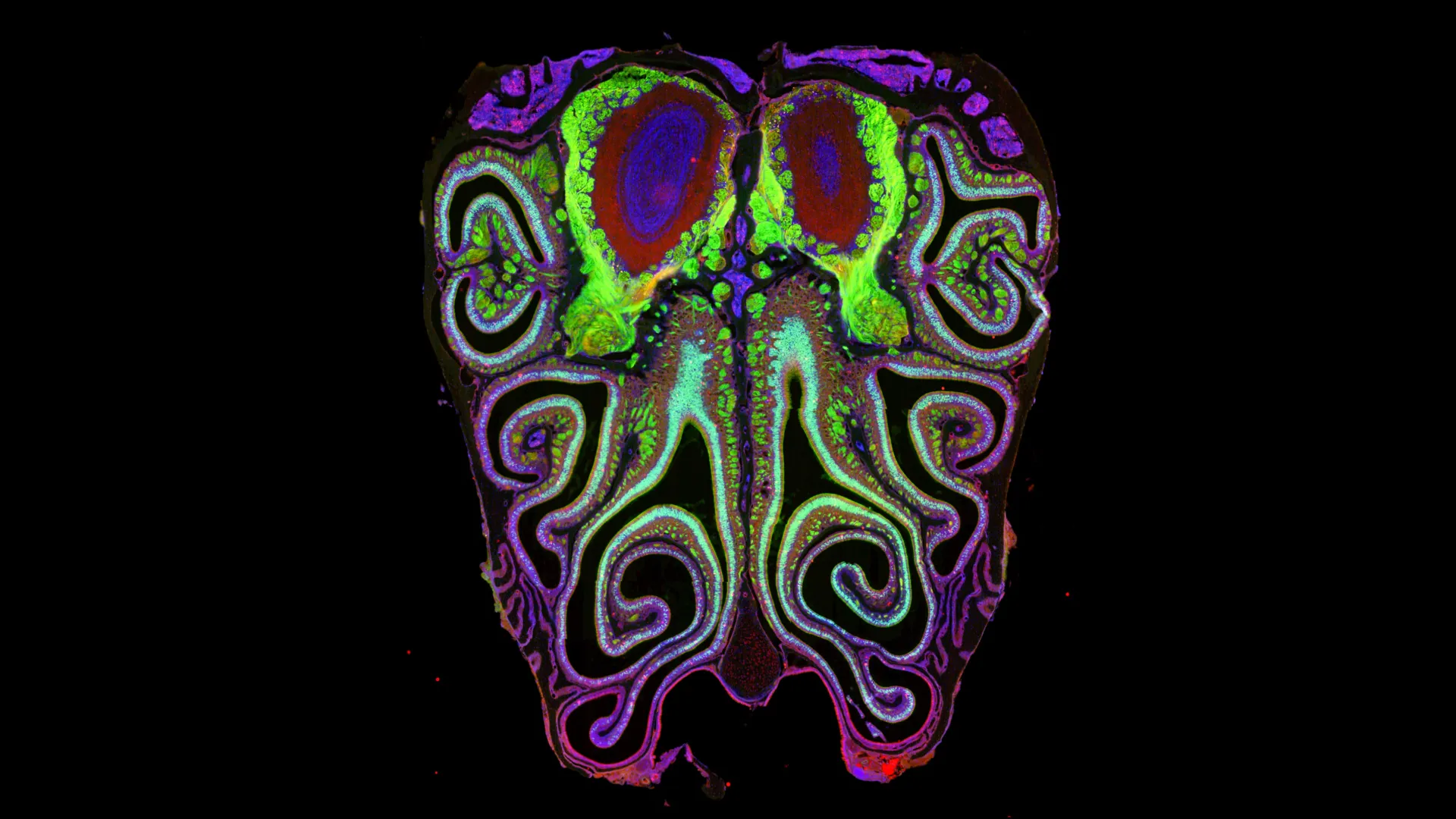
For decades, the biological mechanisms governing the sense of smell have remained one of the most significant enigmas in neuroscience. While the pathways for vision, hearing, and touch have been meticulously mapped—showing exactly how external stimuli are translated into organized neural patterns—the olfactory system appeared to be a chaotic outlier. However, a landmark study published in the journal Cell by researchers at Harvard Medical School has finally overturned this long-standing assumption. By creating the first detailed spatial map of smell receptors in the nose, the team has revealed a hidden, highly organized architecture that explains how the brain begins to process the complex world of odors.
Led by Sandeep Robert Datta, a professor of neurobiology in the Blavatnik Institute at Harvard Medical School, the research team utilized cutting-edge genetic sequencing and imaging technologies to analyze millions of neurons. Their findings demonstrate that the nose is not a random collection of sensors but a precisely structured organ where more than a thousand types of smell receptors are arranged in distinct horizontal "stripes." This discovery provides a missing link in sensory biology and offers a new foundation for treating olfactory disorders, which have gained increased public attention following the global COVID-19 pandemic.
The Historical Context of Olfactory Research
To understand the magnitude of this discovery, one must look back at the history of sensory science. In the late 20th century, the mechanisms for vision and touch were already well-understood. Scientists knew that the retina in the eye is organized into a map that corresponds directly to the visual field, and the skin’s touch receptors are mapped onto the brain’s somatosensory cortex in a predictable "homunculus" pattern. Smell, however, defied such easy categorization.
In 1991, Richard Axel and Linda Buck identified the family of genes responsible for odorant receptors, a discovery that earned them the Nobel Prize. They revealed that mice possess approximately 1,000 different types of smell receptors, while humans have about 350 to 400. Each olfactory sensory neuron expresses only one of these receptor types. For thirty years, the prevailing theory was that these neurons were distributed somewhat randomly within broad "zones" of the olfactory epithelium (the tissue inside the nose).
"Olfaction has been the one exception; it’s the sense that has been missing a map for the longest time," Datta noted. The complexity of the system was the primary barrier. While human color vision depends on just three types of light-sensitive receptors, the olfactory system must manage hundreds or thousands of distinct inputs to identify the myriad scents of the natural world. This sheer scale made it nearly impossible for earlier researchers to detect any underlying spatial logic.
A Breakthrough in Scale and Technology
The Harvard team overcame these historical hurdles by leveraging two powerful modern technologies: single-cell RNA sequencing and spatial transcriptomics. Single-cell sequencing allows researchers to identify the specific genetic signature of an individual cell—in this case, which of the 1,000+ receptor types a neuron is expressing. Spatial transcriptomics then allows them to map that genetic identity back to its exact physical location in the tissue.
The scale of the study was unprecedented. The researchers analyzed approximately 5.5 million neurons across more than 300 mice. Datta described the resulting dataset as "arguably the most sequenced neural tissue ever." This massive volume of data was necessary to move beyond the "broad zone" theories of the past and see the fine-grained patterns that had remained hidden for decades.
By combining these data points, the team constructed a three-dimensional atlas of the mouse nose. They discovered that instead of being scattered, neurons expressing the same receptor type were grouped into tight, overlapping horizontal bands. These "stripes" run from the top of the nasal cavity to the bottom, creating a consistent and predictable geography of scent.
The Discovery of the Retinoic Acid Gradient
A critical question arising from the discovery of this map was how the body creates it. During development, how does a newborn neuron "know" which of the 1,000 receptors to express based on its location in the nose? The researchers identified a molecular signal that acts as a biological GPS: retinoic acid.
Retinoic acid, a derivative of Vitamin A, is a well-known morphogen—a signaling molecule that governs the pattern of tissue development. The study revealed a gradient of retinoic acid within the nasal cavity, with higher concentrations in some areas and lower concentrations in others. This gradient provides the positional information necessary for neurons to select the correct receptor.
To test this mechanism, the researchers manipulated the levels of retinoic acid during the mice’s development. They found that by altering the chemical gradient, they could shift the entire map of receptor stripes upward or downward. This confirmed that retinoic acid is the primary driver of the olfactory system’s spatial organization, ensuring that every animal of a species develops a nearly identical "smell map."
Alignment with the Brain’s Olfactory Bulb
The implications of this nasal map extend deep into the brain. The nose’s primary job is to send signals to the olfactory bulb, the first processing station for scent in the brain. Scientists have known for some time that the olfactory bulb is highly organized, with specific "glomeruli" (clusters of nerve endings) dedicated to specific receptors.
However, without a map of the nose, it was unclear how the wiring between the nose and the brain was established. Datta’s team found that the horizontal stripes in the nose align perfectly with the map in the olfactory bulb. This suggests that the spatial organization of the nose is the blueprint for the entire olfactory circuit. The physical location of a receptor in the nose directly influences where its signal is processed in the brain, facilitating a more efficient and reliable transfer of sensory information.
Interestingly, a separate study led by Catherine Dulac, the Xander University Professor at Harvard, was published in the same issue of Cell and reached consistent conclusions. The convergence of results from two different laboratories underscores the validity of these findings and signals a major shift in the field’s consensus.
Implications for Human Health and Anosmia
While the study was conducted on mice, the biological principles discovered are likely to have profound implications for human health. The mouse model is a standard for olfactory research because the basic architecture of the mammalian nose is highly conserved across species.
The most immediate application of this research is in the treatment of anosmia, or the loss of smell. Before the COVID-19 pandemic, anosmia was often overlooked by the medical community. However, the virus highlighted how devastating the loss of smell can be, leading to decreased appetite, inability to detect hazards like smoke or gas leaks, and a significant increase in rates of depression and anxiety.
"We cannot fix smell without understanding how it works on a basic level," Datta emphasized. Currently, there are few effective treatments for permanent smell loss. Many patients are told to wait and hope for natural regeneration. However, with a detailed map of how the system is supposed to be organized, scientists can now explore more advanced interventions.
Potential future treatments could include:
- Stem Cell Therapies: By understanding the retinoic acid gradient and the spatial "stripes," researchers might be able to guide stem cells to differentiate into specific types of neurons in specific locations, effectively "re-mapping" a damaged nose.
- Brain-Computer Interfaces (BCIs): For patients whose nasal tissue is beyond repair, a BCI could potentially bypass the nose entirely. Understanding the precise mapping between the nose and the olfactory bulb is essential for designing electrodes that can stimulate the brain to "smell" artificial signals.
- Targeted Diagnostics: This map could allow doctors to identify exactly which parts of the olfactory system are damaged in a patient, leading to more personalized treatment plans.
Conclusion: A New Era for Sensory Science
The mapping of the olfactory receptors represents the closing of a major chapter in sensory biology. For thirty years, the "randomness" of smell was a frustrating outlier in an otherwise organized nervous system. By revealing the horizontal stripes of the nose and the retinoic acid gradient that forms them, Datta and his colleagues have brought order to the mystery.
This research does more than just satisfy scientific curiosity; it provides a structural framework for understanding how we experience the world. Smell is uniquely tied to memory and emotion because of its direct path to the brain’s limbic system. By decoding the physical layout of this sense, researchers are now one step closer to understanding the complex interplay between chemical signals in the environment and the internal landscape of the human mind.
As the team continues to investigate whether these same stripes exist in the human nose and how they evolve over a lifetime, the scientific community is hopeful that this map will serve as a North Star for the development of new therapies. In the words of Professor Datta, "Smell has a really profound and pervasive effect on human health… Without understanding this map, we’re doomed to fail in developing new treatments." With the map now in hand, the path forward is clearer than ever.
















Leave a Reply