

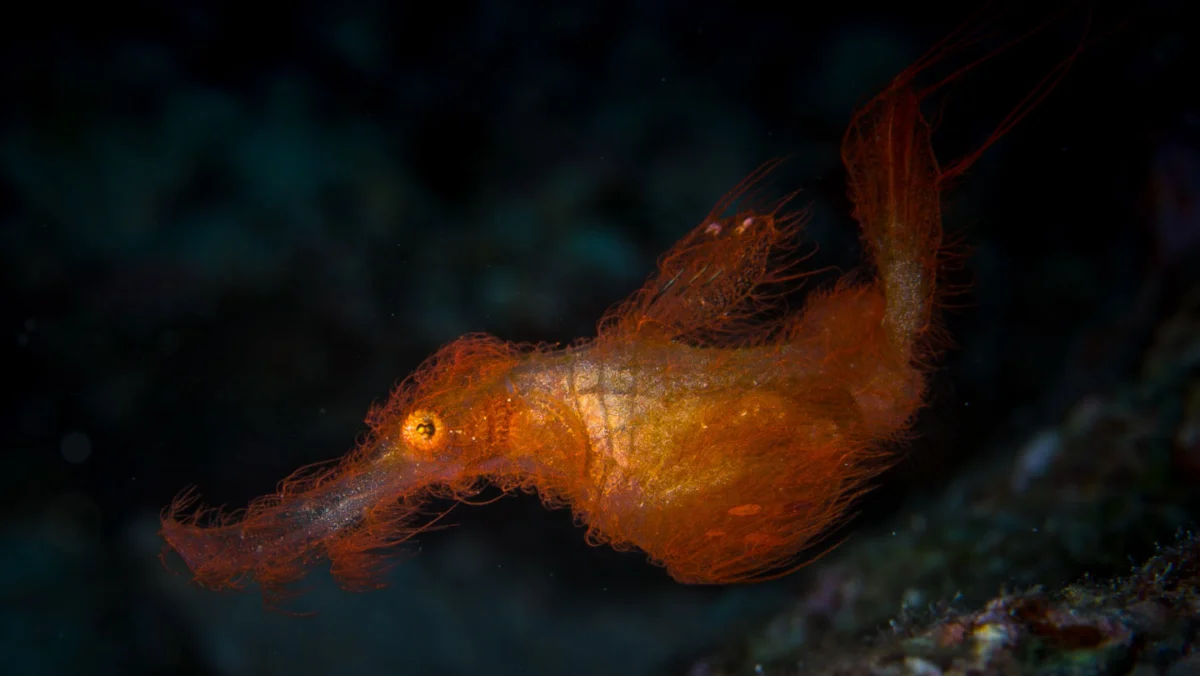
A remarkable new species of ghost pipefish, colloquially dubbed the "Snuffleupagus" fish for its distinctive, trunk-like snout and uncanny camouflage, has been discovered in the vibrant coral reefs off the coast of Australia. This elusive creature, a relative of the well-known seahorse, boasts a thick coat of near-neon orange fibers that meticulously mimic the surrounding red algae, rendering it virtually invisible to predators and the unobservant eye. The discovery, detailed in recent scientific publications, highlights the extraordinary biodiversity that still lies hidden within our planet’s oceans, particularly in the biologically rich Indo-Pacific region.
A Master of Disguise in a Coral Wonderland
The "Snuffleupagus" fish, scientifically designated within the broader ghost pipefish family (Solenostomidae), represents a significant addition to our understanding of marine life’s adaptive strategies. Ghost pipefish are renowned for their exceptional camouflage, but this newly identified species pushes the boundaries of mimicry. Its body is adorned with elaborate, filamentous appendages that not only replicate the color but also the texture and movement of the red algae it inhabits. This intricate disguise is crucial for its survival in a marine environment teeming with both prey and predators.
"The level of detail in its camouflage is astounding," commented Dr. Anya Sharma, a marine biologist not directly involved in the discovery but an expert in reef ecosystems. "It’s not just about blending in; it’s about becoming an indistinguishable part of the environment. This allows it to ambush small crustaceans, its primary food source, while simultaneously evading larger fish that might otherwise consider it a meal."
The specific location of the discovery, in shallow seas near Australia, is significant. Australia’s waters, particularly the Great Barrier Reef and surrounding areas, are recognized as global biodiversity hotspots, harboring an estimated 10% of the world’s fish species. Despite extensive research, these complex and often murky environments continue to yield new and surprising discoveries, underscoring the ongoing need for marine conservation efforts.
Unveiling the "Snuffleupagus": A Chronology of Discovery
While the formal scientific description is recent, the initial sightings of this unusual fish likely occurred over a period of time, with dedicated marine biologists and underwater photographers gradually piecing together evidence of its existence. The process of formally describing a new species is a rigorous undertaking, typically involving:
- Initial Observation: Divers and researchers encounter an organism that appears distinct from known species. This might happen during routine surveys, specialized expeditions, or even through citizen science contributions from skilled underwater photographers.
- Specimen Collection/Documentation: If possible, specimens are carefully collected for detailed morphological and genetic analysis. In cases where collection is difficult or detrimental to the species, high-resolution photographic and video evidence, coupled with detailed behavioral observations, can sometimes suffice.
- Morphological and Genetic Analysis: Scientists meticulously examine the physical characteristics of the collected specimens (or detailed imagery) and compare them to existing species descriptions. DNA sequencing is often employed to confirm its genetic distinctiveness.
- Peer Review and Publication: The findings are compiled into a scientific paper, which is then submitted to a peer-reviewed journal. Experts in the field review the research, ensuring its validity and rigor before publication.
The discovery of the "Snuffleupagus" fish likely followed this established scientific protocol, with researchers working diligently to confirm its status as a new species. The delay between initial sightings and formal announcement is a testament to the scientific community’s commitment to accuracy and thoroughness. The image accompanying the initial report, showcasing the fish’s striking appearance, would have been a crucial piece of evidence in this process.
Supporting Data and the Ghost Pipefish Family
Ghost pipefish belong to the family Solenostomidae, a group of marine fish characterized by their elongated bodies, often elaborate dorsal and anal fins, and their remarkable ability to blend into their surroundings. They are found in the tropical and subtropical waters of the Indo-Pacific.
- Diet: Primarily feed on small crustaceans such as amphipods and mysid shrimp.
- Reproduction: A unique reproductive strategy involves the female carrying her eggs in a brood pouch formed by her greatly enlarged pelvic fins. The male then fertilizes the eggs after they are placed in the pouch.
- Habitat: They inhabit a variety of marine environments, including coral reefs, seagrass beds, and rocky outcrops, where their camouflage is most effective.
- Diversity: The Solenostomidae family currently comprises around 30 described species, with new discoveries, like the "Snuffleupagus" fish, continuing to expand this number.
The "Snuffleupagus" fish, with its dense, fibrous ornamentation, likely represents an evolutionary adaptation to a very specific microhabitat within the coral reefs, possibly one dominated by a particular species of red algae. This level of specialization is a common theme in coral reef ecosystems, where intricate relationships between species drive evolutionary innovation.
Implications for Marine Science and Conservation
The discovery of the "Snuffleupagus" fish has several important implications:
- Biodiversity Assessment: It underscores that our knowledge of marine biodiversity is far from complete. Even in well-studied regions like Australia, new species are regularly found, suggesting that many more remain undiscovered. This highlights the critical need for continued exploration and research.
- Evolutionary Biology: The extreme camouflage of this new species provides a valuable case study for understanding the evolutionary pressures that drive mimicry and adaptation. Scientists can analyze its genetic makeup and morphology to learn more about the specific genes and developmental pathways involved in creating such elaborate disguises.
- Ecosystem Health Indicators: The presence of specialized species like the "Snuffleupagus" fish can serve as indicators of reef health. Their reliance on specific habitats and food sources means that any degradation of these environments could directly impact their survival, making them valuable sentinels for the overall well-being of the coral reef ecosystem.
- Conservation Strategies: Understanding the distribution, habitat requirements, and vulnerabilities of newly discovered species is crucial for developing effective conservation strategies. If the "Snuffleupagus" fish is found to be particularly sensitive to pollution, climate change-induced coral bleaching, or overfishing, targeted conservation measures can be implemented to protect its populations and its habitat.
Broader Impact and the Future of Discovery
The public fascination with unique and visually striking creatures like the "Snuffleupagus" fish plays a vital role in raising awareness about marine conservation. While the scientific community focuses on the biological and evolutionary significance of such discoveries, the charismatic nature of these animals can capture the public’s imagination, fostering a greater appreciation for the ocean’s wonders and the urgent need to protect them.
As technology advances, allowing for deeper dives, more sophisticated imaging, and advanced genetic analysis, the pace of marine discovery is expected to accelerate. However, this progress is occurring against a backdrop of increasing environmental threats. Climate change, ocean acidification, pollution, and unsustainable fishing practices continue to put immense pressure on marine ecosystems worldwide.
The "Snuffleupagus" fish, with its remarkable camouflage and its home in the vibrant but vulnerable coral reefs, serves as a potent reminder of what we stand to lose. Each new species discovered is not just a scientific curiosity; it is a testament to the intricate web of life on Earth and a call to action to safeguard these invaluable natural treasures for future generations. The ongoing exploration of our oceans promises further marvels, but it also carries the responsibility to ensure that these discoveries are not merely footnotes in the history of extinction, but rather triumphs of understanding and conservation.















Leave a Reply