

On February 13, 2023, an instrument located more than 3,000 meters beneath the surface of the Mediterranean Sea registered a signal that would redefine the boundaries of high-energy astrophysics. The KM3NeT/ARCA neutrino telescope, situated off the coast of Capo Passero, Sicily, detected a single cosmic neutrino with an estimated energy of approximately 220 Peta-electronvolts (PeV). To put this in perspective, this single subatomic particle carried more than ten times the energy of any high-energy neutrino previously recorded, and millions of times more energy than the particles accelerated by the Large Hadron Collider (LHC) at CERN. For over a year, an international team of hundreds of scientists has meticulously analyzed this event to determine its origin. A landmark study now published in the Journal of Cosmology and Astroparticle Physics (JCAP) suggests that the most likely culprit for this extraordinary emission is a population of blazars—active galactic nuclei powered by supermassive black holes that act as the universe’s most powerful particle accelerators.
The detection is particularly remarkable given the state of the KM3NeT observatory at the time. Currently under construction, the KM3NeT (Cubic Kilometre Neutrino Telescope) project is designed to eventually consist of hundreds of vertical detection lines anchored to the seabed, each equipped with highly sensitive optical modules. On the day of the detection, only 21 of these lines were operational, representing a mere 10% of the facility’s planned final configuration. Despite this partial setup, the detector’s sensitivity was sufficient to capture the "track" of light produced as the neutrino interacted with the seawater, providing researchers with enough data to begin a forensic reconstruction of the particle’s journey through the cosmos.
The Forensic Investigation of a Ghost Particle
Neutrinos are often referred to as "ghost particles" because they possess no electrical charge and almost no mass, allowing them to travel across the universe in straight lines, unaffected by magnetic fields and passing through stars, planets, and even human bodies without leaving a trace. While this makes them notoriously difficult to detect, it also makes them perfect astronomical messengers. Unlike light, which can be absorbed or scattered by cosmic dust, or charged cosmic rays, which are deflected by magnetic fields, a neutrino points directly back to its source.
However, the 220 PeV event presented a unique challenge. In traditional multi-messenger astronomy, researchers look for an "electromagnetic counterpart"—a flash of light, radio waves, or X-rays—that occurs at the same time and in the same region of the sky as the neutrino. When the KM3NeT team scanned the heavens following the February 2023 detection, they found no such immediate signal. This absence of a "smoking gun" point source led the research team, spearheaded by Meriem Bendahman of the National Institute for Nuclear Physics (INFN) in Naples, to consider a more complex possibility: the neutrino might be part of a "diffuse flux."
A diffuse flux represents the cumulative "background noise" of neutrinos produced by a vast population of distant sources, rather than a single, nearby explosive event. To test this hypothesis, the researchers employed the Astrophysical Multimessenger Modeling and Simulation (AM3) framework. This open-source tool allowed the team to simulate various populations of cosmic objects to see which could realistically produce a 220 PeV neutrino without violating other known astronomical constraints.
Blazars: The Universe’s Natural Particle Cannons
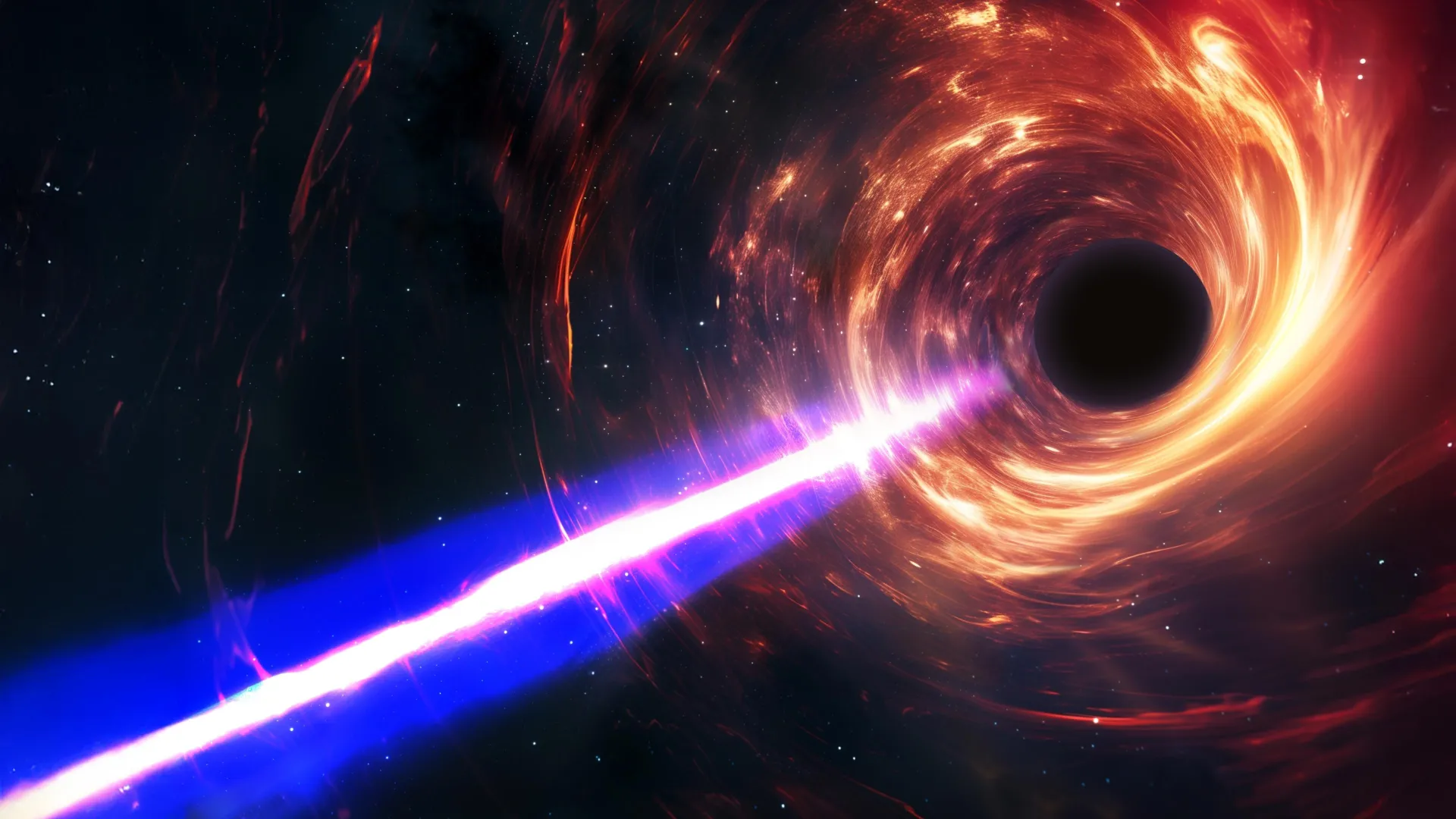
The primary focus of the simulation was blazars. A blazar is a specific type of active galactic nucleus (AGN) where a supermassive black hole at the center of a galaxy is actively consuming matter. As this matter spirals into the black hole, it creates immense gravitational and magnetic forces that eject two relativistic jets of plasma in opposite directions. When one of these jets is pointed directly toward Earth, the object is classified as a blazar.
"There are several possible explanations for the origin of this particle," explains Bendahman. "For example, it has been proposed that such neutrinos are generated when ultra-high-energy cosmic rays interact with the cosmic microwave background radiation, the residual light from the early Universe. But there is also the possibility that the neutrino originates from a diffuse flux produced by a population of extreme accelerators, such as blazars."
The research team adjusted two primary variables in their blazar models: baryonic loading and the proton spectral index. Baryonic loading refers to the ratio of energy carried by protons compared to electrons within the blazar’s jet. Since neutrinos are produced when high-energy protons collide with other particles or photons, a higher baryonic load increases the likelihood of neutrino production. The proton spectral index determines the distribution of energy among these protons—specifically, whether the blazar is capable of accelerating particles to the extreme "ultra-high" energy levels required to produce a 220 PeV neutrino.
Cross-Referencing with IceCube and Fermi Data
A critical component of the study involved comparing the KM3NeT findings with data from other major observatories, most notably the IceCube Neutrino Observatory at the South Pole and NASA’s Fermi Gamma-ray Space Telescope. IceCube, which has been fully operational for over a decade, has detected numerous high-energy neutrinos but none reaching the 220 PeV threshold.
The researchers realized that the "non-detection" of similar events by IceCube was actually a vital piece of data. If 220 PeV neutrinos were common, IceCube would have seen them. Therefore, any valid model for the origin of the KM3NeT neutrino had to account for the extreme rarity of such events. The blazar population model fit this constraint perfectly; the simulation showed that while blazars are capable of producing such energies, the probability of a detector intercepting such a particle is exceptionally low, aligning with the fact that only one such event has been recorded to date.
Furthermore, the team had to ensure their model did not contradict the "extragalactic gamma-ray background" measured by the Fermi telescope. When protons in blazar jets produce neutrinos, they also produce high-energy gamma rays. If the blazar population was too dense or too active, it would have produced more gamma rays than Fermi has observed. The study concluded that a specific subset of "extreme" blazars could produce the 220 PeV neutrino while remaining within the gamma-ray limits established by Fermi.
A Chronology of High-Energy Neutrino Astronomy
The detection of the 220 PeV neutrino marks the latest milestone in a rapidly evolving field. The timeline of this scientific journey highlights the increasing precision of our cosmic "eyes":
- 2013: IceCube provides the first evidence of high-energy cosmic neutrinos originating from outside our solar system, opening the era of neutrino astronomy.
- 2017: A 290 TeV neutrino (IceCube-170922A) is traced back to a specific blazar, TXS 0506+056, marking the first time a neutrino source is identified via multi-messenger observations.
- February 13, 2023: KM3NeT/ARCA detects the 220 PeV event, shattering previous energy records by an order of magnitude.
- 2024: The KM3NeT collaboration publishes its analysis in JCAP, providing a theoretical framework that links ultra-high-energy neutrinos to diffuse blazar populations.
Implications for the Future of Physics
The confirmation of a 220 PeV neutrino has profound implications for our understanding of the laws of physics. Currently, the most powerful man-made accelerator, the LHC, reaches energies of 13.6 TeV. The KM3NeT neutrino was roughly 16,000 times more energetic. This suggests that the natural processes occurring within blazar jets involve magnetic reconnection or shock acceleration mechanisms that are far more efficient than anything humans can currently replicate or fully model.
The study also reinforces the necessity of completing the KM3NeT observatory. Once finished, KM3NeT will consist of two main components: ARCA (Astroparticle Research with Methods in the Abyss), optimized for high-energy cosmic neutrinos like the 220 PeV event, and ORCA (Oscillation Research with Methods in the Abyss), located off the coast of France and optimized for lower-energy atmospheric neutrinos.
"We need more observational data," Bendahman emphasizes. "KM3NeT is still under construction, and we detected this ultra-high-energy neutrino with only a partial configuration. With the full detector and more data, we will be able to perform more powerful statistical analyses and open a new window on the ultra-high-energy neutrino universe."
If future detections continue to align with the blazar model, it would suggest that the universe is populated by "extreme accelerators" that have remained largely hidden from traditional telescopes. These objects could be the source of ultra-high-energy cosmic rays, a long-standing mystery in astrophysics. By using neutrinos as a proxy, scientists are finally beginning to map the most violent and energetic regions of the distant universe.
As KM3NeT expands its footprint on the Mediterranean floor, the scientific community anticipates a new era where the detection of PeV-scale particles becomes a more frequent occurrence. For now, the 220 PeV neutrino remains a solitary messenger from the deep cosmos, a silent witness to the incredible power of supermassive black holes and the vast, energetic mysteries that still await discovery in the dark.














Leave a Reply