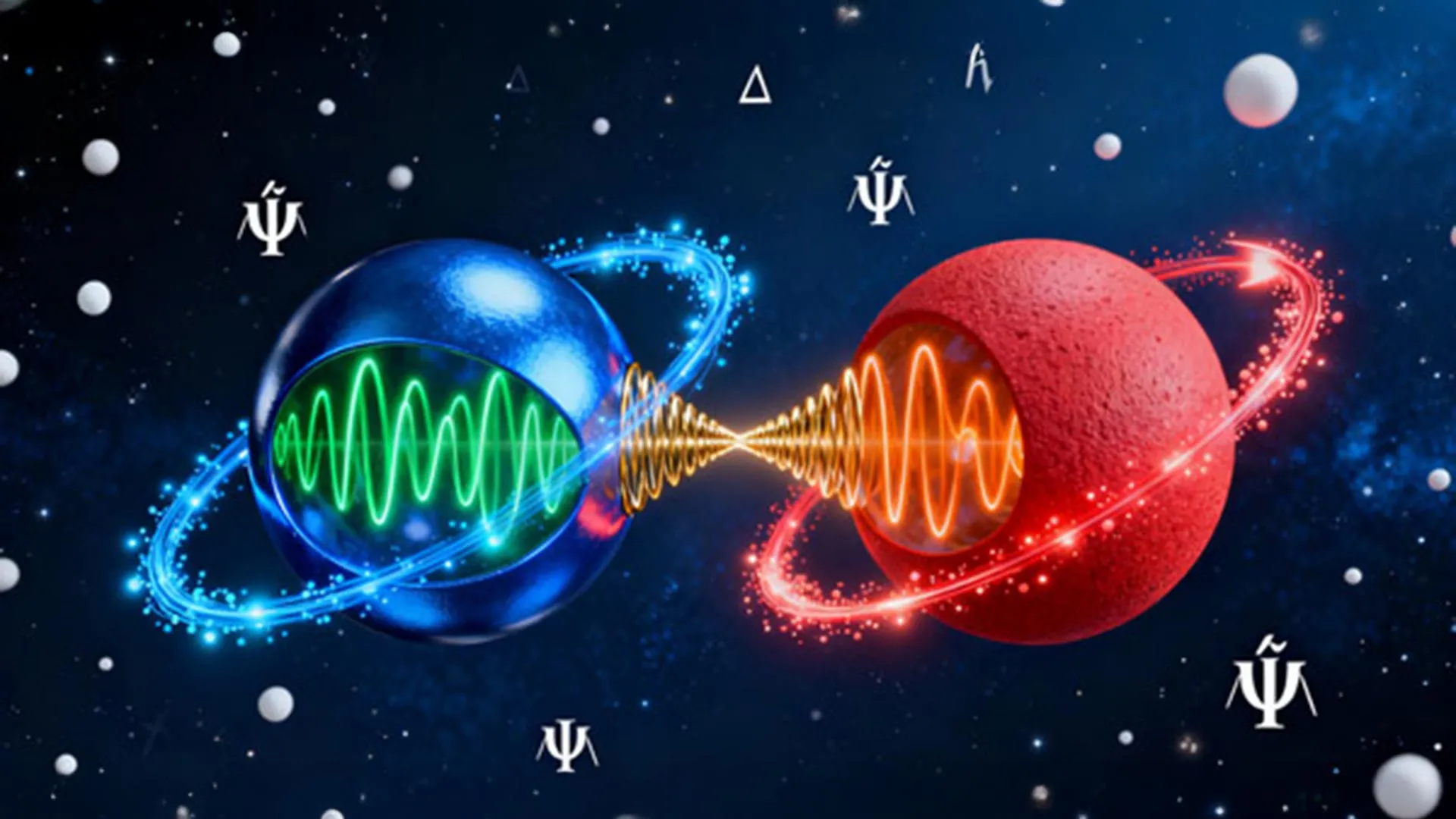
A research team led by theoretical physicists at the RIKEN Center for Quantum Computing (RQC) has unveiled a groundbreaking theoretical framework designed to achieve one-way quantum synchronization of phonons—the fundamental particles of sound and mechanical vibration. This development marks a significant departure from previous quantum synchronization efforts, as the new model maintains its integrity and functionality even when subjected to the chaotic conditions of real-world environments, including significant manufacturing flaws and pervasive external noise. By establishing a method for nonreciprocal synchronization that is inherently robust, the researchers have addressed one of the most persistent bottlenecks in the transition from laboratory-scale quantum experiments to scalable, industrial-grade quantum technologies.
The Architecture of One-Way Quantum Systems
In the landscape of modern electronics and photonics, the concept of nonreciprocity serves as a cornerstone for signal integrity. Nonreciprocal components are devices that permit the passage of a signal in one direction while blocking or heavily attenuating it in the reverse direction. Common examples include isolators and circulators used in microwave engineering and fiber-optic communications. Without these "one-way streets," reflected signals would return to their source, causing interference, damaging sensitive laser equipment, or destabilizing the precision of high-speed data transmissions.
The extension of this concept into the quantum realm, however, introduces a layer of complexity that has long eluded scientists. In quantum mechanics, synchronization occurs when two distinct quantum systems—such as mechanical resonators or superconducting qubits—begin to oscillate in unison due to a shared influence or coupling. When this synchronization is "nonreciprocal," the first system influences the second, but the second system exerts no reciprocal influence back onto the first. Achieving this state is essential for creating "protected" quantum circuits where information flows in a controlled, unidirectional manner, shielding the source from the potential "back-action" of the measurement or the environment.
Franco Nori, a leading figure at the RIKEN Center for Quantum Computing, emphasizes the utility of this one-way flow. According to Nori, nonreciprocal components are the primary drivers of directed signal travel, ensuring that quantum information reaches its destination without being degraded by backward-propagating noise. The potential applications for such a technology are vast, ranging from advanced signal processing in quantum computers to the development of "invisible cloaking" for acoustic waves, where sound can be diverted around an object without reflection.
Overcoming the Fragility of Quantum Resources
The primary challenge in developing nonreciprocal quantum synchronization has historically been the "fragility" of quantum states. Quantum systems are notoriously sensitive to their surroundings. A phenomenon known as decoherence—where a quantum system loses its "quantumness" due to interaction with the environment—usually destroys synchronization before it can be utilized for practical computing or sensing. Furthermore, the physical fabrication of quantum devices is never perfect. Minor variations in the size of a resonator or the purity of a material can shift the frequency of a device, causing it to fall out of sync with its counterparts.
Adam Miranowicz, a researcher at RQC and a key contributor to the study, points out that these random fabrication imperfections and environmental noise are the "critical challenges" facing the current generation of quantum technologies. In conventional approaches, even a slight deviation in the manufacturing process or a minor increase in thermal noise can suppress or completely annihilate the quantum resources required for synchronization.
The RIKEN team’s new study, published in collaboration between Nori, Miranowicz, and Deng-Gao Lai, introduces a technique that specifically targets these vulnerabilities. Their strategy does not rely on the "perfect" conditions often assumed in theoretical models. Instead, it utilizes a sophisticated combination of two distinct quantum effects within a single framework to create a system that is naturally resistant to disorder.
The Mechanics of Phonon Synchronization
At the heart of the RIKEN proposal is the manipulation of phonons. While photons (particles of light) are the standard medium for quantum communication, phonons (particles of sound) offer unique advantages for on-chip quantum processing. Phonons have much shorter wavelengths than photons at the same frequency, allowing for more compact device architectures. However, phonons are also more susceptible to thermal noise, making the achievement of robust synchronization particularly impressive.
The team’s method involves the application of external influences—specifically light or magnetic fields—to a set of coupled mechanical resonators. When these influences are applied from a specific direction, they induce a state of quantum synchronization between the phonons in the resonators. If the influence is reversed or applied from the opposite direction, the synchronization fails to manifest. This creates a functional "quantum diode" for mechanical vibrations.
The most striking aspect of this discovery was the degree of resilience observed. "We were thrilled to discover that quantum synchronization persists even in the presence of substantial imperfections and noise," says Deng-Gao Lai. Previously, the scientific community largely believed that such robustness was impossible to achieve without the use of "complex protection schemes," such as active error correction or extremely low-temperature environments that are difficult to maintain.
Chronology of Nonreciprocity and Quantum Synchronization Research
To understand the weight of the RIKEN discovery, it is necessary to look at the timeline of development in the field of quantum nonreciprocity:
- Early 2000s: The theoretical foundations for quantum synchronization were laid, primarily focusing on how atomic ensembles could be forced into phase-locking.
- 2010–2015: Research into "topological insulators" began to gain traction, showing that electrons could move along the edges of certain materials in one direction only. This sparked interest in creating similar "one-way" effects for light and sound.
- 2017–2019: Several groups proposed the first models for nonreciprocal quantum systems using optomechanics—the interaction between light and mechanical motion. However, these models remained highly sensitive to "disorder" (manufacturing defects).
- 2021–2023: The focus shifted toward finding "robust" solutions. Researchers realized that for quantum computers to leave the lab, they needed components that could be mass-produced despite minor variations in hardware.
- 2024: The RIKEN team proposes the current model, demonstrating that nonreciprocal synchronization can be achieved in phonons with built-in resistance to noise and fabrication errors.
Implications for Quantum Networking and Computing
The implications of robust nonreciprocal quantum synchronization extend far beyond the theoretical interest of physicists. In the race to build a functional quantum internet, the ability to move information between different "nodes" (individual quantum computers) is paramount. These nodes must be able to send signals to one another without those signals reflecting back and causing errors in the source computer. The RIKEN team’s phonon-based synchronization provides a blueprint for creating these directional links.
Furthermore, this research has profound implications for quantum error-resilient processing. Current quantum processors are limited by "gate errors" often caused by the very noise the RIKEN team has learned to bypass. By creating synchronization that is "fragile-to-robust"—meaning it takes a delicate quantum state and makes it resilient—the researchers are providing a new foundation for more reliable quantum hardware.
Industry experts suggest that if this theoretical model can be successfully implemented in hardware, it could lower the cost of quantum device manufacturing. Currently, the "yield" of usable quantum chips is low because so many are discarded due to minor fabrication errors. A system that works despite these errors would represent a significant economic and technical leap forward.
Analysis: A Paradigm Shift in Quantum Resource Management
The RIKEN study suggests a paradigm shift in how physicists approach quantum resources. For decades, the prevailing wisdom was that quantum states must be "shielded" from the world at all costs. This led to the development of massive dilution refrigerators and vacuum chambers. While these tools remain necessary, the RIKEN approach suggests that "engineering the environment" or the coupling mechanisms can provide a form of intrinsic protection.
By enabling robust nonreciprocal synchronization, the team is essentially creating a self-correcting quantum system. If a mechanical resonator is slightly off-pitch due to a manufacturing defect, the coupling mechanism described by Nori and his colleagues is designed to compensate for that deviation, maintaining the synchronized state regardless. This "passive" protection is much more efficient than "active" error correction, which requires additional qubits and complex software overhead.
Future Horizons: From Theory to Application
Following the publication of their theoretical findings, the RIKEN team is moving toward the experimental validation phase. This will involve working with experimental physicists to fabricate mechanical resonators that can test the "one-way" synchronization in a laboratory setting.
"Our research paves the way for realizing more reliable quantum processors and protected quantum resources," comments Lai. The team is already planning to explore how this robust synchronization can be used in quantum networking—specifically in creating "repeaters" that can amplify quantum signals across long distances without introducing noise.
As the global competition for quantum supremacy intensifies, the ability to create robust, nonreciprocal components may become the deciding factor in which technology becomes the industry standard. The RIKEN Center for Quantum Computing has positioned itself at the forefront of this movement, shifting the focus from the fragile nature of quantum particles to the resilient potential of synchronized systems. The "one-way street" for phonons may very well be the highway upon which the next generation of quantum information travels.