The cosmological constant, represented by the Greek letter lambda (Λ), stands as perhaps the most significant discrepancy in the history of theoretical physics, representing a chasm between the macro-scale observations of general relativity and the micro-scale predictions of quantum mechanics. For decades, physicists have grappled with the "vacuum catastrophe," a problem where the calculated energy of empty space differs from observed reality by a factor of 10 to the power of 120. This gap is so vast that it has been described by researchers as the most unsuccessful prediction in the history of science. However, a new study from theoretical physicists at Brown University, published in the prestigious journal Physical Review Letters, suggests that the solution may not lie in new particles or forces, but in the fundamental mathematical "shape" of space-time itself.
By drawing an innovative parallel between the behavior of the universe and the quantum Hall effect—a phenomenon typically observed in two-dimensional electron systems—the research team has proposed a mechanism of "topological protection." This mechanism suggests that the cosmological constant is not a value that accidentally happens to be small, but is instead mathematically locked into a stable, low-energy state by the topology of the universe, shielding it from the volatile energy fluctuations predicted by quantum field theory.
The Roots of the Cosmological Constant Problem
To understand the magnitude of the breakthrough proposed by the Brown University team, one must first look at the conflicting foundations of modern physics. On one side is Albert Einstein’s General Relativity, which describes gravity as the curvature of space-time. On the other is Quantum Field Theory (QFT), which describes the three other fundamental forces and the particles that inhabit the universe.
In the language of QFT, "empty" space is never truly empty. It is a roiling sea of "virtual particles" that constantly pop in and out of existence. These quantum fluctuations possess a non-zero "zero-point energy." When physicists sum up these energies across the entire spectrum of particle fields, the resulting vacuum energy density is staggering. If this energy were to act as the cosmological constant, the repulsive force would be so powerful that space-time would have ripped itself apart in the first fraction of a second following the Big Bang.
In contrast, astronomical observations of distant supernovae and the cosmic microwave background radiation indicate that the cosmological constant is remarkably small—roughly $10^-29$ grams per cubic centimeter. This "fine-tuning" problem suggests that either our understanding of vacuum energy is fundamentally flawed, or there is a hidden mechanism canceling out the massive quantum contributions with near-perfect precision.
A Chronology of the Cosmological Constant
The journey of the cosmological constant has been one of the most erratic in scientific history, moving from a "fudge factor" to a "blunder" and finally to the centerpiece of modern cosmology.
- 1917: Einstein’s Introduction. While developing General Relativity, Einstein realized his equations predicted a dynamic universe that would either expand or collapse under gravity. Believing the universe to be static, he added the cosmological constant ($Lambda$) as a repulsive force to maintain a steady state.
- 1929: The Hubble Revolution. Astronomer Edwin Hubble observed that distant galaxies were moving away from Earth, proving the universe was expanding. Einstein subsequently discarded the constant, famously calling it his "biggest blunder" (die größte Eselei).
- 1930s–1980s: The Quantum Era. As Quantum Field Theory matured, physicists realized that the vacuum energy of space should act exactly like Einstein’s discarded constant. However, the math produced a value 120 orders of magnitude larger than what was cosmologically plausible.
- 1998: The Discovery of Acceleration. Two independent teams of astronomers, led by Saul Perlmutter, Brian Schmidt, and Adam Riess, used Type Ia supernovae to discover that the expansion of the universe was not slowing down, as gravity would suggest, but was actually accelerating. This acceleration required the reintroduction of the cosmological constant (now often associated with "Dark Energy").
- 2024: The Brown University Proposal. Researchers Stephon Alexander, Aaron Hui, and Heliudson Bernardo propose that the constant’s stability is a result of topological constraints, bridging the gap between condensed matter physics and cosmology.
The Quantum Hall Connection
The breakthrough at Brown University hinges on a surprising cross-disciplinary realization. The researchers noticed that the mathematical structure of a specific approach to quantum gravity—the Chern-Simons-Kodama (CSK) state—mirrors the mathematics of the quantum Hall effect.
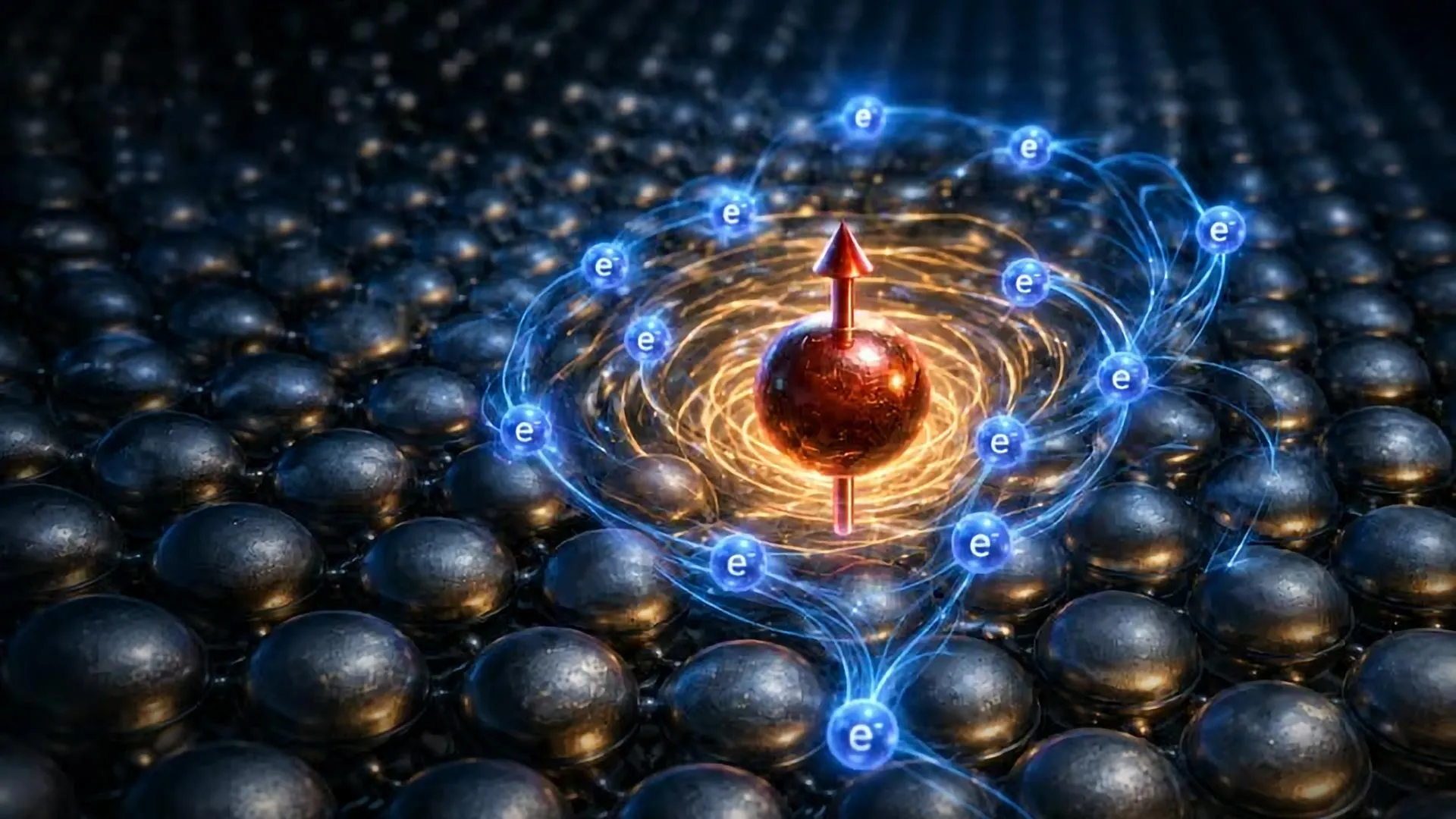
The quantum Hall effect occurs in thin, two-dimensional conducting materials at extremely low temperatures and under high magnetic fields. In this state, the electrical conductance of the material becomes "quantized," meaning it changes only in discrete, highly precise steps. What makes this effect remarkable is its robustness; the conductance values remain exactly the same even if the material is "dirty" or contains physical imperfections.
This stability is "topological." In mathematics, topology studies properties that remain unchanged even when a shape is deformed (such as a coffee mug being topologically equivalent to a donut because both have one hole). In the quantum Hall effect, the electrons move in a collective state that is protected by the system’s underlying topology, making it immune to local disturbances.
How Topology "Numbed" the Vacuum
The Brown University team, led by Professor Stephon Alexander, argues that the universe’s space-time possesses a similar non-trivial topology. By applying the logic of the Chern-Simons-Kodama state—a proposed ground state for the universe that merges gravity with quantum principles—they found that the cosmological constant behaves like the quantized conductance in the Hall effect.
In this model, the massive quantum fluctuations that QFT predicts are still present, but they are "rendered inert." The topology of space-time acts as a filter or a stabilizer, forcing the cosmological constant to take on specific, stable values. This prevents the constant from "blowing up" to the infinite or near-infinite values suggested by standard quantum calculations.
"It turns out there are constraints in the theory that force the cosmological constant to take certain allowed quantized values," explained Aaron Hui, an assistant professor at Brown and co-author of the study. This means the smallness of the cosmological constant is not a coincidence, but a mathematical necessity of the universe’s structure.
Supporting Data and Theoretical Implications
The implications of this research extend far beyond solving a single numerical discrepancy. The study provides a potential roadmap for a "Theory of Everything" by successfully using a "conservative" approach to quantizing gravity.
- Consistency with Canonical Quantization: Professor Alexander noted that their approach utilizes "good, old-fashioned quantization" methods pioneered by giants like Paul Dirac and Erwin Schrödinger. This suggests that the solution to quantum gravity may not require radical new dimensions (as in String Theory) but rather a better understanding of the states we have already identified.
- The CSK State as a Viable Candidate: The Chern-Simons-Kodama state has often been a controversial topic in physics due to concerns about its physical interpretability. This new research provides strong evidence that the CSK state is not just a mathematical curiosity but a vital candidate for describing the actual ground state of our universe.
- Cross-Pollination of Physics: The collaboration between a cosmologist (Alexander) and a condensed matter theorist (Hui) highlights a growing trend in physics where the study of "small" systems (like electrons in a lab) provides the keys to understanding "large" systems (the entire cosmos).
Analysis of Potential Impact
While the proposal is a significant step forward, the physics community remains cautious. For the topological explanation to be fully accepted, it must be reconciled with other observations of the early universe, such as the period of rapid "inflation" that occurred shortly after the Big Bang.
If the Brown University theory holds, it would fundamentally change our understanding of Dark Energy. Instead of viewing Dark Energy as a mysterious substance or a new field filling the universe, it could be understood as a fundamental property of the geometry of space-time itself. This would simplify the standard model of cosmology, potentially removing the need for exotic new particles that have so far evaded detection in experiments like the Large Hadron Collider.
Furthermore, this topological protection could explain why the universe is "fine-tuned" for life. If the cosmological constant were even slightly larger, stars and galaxies would never have coalesced. By showing that the constant is "locked" into place by topology, the researchers provide a physical reason for this life-sustaining stability, moving the conversation away from the "Anthropic Principle"—the idea that the universe is the way it is simply because we are here to observe it.
Future Research and Conclusion
The team at the Brown Theoretical Physics Center is now focused on expanding this model to see if it can account for other mysterious features of the universe, such as the nature of dark matter or the initial conditions of the Big Bang.
"We took something old… and discovered something new that had been there all along," Alexander stated, emphasizing that the mathematical foundations for this solution were present in the works of 20th-century physicists but required the lens of modern condensed matter theory to be fully realized.
As physicists continue to probe the limits of the observable universe, the bridge between the very small and the very large appears to be strengthening. If the "shape" of space-time is indeed protecting the universe from its own quantum volatility, it would mark one of the most profound shifts in our understanding of the cosmos since Einstein first penned his equations over a century ago. The study serves as a reminder that in the quest to understand the infinite, the most elegant solutions often lie in the fundamental rules of geometry and mathematics.