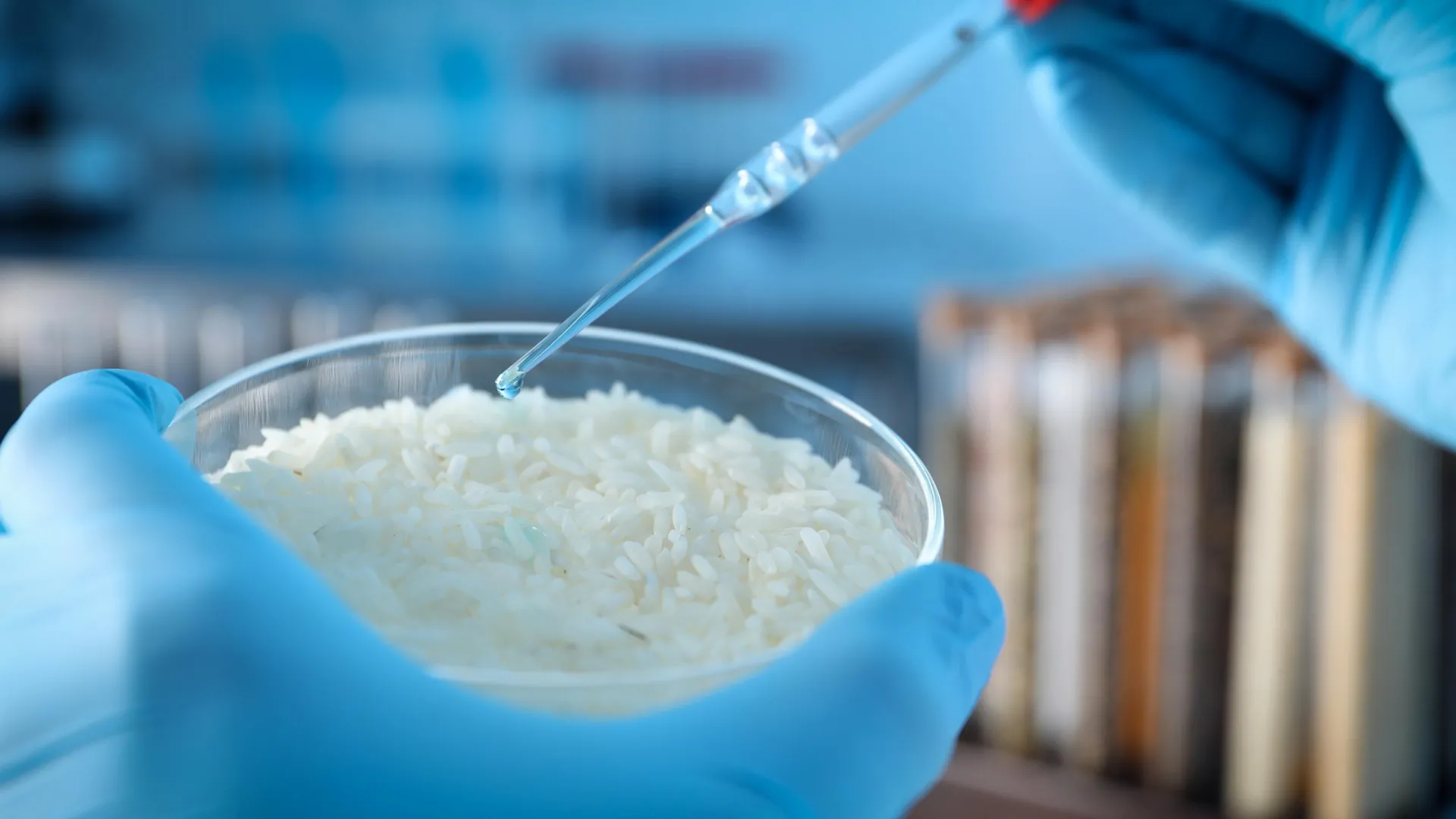
The humble rice grain, a dietary staple for more than half of the world’s population, has long been studied for its nutritional value and agricultural resilience. However, a groundbreaking study led by an international team of researchers has revealed that rice possesses mechanical properties so unique they could revolutionize the field of materials science. By observing how packed rice grains respond to physical stress, scientists have discovered a phenomenon known as "rate softening," a rare characteristic that allows the material to weaken under rapid pressure while maintaining strength under slow compression. This discovery, recently published in the prestigious journal Matter, provides a blueprint for a new class of "intelligent" metamaterials that could transform soft robotics, medical devices, and high-performance protective equipment.
The research, spearheaded by Dr. Mingchao Liu and his colleagues at the University of Birmingham, challenges traditional engineering assumptions about granular materials. While most substances, such as sand or cornstarch slurries, tend to stiffen or "jam" when subjected to sudden force—a property known as rate hardening—rice behaves in the exact opposite manner. This counterintuitive response has opened a new frontier in "passive" engineering, where the physical structure of a material, rather than complex electronic sensors, dictates how it responds to its environment.
The Mechanics of Rate Softening: A Deep Dive into Granular Physics
To understand why rice behaves this way, the research team conducted a series of rigorous experiments involving the compression of tightly packed rice grains within controlled environments. Using high-speed imaging and sensitive force-displacement sensors, the team measured how the grains shifted and interacted under varying speeds of loading. They found that when pressure is applied slowly, the grains have sufficient time to settle and interlock, forming robust "force chains"—internal networks of physical contact that distribute and support the weight of the load.
However, when the loading speed is increased, the behavior shifts dramatically. At higher speeds, the friction between individual rice grains drops significantly. This reduction in friction prevents the formation of stable force chains, causing the internal structure of the packed grains to effectively "collapse" or soften. This "rate softening" means that the material becomes more pliable and less resistant precisely when the force is most intense.
This discovery is significant because rate softening is an elusive property in the world of natural materials. Most granular substances follow the principles of Reynolds’ dilatancy or friction-induced hardening. By identifying a common, biological material that exhibits the opposite trend, the University of Birmingham team has provided engineers with a new variable to manipulate when designing complex structures.
Engineering the First Self-Adapting Granular Metamaterial
The true breakthrough of the study lies in the application of this "curiosity" into a functional design principle. The researchers realized that by combining the rate-softening properties of rice with the rate-hardening properties of other materials, such as sand, they could create a "metamaterial"—a composite structure engineered to have properties not found in nature.
To build this metamaterial, the team created modular units containing rice grains and interspersed them with units containing sand-like particles. The resulting structure acts as a mechanical chameleon. When subjected to slow, steady movements, the rice components remain stiff, providing structural integrity. When hit with a sudden, high-velocity impact, the rice components soften while the sand components harden, allowing the overall structure to bend, buckle, or absorb energy in a highly controlled and predictable manner.
Dr. Mingchao Liu explained the philosophy behind this approach: "Rather than treating this phenomenon as a curiosity, we turned it into a design principle. This approach enabled us to create a material that can bend, buckle, or stiffen differently under slow movements versus sudden impacts—without electronics, sensors, or active control. Instead of telling a structure how to respond, we let physics decide: fast loads trigger one behavior, slow loads another."
A New Era for Soft Robotics and Surgical Precision
One of the most promising applications for this rice-based metamaterial is in the rapidly evolving field of soft robotics. Traditional robots are often constructed from rigid metals and plastics, powered by complex motors and navigated by arrays of electronic sensors. While effective in factory settings, these "hard" robots can be dangerous or ineffective when working in close proximity to humans or in delicate environments.
Soft robots, made from flexible materials, offer a safer alternative, but they often struggle with "variable stiffness"—the ability to be soft when moving through an environment but rigid when performing a task that requires force. The new granular metamaterial solves this problem elegantly. A robotic arm built with these materials could remain soft and compliant during fast movements, preventing injury if it accidentally bumps into a person. However, when it slows down to perform a precise task, such as gripping a tool or assisting in a surgical procedure, the material would naturally stiffen, providing the necessary stability.
In the medical field, this could lead to the development of minimally invasive surgical tools that can navigate the complex, soft pathways of the human body without causing trauma, yet become rigid enough to perform incisions or sutures once in place. Because the response is built into the material’s physics, there is no risk of electronic failure or sensor lag, making the devices inherently more reliable.
Enhancing Human Safety: Protective Gear and Impact Absorption
Beyond robotics, the implications for personal safety and industrial protection are vast. Current protective gear, such as helmets and body armor, is often designed to be rigid to deflect impact. However, extreme rigidity can sometimes transmit the force of an impact to the wearer, leading to internal injuries or concussions.
A protective material incorporating the rice-inspired metamaterial could offer a "multi-stage" response to danger. In the event of a low-speed fall, the material could remain firm to provide support. In a high-speed collision, the rate-softening components would allow the gear to deform and absorb the kinetic energy, acting as a sophisticated shock absorber. This could lead to a new generation of sports helmets, automotive bumpers, and aerospace components that are lighter than current models but offer superior protection by "intelligently" managing the physics of a crash.
The fact that these responses occur without the need for external power or sensors is a major advantage. In a high-stakes environment—such as a construction site or a battlefield—equipment that adapts automatically to its environment without relying on batteries or delicate circuitry is invaluable.
Chronology of the Research and Global Collaboration
The journey from observing rice in a lab to publishing in Matter involved several years of interdisciplinary work. The project began with a fundamental interest in granular physics, a field that has fascinated scientists since the days of Osborne Reynolds in the late 19th century.
- Initial Observation (2020-2021): The University of Birmingham team began exploring the friction coefficients of various organic grains. They noted that rice grains, due to their elongated shape and specific surface texture, did not follow standard "jamming" models.
- Experimental Validation (2022): The team developed a series of compression tests using high-speed photography to map the "force chains" within packed rice. This was when the "rate softening" effect was first quantified.
- Metamaterial Development (2023): Researchers began combining rice with rate-hardening materials to see if they could "tune" the response of a composite structure. They utilized 3D-printed housing units to hold the granular materials in specific configurations.
- Peer Review and Publication (2024): The findings were submitted to Matter, where they underwent rigorous peer review by experts in materials science and mechanical engineering before being released to the public.
The research was a collaborative effort, involving contributions from international partners who provided expertise in mathematical modeling and advanced manufacturing. This global perspective helped the team move beyond the "why" of rice’s behavior and focus on the "how" of its application in modern engineering.
Fact-Based Analysis: The Future of Passive Intelligence
The success of this research highlights a growing trend in engineering: the move toward "embodied intelligence" or "passive control." For decades, the trend was to make materials "smarter" by embedding them with more electronics. However, as the limitations of power consumption, weight, and electronic complexity become apparent, scientists are looking back to the fundamental laws of physics to solve problems.
By using the mechanical properties of the material itself to dictate behavior, engineers can create systems that are:
- More Sustainable: Using natural materials like rice and sand reduces the reliance on rare-earth metals and plastics.
- More Durable: Without electronic components that can break or short-circuit, these materials can function in extreme environments, including underwater or in space.
- More Cost-Effective: Granular materials are abundant and inexpensive, potentially lowering the cost of advanced robotics and safety gear.
The University of Birmingham study serves as a reminder that some of the most sophisticated solutions to modern problems can be found in the most common places. As Dr. Liu noted, rice is rarely associated with advanced engineering, yet it has provided the key to a new class of functional materials.
Looking forward, the research team plans to investigate other biological and granular materials to see if similar "anomalous" behaviors exist. They are also looking into scaling the metamaterial for industrial use, exploring how these granular units can be integrated into large-scale construction or aerospace designs. The transformation of a staple food into a high-tech building block marks a significant milestone in our understanding of the natural world and our ability to mimic its complexity in the lab.