The fundamental laws of thermodynamics generally dictate that energy tends to dissipate and degrade, moving from a concentrated state to a more disordered one. In the realm of optics, this usually means that high-energy light, such as ultraviolet (UV) radiation, naturally loses energy as it interacts with matter, eventually becoming lower-energy visible or infrared light. However, researchers at Kyushu University have successfully inverted this paradigm. In a study recently published in the journal Nature Communications, a team of molecular engineers announced the development of a novel solid-state material capable of "upconverting" visible sunlight into ultraviolet light under ambient outdoor conditions. This achievement, characterized by a 1.9% efficiency rate, represents a significant milestone in photonics and materials science, offering a sustainable pathway to generate UV radiation for industrial and medical applications using nothing but the power of the sun.
The Quantum Mechanics of Photon Upconversion
To understand the magnitude of this discovery, one must first grasp the concept of photo upconversion. In everyday experience, combining two cups of lukewarm water results in a larger volume of lukewarm water, not a smaller volume of boiling water. In the quantum world, however, certain molecular systems can perform an analogous feat with light. This process, known as triplet-triplet annihilation (TTA), allows multiple low-energy photons to combine their energy to produce a single photon of higher energy.
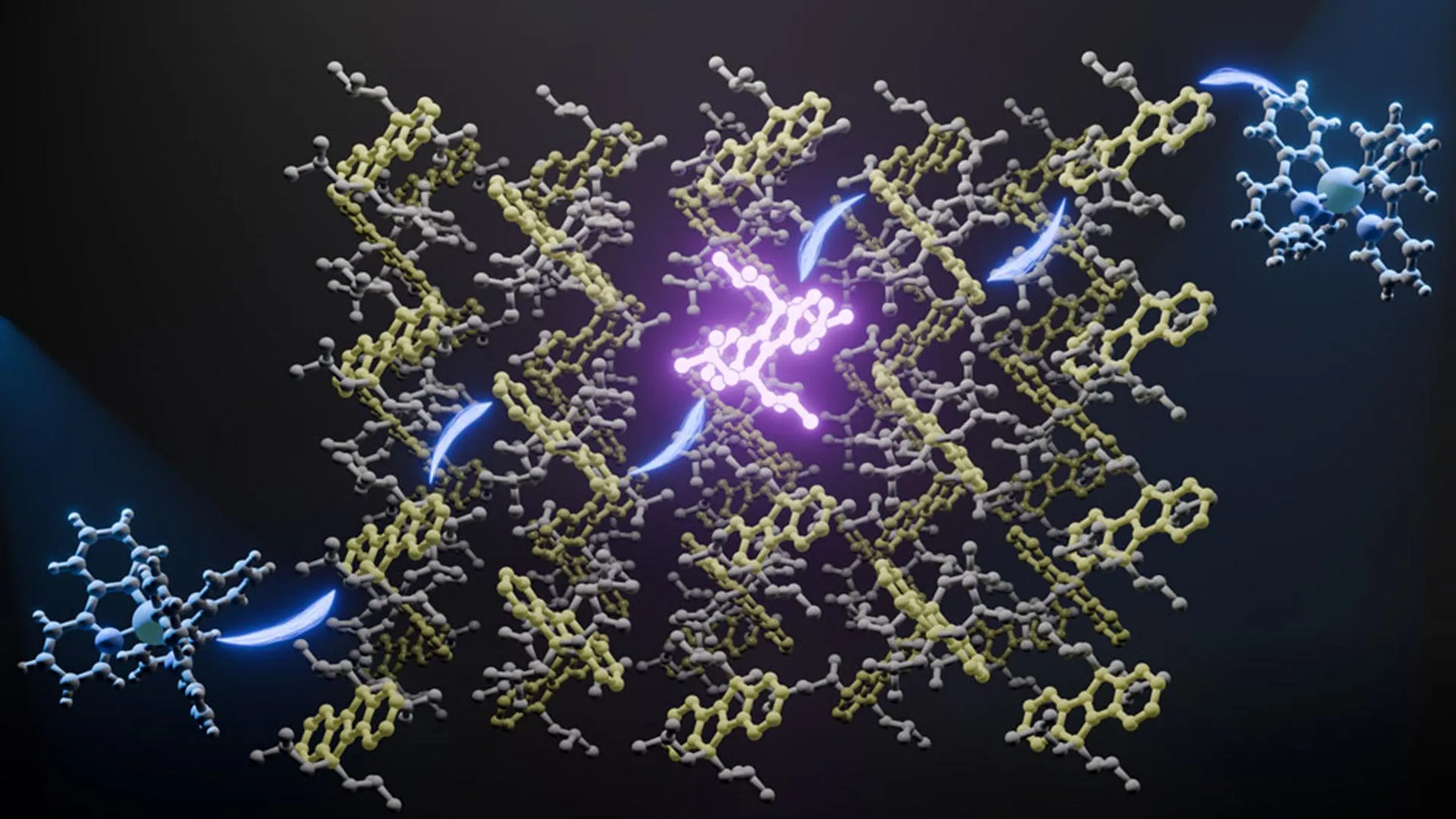
The mechanism relies on a sophisticated "relay race" of energy between two types of molecules: a donor and an acceptor. When the donor molecule absorbs visible light, it enters an excited "triplet state." This energy is then transferred to a nearby acceptor molecule. When two such excited acceptor molecules collide or interact closely, they undergo triplet-triplet annihilation, merging their energy to release a single, high-energy ultraviolet photon.
While scientists have successfully demonstrated TTA in liquid solutions for years, transitioning this technology to a solid-state format has been a persistent challenge. In liquids, molecules move freely, facilitating the necessary collisions. In solids, however, molecules are often packed so tightly that their electronic clouds—specifically the pi-electron clouds—overlap too much. This overlap often leads to a phenomenon known as "quenching," where the excited energy is lost as heat before it can be converted into UV light. The Kyushu University team’s breakthrough lies in the precise spatial engineering of these molecules to prevent this energy loss.
The Role of Ultraviolet Light in Modern Industry
The demand for ultraviolet light extends far beyond the common associations with tanning beds or the risks of skin damage. UV radiation is a critical component in a wide array of modern technological processes. In the medical and dental fields, UV light is used to harden resins in dental fillings and to sterilize surgical equipment. In manufacturing, it is the primary catalyst for curing resins in high-resolution 3D printing and for industrial coatings. Furthermore, UV-C light is one of the most effective tools for air and water purification, as it can neutralize pathogens by disrupting their DNA.
Despite its utility, UV light is a scarce resource in the natural solar spectrum. Only about 6% of the sunlight that reaches the Earth’s surface falls within the ultraviolet range. The majority of solar energy arrives as visible or infrared light. Currently, most industrial UV light is generated using mercury vapor lamps or specialized LEDs, both of which require significant electrical input. The ability to convert the abundant visible portion of the solar spectrum into usable UV light could revolutionize these industries, making them more energy-efficient and reducing their carbon footprint.
Engineering the Solution: DHI and Alkyl Chain Spacing
The research team, led by Associate Professor Yoichi Sasaki and Professor Emeritus Nobuo Kimizuka, focused their efforts on an organic semiconductor known as dihydroindenoindenedene (DHI). To overcome the quenching issues inherent in solid-state materials, the researchers modified the DHI molecule by attaching specific alkyl chains to its sp3 carbon atoms.
In organic chemistry, sp3 hybridized carbons have four bonds pointing in fixed three-dimensional directions. By using these as "anchors" for alkyl chains, the team created a molecular structure that acts like a microscopic spacer. These chains ensure that the DHI molecules remain close enough to allow for efficient energy transfer and triplet-triplet annihilation, but far enough apart to prevent the electronic interference that leads to exciton quenching.
The resulting material demonstrated remarkable optical properties. It achieved a solid-state fluorescence quantum yield of over 60%, indicating that the majority of the energy absorbed was successfully retained as excited states rather than being lost to heat. When integrated into a system with a suitable donor molecule, the material achieved an upconversion efficiency of 1.9% under sunlight-equivalent intensity. While a 1.9% efficiency may appear modest, it is a landmark figure for solid-state materials operating under non-concentrated, natural sunlight. Most previous attempts at solid-state upconversion required high-intensity lasers to function, making them impractical for real-world outdoor use.
A 14-Year Chronology of Discovery
The publication of this research marks the culmination of a scientific journey that began more than a decade ago. Professor Emeritus Nobuo Kimizuka first began exploring the potential of photon upconversion through triplet energy migration in 2012. His vision was to move beyond simple chemical reactions and create "molecular systems chemistry," where self-assembled molecules could perform complex, life-like functions such as energy harvesting and conversion.
The timeline of the project reflects the steady, iterative nature of high-level scientific inquiry:
- 2012–2015: The team focused on solution-based and gel-based systems, proving that self-assembled molecular structures could facilitate energy migration.
- 2016–2020: Research shifted toward finding solid-state alternatives to eliminate the need for toxic, volatile organic solvents. During this phase, the team experimented with various molecular frameworks but struggled with the quenching effects of tightly packed crystals.
- 2021–2023: The focus narrowed onto the DHI molecule. Researchers began testing different chemical modifications to find the "Goldilocks" distance between molecules—close enough for energy transfer, but far enough to avoid quenching.
- May 2024: A definitive breakthrough was achieved when the alkyl-chain-modified DHI showed stable, high-efficiency upconversion under low-intensity light.
- June 2024: The research was finalized and published in Nature Communications, just as Professor Kimizuka reached the end of his tenure at Kyushu University.
Associate Professor Yoichi Sasaki noted the emotional weight of the project’s conclusion, describing the final manuscript as a "heartfelt retirement gift" for Professor Kimizuka, representing 14 years of dedicated labor by dozens of graduate students and faculty members.
Comparative Analysis and Economic Impact
The implications of this new material are multifaceted, touching on environmental sustainability, manufacturing efficiency, and economic viability.
Environmental Benefits: By utilizing visible sunlight to generate UV radiation, this technology reduces the reliance on electricity-intensive UV lamps. Furthermore, unlike liquid-state upconversion systems that require hazardous solvents, this solid-state material is stable, non-volatile, and significantly safer for consumer and industrial applications.
Manufacturing and Cost: One of the most promising aspects of the DHI-based material is its ease of synthesis. The researchers noted that the material is made from relatively inexpensive starting materials and can be produced using standard chemical processes. This low barrier to production increases the likelihood of commercial adoption.
Technological Integration: The material’s ability to function under low-intensity light makes it uniquely suited for indoor and outdoor use. Potential applications include:
- Solar-Powered Photocatalysis: Using UV light to drive chemical reactions that break down pollutants in the air or water.
- 3D Printing: Allowing for low-power, solar-assisted curing of resins, which could be particularly useful in remote or off-grid locations.
- Indoor Air Quality: Integrating the material into window coatings to convert sunlight into UV-C light for continuous, passive air disinfection.
Future Outlook and Intellectual Property
Kyushu University has already filed a patent application for the material and the specific molecular design used to achieve the upconversion. The research team is now looking toward the next phase of development, which involves optimizing the efficiency further and testing the material’s long-term stability under continuous solar exposure.
The success of the DHI-based system provides a roadmap for other researchers in the field. By demonstrating that precise geometric control at the molecular level can overcome quantum-level energy losses, the Kyushu team has opened the door for a new generation of "smart" materials.
"This discovery is the culmination of over 14 years of our research and marks a major milestone in photon-upconversion and molecular self-assembly research," Professor Kimizuka concluded in his final statement. The work stands as a testament to the power of persistent, long-term academic research and its ability to solve fundamental physical challenges that have direct, practical benefits for society. As the global community continues to seek out sustainable energy solutions, the ability to "add together" photons to create high-value UV light from the visible spectrum may become an essential tool in the green technology arsenal.